





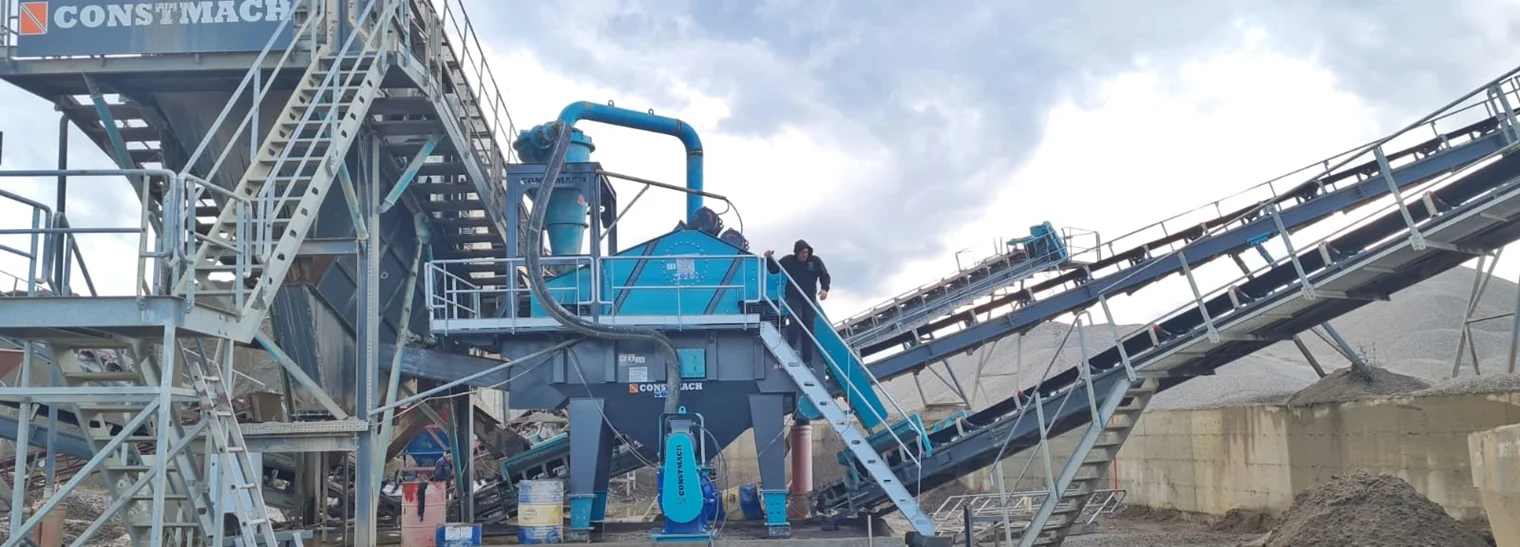

The CDS-1635 is used at the end of a sand-washing line to dewater washed sand and to recover the ultra-fine particles that ordinary washers lose. It does not wash or remove clay itself — it takes already-washed sand slurry, drives the water out through a high-frequency polyurethane screen, and uses a single 26-inch hydrocyclone to capture fines down to about 90 microns. The output is a dry, stackable sand at a controlled gradation.
Where is it used and what does it produce?
It is used in concrete-sand, plaster-sand and manufactured-sand plants where both a dry product and a precise fine fraction matter. Because the CDS-1635 recovers 90-micron material that screw and wheel washers flush away, the producer can hold the fine end of the grading curve and tailor the sand to project specifications. Rated at 100–150 t/h, it is matched to the mid-range throughput band of the CDS range.
How much power and water does the CDS-1635 use?
The CDS-1635 is driven by a 55 kW slurry pump and two vibrator motors rated 2 x 7.5 kW. A dewatering stage is not a heavy water consumer in itself — its purpose is to take water out — but the water and fines it recovers in the cyclone underflow are returned to the sand rather than lost, and the overflow water can be sent to a settling pond for recirculation, which lowers the fresh-water demand of the whole plant.
How dry is the sand, and how does it handle clay?
The CDS-1635 is a dewatering device, not a clay scrubber. Any clay must already have been washed out upstream by a screw or bucket-wheel washer; the dewatering screen then takes the washed slurry and reduces its moisture to roughly 12–15%, low enough that the sand can be stockpiled and handled immediately. If the feed still contains clay, that clay will simply pass through with the sand, so correct upstream washing is essential.
Dewatering screen vs screw washer vs bucket-wheel washer
Dewatering screen (CDS-1635) — high-frequency screen plus hydrocyclone; removes residual water and recovers 90-micron fines from already-washed sand. Does not wash.
Screw washer — inclined spiral that washes and partially dewaters fine sand; good for light to moderate clay.
Bucket-wheel washer — washes high-clay feed with low water and power use, but leaves the sand wetter and loses more fines.
The three are complementary: a washer (screw or wheel) cleans the sand, and the CDS-1635 finishes the job by drying it and saving the fines.
What maintenance does the CDS-1635 need?
The main wear items are the polyurethane screen panels, which resist abrasion and are designed for easy replacement, and the slurry-pump impeller and liners. Routine checks cover the vibrator-motor mounts and the cyclone apex for wear. Keeping the screen fed at the 100–150 t/h design rate and the PU panels in good condition maintains efficient drainage and consistent fines recovery.
Why add a dewatering screen to an existing washing line?
Two reasons. First, product quality: a screw or wheel washer flushes the finest particles away with the dirty water, which can leave the sand short of fines and outside the target grading curve. The hydrocyclone on the CDS-1635 captures that 90-micron material and returns it to the sand. Second, handling and yield: wet sand from a washer drains in the stockpile, ties up storage and loses saleable tonnage. By cutting moisture to roughly 12–15%, the CDS-1635 gives a sand that can be stocked, loaded and sold immediately, which is why a dewatering screen is a common final stage in mid-range and larger washing plants.