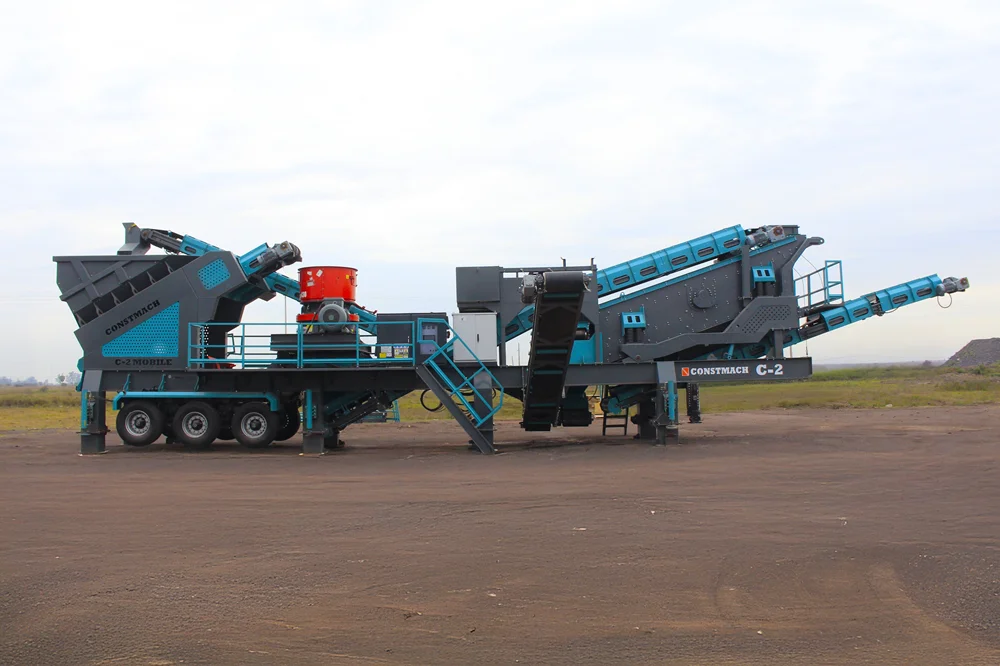






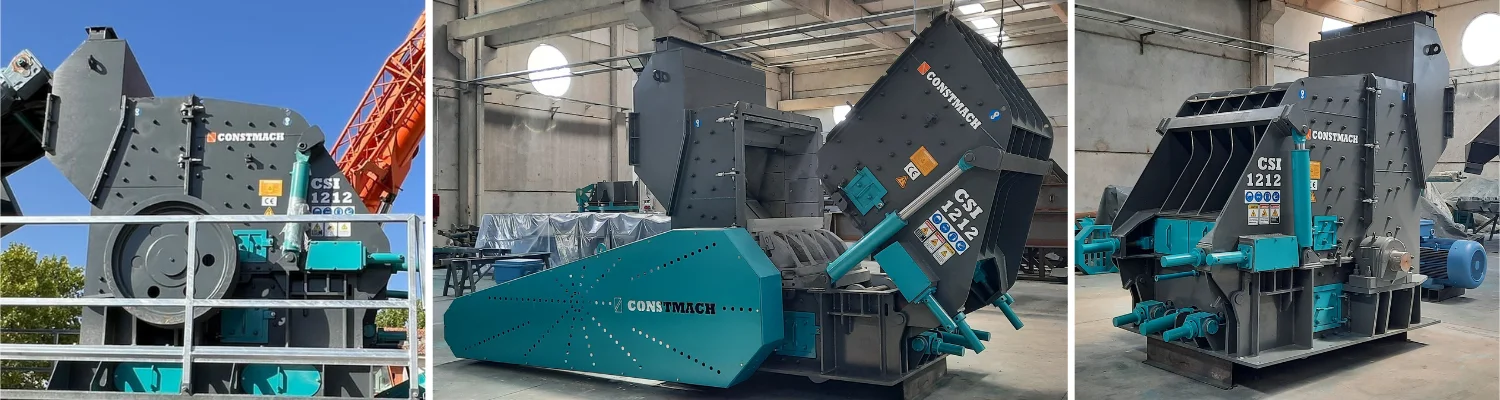

The CSI-1210 Secondary Impact Crusher sits in the second crushing stage of an aggregate production line. The information below covers feed materials, output products, applications, wear-part service and how the machine compares with the alternatives, to support buyers evaluating it for a specific plant.
What materials can be fed into the CSI-1210?
The CSI-1210 is designed for medium-hard, low to moderately abrasive stone that has already passed through a primary crusher. Typical feed materials include:
- Limestone, dolomite and similar sedimentary rock
- River gravel and natural stone
- Recycled concrete, demolition rubble and crushed asphalt
Maximum feed size is 200 mm. Highly abrasive rock such as granite or quartz-rich stone can be processed, but it raises blow-bar wear and is usually better matched to a tertiary or vertical shaft impactor in the final stage.
What products does it produce?
The CSI-1210 produces well-graded, predominantly cubical aggregate suitable for downstream screening into standard fractions. Common output products are base and sub-base aggregate, concrete aggregate and asphalt aggregate. Because the impact crushing principle generates a cubical particle shape, the output is well suited to applications where grain shape affects strength and workability.
What industries and applications use this machine?
- Aggregate and quarrying operations producing graded stone
- Ready-mix concrete and precast supply
- Asphalt and road construction
- Construction and demolition recycling
How are the wear parts replaced and how long do they last?
The main wear parts are the blow bars (breaker bars) mounted on the rotor and the liner plates fitted to the breaker plates. They are produced from high-chrome or manganese alloy and are interchangeable. Service life depends on feed abrasiveness and tonnage; harder, more abrasive material shortens the interval. Replacement is straightforward because two hydraulic cylinders open the housing for rotor access and the rear doors expose the breaker plate liner bolts, reducing downtime compared with machines that require dismantling.
How does a secondary impact crusher compare with a cone crusher?
A cone crusher reduces material by compression and is favoured for hard, abrasive rock, but it tends to produce a higher proportion of flaky particles and offers a lower reduction ratio per stage. The CSI-1210, working by impact, delivers a higher reduction ratio and a more cubical product in a single pass, which is why impact crushers are preferred for limestone-based aggregate and recycling. For very hard, abrasive feed the compression principle of a cone may give lower operating cost, so the choice depends on the rock being processed. A secondary impact crusher also typically carries a lower purchase price and simpler maintenance than a cone of comparable capacity, which matters for operations weighing total cost of ownership.
Where does the CSI-1210 sit relative to the CSI-1212 and CSI-1215?
The CSI-1210 is the smallest of the three, with a 1,100 x 1,100 mm rotor, 200 mm feed limit and 60-100 t/h capacity. The CSI-1212 (250 mm feed, 120-150 t/h) and CSI-1215 (350 mm feed, 200-250 t/h) use wider rotors to accept larger feed and reach higher tonnages, but all three share the same crushing principle, hydraulic adjustment system and maintenance layout. Selecting between them comes down to the required throughput and the largest feed size the secondary stage must handle.
What support is available for the CSI-1210?
The CSI-1210 is supplied as part of complete CONSTMACH crushing and screening plants, and can also be integrated into an existing line. Spare and wear parts, including blow bars and breaker plate liners, are available from the manufacturer, and the modular construction allows the machine to be transported and installed without specialised handling.