





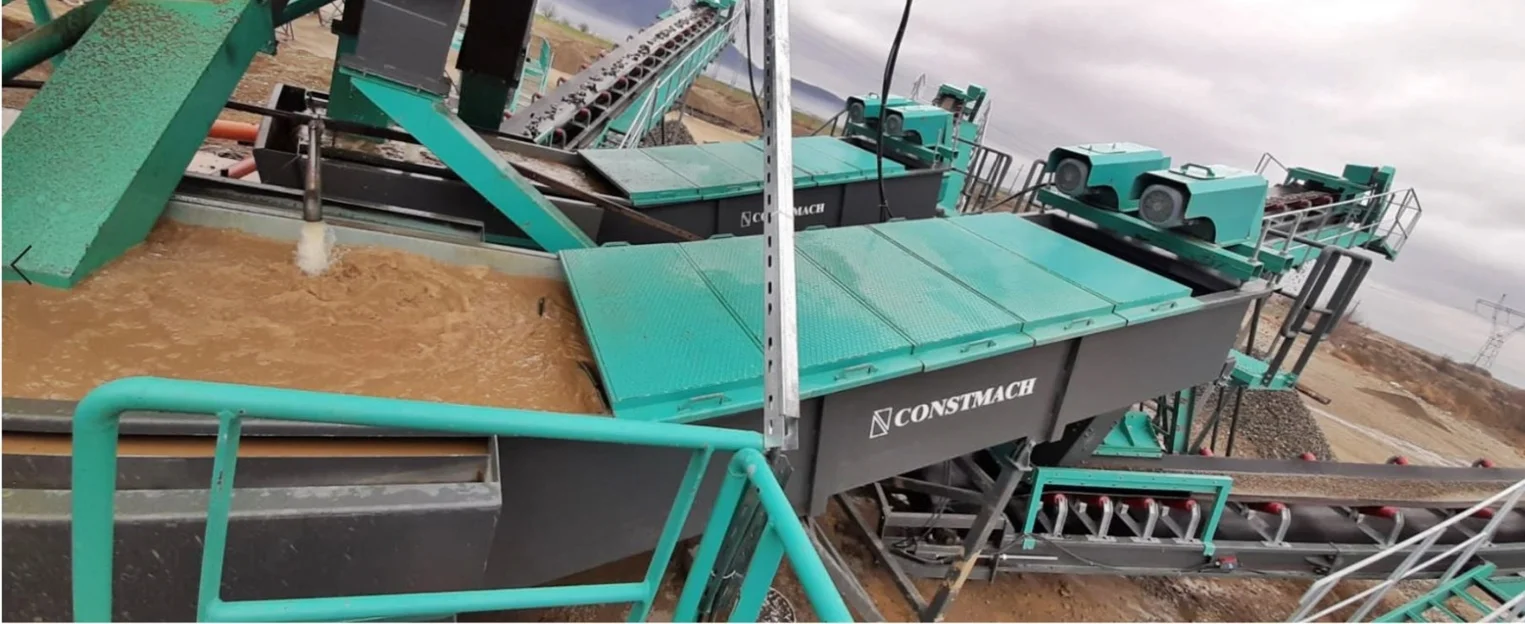

The CSW-80 is used in sand and gravel washing plants to clean the fine 0–5 mm fraction before it is sold as concrete sand, plaster sand or fine aggregate. It is common in river-sand operations, crushed-stone quarries that produce manufactured sand, and any plant where the feed carries clay, silt or organic fines that must be washed out to meet concrete-grade specifications. With a capacity of 50 m³/h, the CSW-80 suits small to medium throughput lines.
What does it wash, and how much clay can it handle?
The screw washer scrubs sand particles against each other and against the spiral, lifting clay and silt films off the grains. It handles light to moderate clay contamination well — as a guide, feed with up to roughly 10% clay/dirt is within its comfortable range. For feed with very heavy, sticky clay a bucket-wheel washer or an attrition cell ahead of the screw is the better choice, because extremely high clay loads can overwhelm a single washing stage.
How much water and power does the CSW-80 use?
The CSW-80 draws a 2 x 11 kW twin-shaft drive and needs about 20 m³/h of process water. Because the inclined screw lifts the sand out of the water bath, the bulk of that water drains back into the trough and overflows for recirculation, so net fresh-water consumption with a settling pond is modest. The screw speed of 90 rpm balances throughput against scrubbing time.
How dry is the washed sand?
A screw washer both washes and partially dewaters. Sand discharged from the CSW-80 typically retains residual moisture in the region of 15–25%, lower than the slurry leaving a bucket-wheel washer because of the longer drainage path up the inclined trough. Where a drier, immediately stackable product is needed, a dewatering screen placed after the screw washer can reduce moisture to around 12–15%.
Screw washer vs bucket-wheel washer vs dewatering screen
Screw washer (CSW-80) — washes and dewaters fine sand on an inclined spiral; good for light to moderate clay, gives a relatively dry discharge and a long scrubbing path.
Bucket-wheel washer — lifts sand out of a tank in buckets; the best choice for high-clay feed and the lowest water and power consumption, but the discharge is wetter.
Dewatering screen — a high-frequency screen that does not wash but removes residual water and recovers fine particles from already-washed sand; usually fitted downstream of a screw or wheel washer.
The twin-shaft CSW-80 therefore covers the washing-and-dewatering duty, while a bucket wheel or dewatering screen is added when the clay load or the moisture specification calls for it.
What maintenance does the CSW-80 need?
Maintenance is light. The main wear parts are the replaceable rubber paddles on the spiral, which can be renewed individually without changing the whole screw. The oil-lubricated heavy-duty gearbox is designed with a large service factor for a long life cycle, and the heavy steel-plate body resists abrasion. Regular checks of paddle wear, gearbox oil and the bearing seals keep the CSW-80 producing its 50 m³/h of clean sand reliably.