





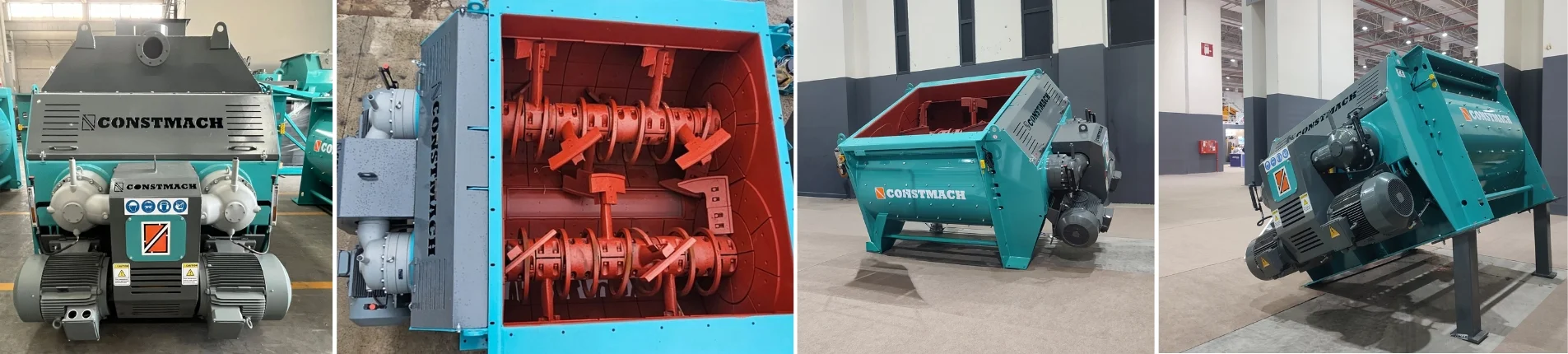

The CTS-1 Twin Shaft Mixer is the smallest member of the CTS family, and selecting it correctly means matching its 1 m³ compacted batch and 37 kW drive to the right kind of plant and product. The notes below cover the questions a buyer asks beyond the specification table.
Where It Is Used
- Compact stationary concrete batching plants in the 30 to 60 m³/h range
- Mobile and relocatable plants where low weight and a small footprint are priorities
- Small ready-mix operations supplying local construction sites
- Lower-volume precast and concrete block production
- Contractors setting up their first in-house batching plant
What It Produces
Each cycle yields 1,000 lt (1 m³) of compacted concrete from a 1,500 lt charge. The twin-shaft action handles standard ready-mix, structural concrete, and stiffer precast and block mixes with low slump, because the counter-rotating arms keep dry, low-water mixes moving rather than balling up as a drum mixer can. For coloured or fibre-reinforced batches, the intensive mixing distributes pigment and fibre evenly.
Installation And Power
The single 37 kW motor keeps the electrical connection small, which simplifies integration into modest plant switchgear and reduces the generator size on off-grid sites. The mixer requires a compressed-air or hydraulic supply for the discharge door and an electrical feed for the automatic lubrication pump. Because the unit is light relative to larger CTS models, it suits mobile chassis-mounted plants.
Maintenance And Wear Parts
- Side body wearing plates: 15 mm Hardox, replaceable as a set when worn
- Main body wearing plates: 15 mm
- Mixing arm wearing plates: 25 mm, the highest-wear items, inspected most often
- Mixing arm tips and paddles should be checked for clearance to the liners and adjusted as they wear
- The automatic lubrication system reservoir must be kept filled; verify grease delivery to all bearing points
- Wash the trough at the end of each shift to prevent concrete build-up on shafts and liners
Operating Considerations
Because the CTS-1 serves smaller plants, it is often the most accessible part of the line for the operator, which makes daily discipline important. The trough should be charged with aggregate and binder in the correct sequence so the arms are never asked to start against a packed, dry load, and the water jets should be confirmed clear before each shift so cement slurry forms evenly. Mixing time should be set from trial batches rather than guessed; with a 1 m³ batch, even a few seconds of unnecessary mixing per cycle adds up across a production day and wears the liners and arms faster than required. End-of-shift washout matters as much on the entry model as on the large machines, since hardened concrete on the shafts and paddles is the most common cause of premature wear and increased power draw.
Comparison Versus Other Mixer Types And Larger CTS Models
Against a pan or planetary mixer of similar batch size, the CTS-1 mixes faster and tolerates larger aggregate, and against a drum mixer it produces a more homogeneous batch and handles low-slump mixes better. Within the CTS family, the CTS-1 is the only single-motor model; the CTS-2 doubles the batch to 2 m³ with twin 37 kW drives, and the larger CTS-3, CTS-4 and CTS-5 step up to 3, 4 and 5 m³ for higher-throughput and central-mix plants. A buyer should choose the CTS-1 when planned output and product range stay within roughly 1 m³ per batch, and step up to a larger model if daily volume is expected to grow, since over-running a small mixer to chase output shortens liner life and offers no cost saving over the correctly sized machine.