







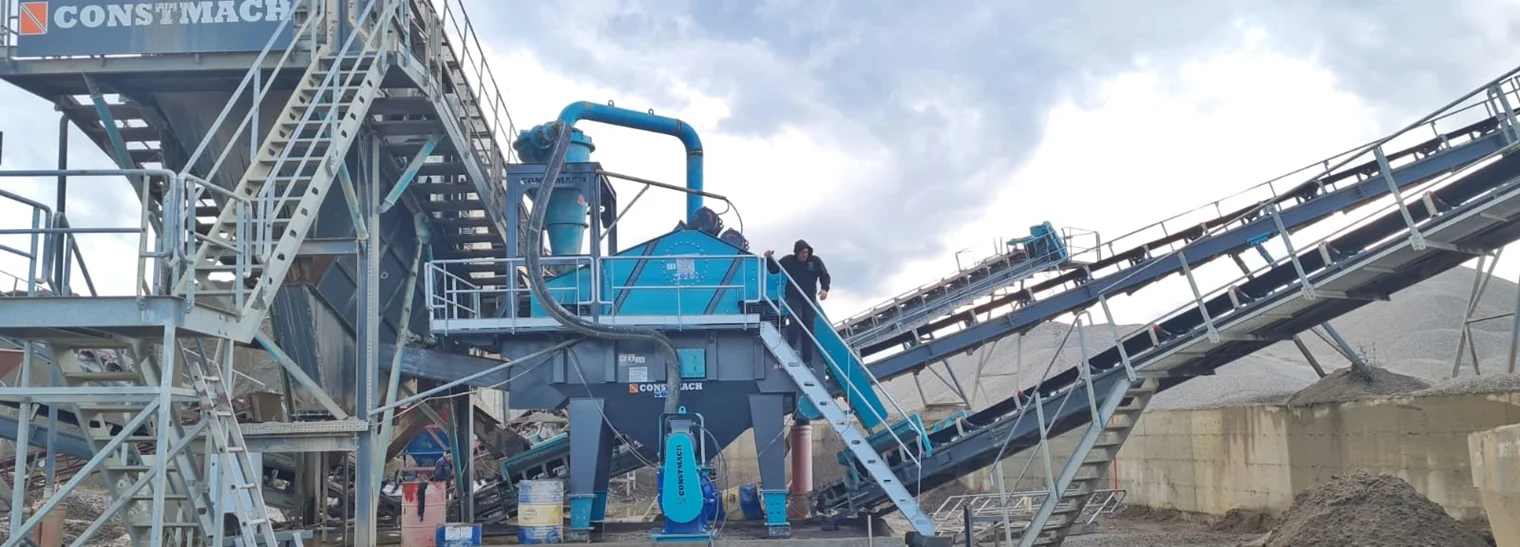

CDS - 1635 | Entwässerungssieb & Hydrozyklon

Das CDS-1635 Entwässerungssieb ist eine Baugruppe aus Hochfrequenz-Vibrationssieb und Hydrozyklon, die von CONSTMACH zur Rückgewinnung und Entwässerung von feinem, gewaschenem Sand gebaut wird. Anders als ein Schneckenwäscher oder Schaufelradwäscher schrubbt das CDS-1635 den Ton nicht von den Körnern ab; seine Aufgabe beginnt nach dem Waschen, wo es das Restwasser aus dem Sand entfernt und die sehr feinen Partikel rettet, die andernfalls im Überlauf verloren gingen. Das Ergebnis ist ein trockenes, stapelbares Produkt, das direkt zur Halde gefördert werden kann.

Das CDS-1635 kombiniert ein Entwässerungssiebdeck von 1,600 x 3,500 mm mit einem einzelnen 26-Zoll-Hydrozyklon. Die Sandtrübe wird von einer 55 kW Schlammpumpe nach oben in den Zyklon gepumpt, wo die Zentrifugalwirkung die Trübe eindickt und auf das Sieb abgibt. Der Hydrozyklon ist der Schlüssel zur Feingutrückgewinnung: Er erfasst Partikel bis hinunter zu etwa 90 Mikron, die klassische Schnecken- und Schaufelradwäscher tendenziell mit dem Schmutzwasser wegspülen, sodass der Sand den feinen Anteil behält, der zur Einhaltung vieler Sieblinien für Beton und Putz erforderlich ist.

Auf dem Siebdeck erzeugen zwei Vibrationsmotoren mit 2 x 7.5 kW die hochfrequente, geradlinige Bewegung, die das Wasser durch das Polyurethangewebe treibt, während der Sand ein abtropfendes Bett bildet und zur Austragskante wandert. Polyurethan-Siebbeläge werden verwendet, weil sie dem Abrieb durch den scharfkantigen Sand widerstehen und eine lange Lebensdauer bieten. Die hohe Frequenz ist es, die ein Entwässerungssieb von einem gewöhnlichen Klassiersieb unterscheidet — es ist darauf abgestimmt, Wasser abzuführen, statt Korngrößen zu trennen.

Das CDS-1635 ist das Modell der mittleren Leistungsklasse der CONSTMACH CDS-Baureihe mit einer Leistung von 100–150 t/h. Diese Leistung ergibt sich aus dem Zusammenspiel der Deckfläche von 1,600 x 3,500 mm, der 26"-Zyklonkonfiguration und der 55 kW Pumpe, sodass die drei als Paket aufeinander abgestimmt und nicht isoliert spezifiziert sind. Die Beschickung des Siebs mit seiner Auslegungsrate hält das Sandbett auf der richtigen Tiefe für eine effiziente Entwässerung.

In einer Sandanlage wird das CDS-1635 hinter der Waschstufe — typischerweise einem Schneckenwäscher oder einem Schaufelradwäscher — installiert und mit der gewaschenen Sandtrübe beschickt. Durch die Entfernung des Restwassers senkt es den Feuchtegehalt des Produkts von den nassen Werten, die einen Wäscher verlassen, auf ein stapelbares Niveau, was bedeutet, dass der Sand früher verkauft oder verwendet werden kann und in der Halde weniger abtropft. Die gleichzeitige Rückgewinnung des 90-Mikron-Feinguts verbessert sowohl die Ausbeute als auch die Produktqualität.

Die Wartung konzentriert sich auf die Polyurethan-Siebbeläge und die Verschleißteile der Schlammpumpe, die beide auf einen unkomplizierten Austausch ausgelegt sind. Mit einfacher Wartung, langlebigen PU-Geweben und einem trockenen Endprodukt, das sich leicht lagern lässt, ist das CDS-1635 ein praktischer Weg, um Qualität und Ausbeute einer Waschlinie zu steigern. CONSTMACH liefert die Einheit mit Inbetriebnahme-Unterstützung und Ersatzteilverfügbarkeit für einen kontinuierlichen Betrieb.

CDS - 1635 Technische Daten

Entwässerungssieb-Abmessungen1,600 x 3,500 mm
Hydrozyklon-Durchmesser26”
Schlammpumpen-Motorleistung (kW)55 kW
Vibrationsmotor-Leistung (kW)2 x 7.5 kW
Produktionsleistung (t/h)100 - 150 t/h

CDS - 1635Video

CDS - 1635 Gesamtanordnung

FAQ

The CDS-1635 is used at the end of a sand-washing line to dewater washed sand and to recover the ultra-fine particles that ordinary washers lose. It does not wash or remove clay itself — it takes already-washed sand slurry, drives the water out through a high-frequency polyurethane screen, and uses a single 26-inch hydrocyclone to capture fines down to about 90 microns. The output is a dry, stackable sand at a controlled gradation.

Where is it used and what does it produce?

It is used in concrete-sand, plaster-sand and manufactured-sand plants where both a dry product and a precise fine fraction matter. Because the CDS-1635 recovers 90-micron material that screw and wheel washers flush away, the producer can hold the fine end of the grading curve and tailor the sand to project specifications. Rated at 100–150 t/h, it is matched to the mid-range throughput band of the CDS range.

How much power and water does the CDS-1635 use?

The CDS-1635 is driven by a 55 kW slurry pump and two vibrator motors rated 2 x 7.5 kW. A dewatering stage is not a heavy water consumer in itself — its purpose is to take water out — but the water and fines it recovers in the cyclone underflow are returned to the sand rather than lost, and the overflow water can be sent to a settling pond for recirculation, which lowers the fresh-water demand of the whole plant.

How dry is the sand, and how does it handle clay?

The CDS-1635 is a dewatering device, not a clay scrubber. Any clay must already have been washed out upstream by a screw or bucket-wheel washer; the dewatering screen then takes the washed slurry and reduces its moisture to roughly 12–15%, low enough that the sand can be stockpiled and handled immediately. If the feed still contains clay, that clay will simply pass through with the sand, so correct upstream washing is essential.

Dewatering screen vs screw washer vs bucket-wheel washer

  • Dewatering screen (CDS-1635) — high-frequency screen plus hydrocyclone; removes residual water and recovers 90-micron fines from already-washed sand. Does not wash.

  • Screw washer — inclined spiral that washes and partially dewaters fine sand; good for light to moderate clay.

  • Bucket-wheel washer — washes high-clay feed with low water and power use, but leaves the sand wetter and loses more fines.

The three are complementary: a washer (screw or wheel) cleans the sand, and the CDS-1635 finishes the job by drying it and saving the fines.

What maintenance does the CDS-1635 need?

The main wear items are the polyurethane screen panels, which resist abrasion and are designed for easy replacement, and the slurry-pump impeller and liners. Routine checks cover the vibrator-motor mounts and the cyclone apex for wear. Keeping the screen fed at the 100–150 t/h design rate and the PU panels in good condition maintains efficient drainage and consistent fines recovery.

Why add a dewatering screen to an existing washing line?

Two reasons. First, product quality: a screw or wheel washer flushes the finest particles away with the dirty water, which can leave the sand short of fines and outside the target grading curve. The hydrocyclone on the CDS-1635 captures that 90-micron material and returns it to the sand. Second, handling and yield: wet sand from a washer drains in the stockpile, ties up storage and loses saleable tonnage. By cutting moisture to roughly 12–15%, the CDS-1635 gives a sand that can be stocked, loaded and sold immediately, which is why a dewatering screen is a common final stage in mid-range and larger washing plants.

Frequently Asked Questions

whatsapp gorsel 2024 01 10 saat 15 28 30 bf9fc1cb 9474
Schnellkontakt

Hinterlassen Sie eine Anfrage, und unser Expertenteam wird sich so schnell wie möglich bei Ihnen melden

Füllen Sie das Formular aus, um ausführliche Informationen über Betonmischanlagen, Brech- und Siebanlagen oder unsere anderen Produkte zu erhalten – oder kontaktieren Sie uns direkt.

Mit dem Absenden einer Anfrage stimmen Sie der Verarbeitung Ihrer personenbezogenen Daten zu.

oder direkt

Was gibt es Neues bei Constmach

Unser Expertenteam steht bereit, um eine auf Ihr Projekt zugeschnittene Lösung zu bieten. Wir sind nur einen Anruf entfernt — rufen Sie uns jetzt an.