







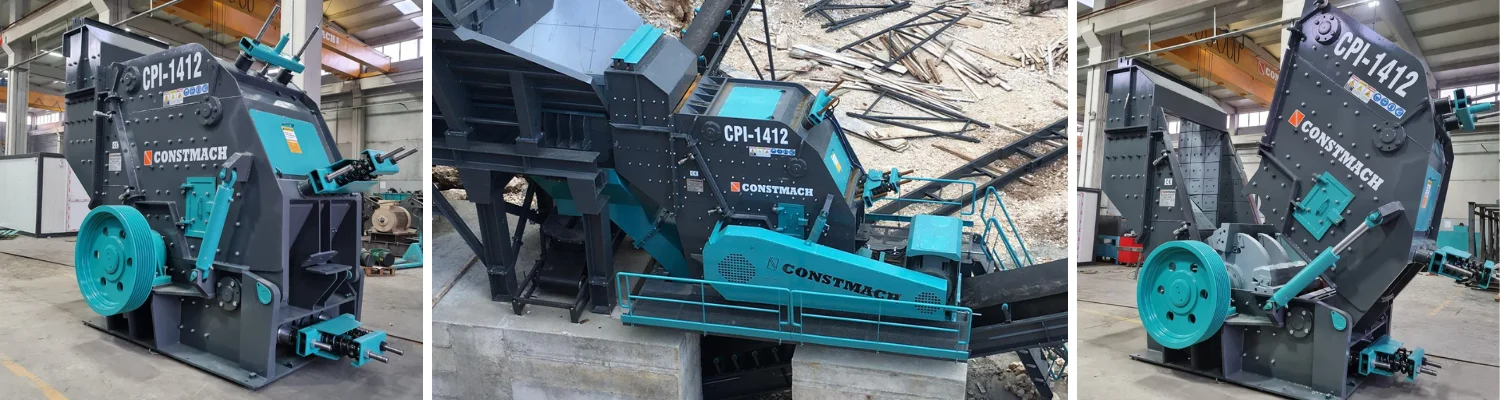

CPI - 1412 | Frantoio a percussione primario

Il CPI-1412 è il modello entry-level della gamma di frantoi a percussione primari CONSTMACH, progettato come macchina di primo stadio per la frantumazione di materiali a media durezza come calcare e dolomite. Con un rotore da 1,400 x 1,250 mm, una dimensione massima di alimentazione di 900 x 900 mm, un azionamento da 250 kW e una capacità da 200 a 250 t/h, produce un prodotto cubico e ben conformato con l'elevato rapporto di riduzione tipico della frantumazione a percussione, in un pacchetto compatto adatto a impianti di inerti piccoli e medi.

A differenza di un frantoio a mascelle, che riduce il materiale per compressione, il frantoio a percussione primario riduce per impatto. Il materiale che entra dalla grande apertura di alimentazione viene colpito dalle mazze (blow bar) in acciaio al manganese montate sul rotore ad alta velocità, proiettato contro piastre d'urto regolabili e fratturato lungo i suoi piani naturali di clivaggio. È questa azione d'impatto a conferire la forma cubica del prodotto, apprezzata per gli inerti da calcestruzzo e asfalto, e l'elevato rapporto di riduzione che può ridurre la necessità di uno stadio secondario separato con materiali più teneri.

Il CPI-1412 è configurato per controllare la pezzatura del prodotto e proteggere la macchina. Le piastre d'urto sono regolabili per mettere a punto la luce e quindi la granulometria in uscita, e una cortina a catene sulla grande bocca di alimentazione protegge dai materiali di rimbalzo. La regolazione idraulica rende semplici sia la regolazione sia l'accesso per la manutenzione, consentendo all'operatore di ripristinare le luci di frantumazione man mano che le mazze e le piastre d'urto si usurano e il prodotto tende a diventare più grossolano.

La durata in un ambiente abrasivo deriva da una costruzione robusta. Il rotore è saldato ad arco e successivamente sottoposto a distensione termica per eliminare le tensioni residue, le fiancate sono spesse con rivestimenti al manganese nelle zone d'usura, e il rotore e le mazze ruotano su grandi cuscinetti orientabili a rulli a botte autoallineanti. L'ampia apertura di scarico priva di ostruzioni consente al materiale frantumato di liberare la camera senza impedimenti, aiutando la macchina a mantenere la sua portata di 200-250 t/h senza impaccamenti.

Con un peso operativo di circa 23,000 kg, il CPI-1412 è il più leggero dei frantoi a percussione primari, il che mantiene contenuti i requisiti di fondazione e i costi di trasporto. La sua struttura modulare lo rende adatto al trasporto su rimorchi standard e in container da 40 ft, e all'integrazione in un impianto fisso compatto in cui funge da frantoio primario che alimenta i vagli e, ove necessario, un frantoio secondario. Poiché l'elevato rapporto di riduzione spesso realizza gran parte della riduzione di pezzatura in un solo passaggio, un impianto per calcare costruito attorno al CPI-1412 può talvolta essere semplificato a un unico stadio di frantumazione.

In esercizio, il CPI-1412 riceve materiale a media durezza e produce un prodotto primario cubico la cui pezzatura è governata dalla regolazione delle piastre d'urto, pronto per la vagliatura nelle frazioni di inerti da calcestruzzo e asfalto e nel materiale di base. Poiché la frantumazione a percussione richiede che il materiale sia non abrasivo e non eccessivamente duro, è ideale per rocce di tipo calcareo piuttosto che per granito o basalto. Per i produttori che frantumano calcare o dolomite a tonnellaggi moderati e necessitano di un prodotto cubico, il CPI-1412 offre una soluzione efficiente di primo stadio.

CPI - 1412 Specifiche tecniche

Dimensioni rotore (mm)1.400 x 1.250 mm
Dimensione massima di alimentazione (mm)900 x 900 mm
Capacità (tonnellate/ora)200 - 250 t/h
Potenza motore (kW)250 kW
Peso (kg)23.000 kg

CPI - 1412 Layout generale

FAQ

The CPI-1412 primary impact crusher is a first-stage machine for medium-hardness materials. This section covers the feed it accepts, the products it generates, its industries, wear-part management and how it compares with a jaw crusher.

What Materials Can the CPI-1412 Process?

The CPI-1412 is designed for medium-hardness, low-abrasion feed, most commonly:

  • Limestone
  • Dolomite
  • Other soft to medium-hard sedimentary rock

It is not intended for hard, abrasive rock such as granite or basalt, which would cause rapid wear of the blow bars and breaker plates. Feed must be within the 900 x 900 mm maximum size to enter the chamber; the large inlet allows substantial run-of-quarry limestone blocks to be charged directly.

What Products Does It Produce?

The CPI-1412 produces a cubical, well-shaped primary product. The high reduction ratio of impact crushing means the output is often fine enough to reduce or remove the need for a separate secondary stage on softer limestone. The product is screened into concrete and asphalt aggregate fractions and base course material. Cubical particle shape is a specific advantage for concrete and asphalt mixes, where flaky or elongated particles weaken the mix and increase binder demand.

Which Industries Use This Crusher?

  • Limestone and dolomite quarries
  • Concrete and asphalt aggregate producers needing cubical shape
  • Cement raw-material preparation
  • Road base and construction aggregate supply

At approximately 23,000 kg with a 250 kW drive, the CPI-1412 is the compact entry point into impact crushing for small and medium limestone operations.

How Are Wear Parts Managed?

The main wear parts are the manganese steel blow (impeller) bars on the rotor, the breaker plates and the chamber liners. Blow bars wear fastest and are replaced or rotated as they round off; the breaker bar setting is adjusted to compensate for wear before replacement. Because wear is directly tied to feed abrasiveness, keeping the crusher on low-abrasion limestone-type feed is the key to acceptable wear-part cost. Verifying the iron content of the feed is also important, as tramp metal can damage the high-speed rotor and bars.

What Should Be Considered During Operation?

Consistent feed and a protected inlet (chain curtain) keep the impact process efficient and the rotor balanced. The breaker bar gaps should be checked and re-set as wear progresses to hold product size. The unobstructed discharge must be kept clear to prevent packing, and bearing lubrication maintained for continuous duty. Rotor balance should be confirmed after each blow-bar change, since an unbalanced rotor at operating speed causes vibration and shortens bearing life.

Impact Crusher Versus Jaw Crusher

A primary impact crusher such as the CPI-1412 reduces by impact, gives a cubical product and a high reduction ratio, and is best for medium-hardness, low-abrasion limestone and dolomite. A jaw crusher reduces by compression and is the better primary choice for hard, abrasive rock such as granite and basalt, where an impact crusher would wear quickly. The choice is driven mainly by feed hardness and abrasiveness: where the feed is limestone and a cubical product is required, the impact crusher is the more efficient option; where the feed is hard or abrasive, the jaw crusher gives lower wear cost.

Frequently Asked Questions

whatsapp gorsel 2024 01 10 saat 15 28 30 bf9fc1cb 9474
Contatto rapido

Lascia una richiesta e il nostro team di esperti ti il prima possibile ricontatterà

Compila il modulo per informazioni dettagliate su impianti di betonaggio, impianti di frantumazione e vagliatura o altri nostri prodotti — oppure contattaci direttamente.

Inviando una richiesta, acconsenti al trattamento dei tuoi dati personali.

oppure direttamente

Novità su Constmach

Il nostro team di esperti è pronto a offrirti una soluzione su misura per il tuo progetto. Siamo a portata di telefono — chiamaci subito.