







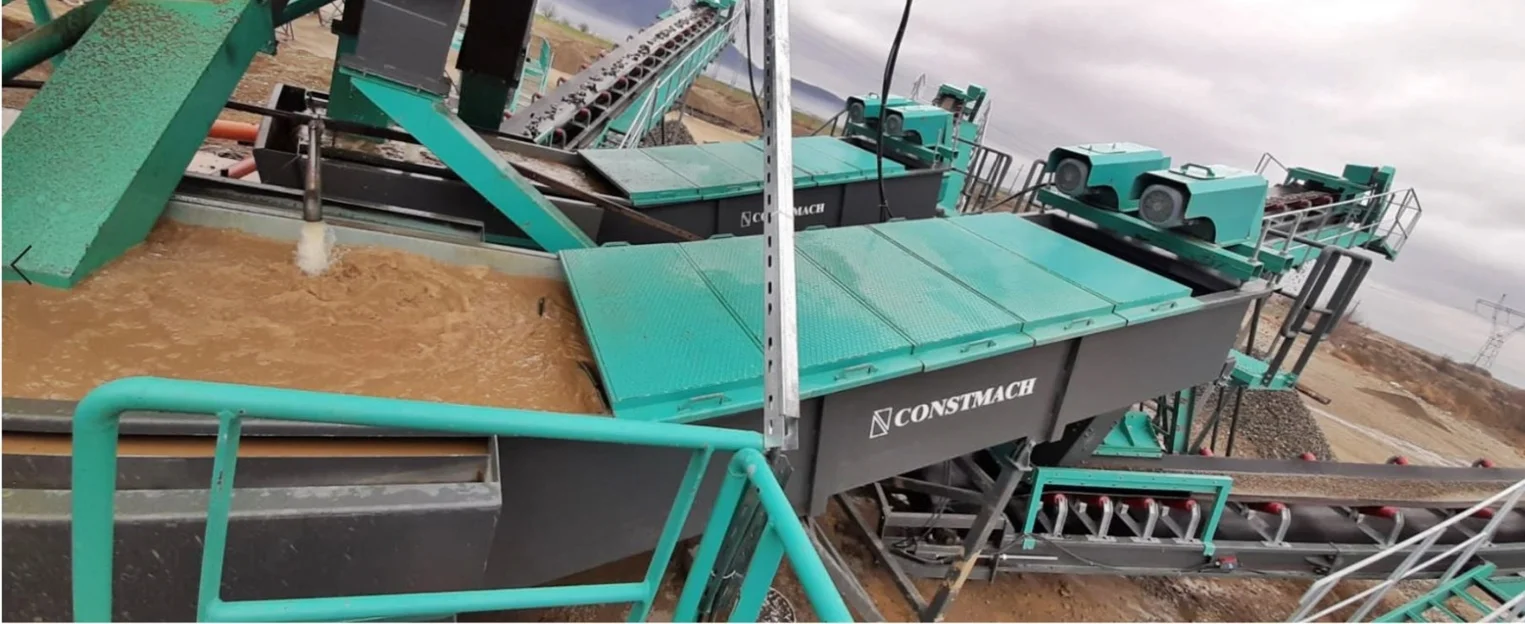

CSW-75 | Lavasabbia a coclea

Il lavasabbia a coclea CSW-75 è un'unità inclinata di lavaggio e disidratazione a spirale costruita da CONSTMACH per pulire gli inerti fini — ghiaia, sabbia naturale e pietrisco frantumato 0–5 mm — che contengono argilla, limo e sporco in eccesso. La macchina funziona secondo un principio semplice: la sabbia sporca e l'acqua entrano nell'estremità inferiore di una vasca inclinata, la coclea rotante sfrega i granuli l'uno contro l'altro e solleva la sabbia lavata lungo l'inclinazione, mentre i contaminanti leggeri e l'acqua di lavaggio tracimano all'estremità inferiore. Quando la sabbia raggiunge lo scarico è al tempo stesso pulita e parzialmente disidratata.

Il CSW-75 è l'unità ad alta capacità della gamma di lavasabbia a coclea CONSTMACH. È costruito attorno a una vasca e una coclea Ø750 x 7,500 mm, azionate in configurazione bialbero da un motore da 2 x 7.5 kW. La coclea gira a 80 rpm, valore che determina il tempo di permanenza della sabbia nella zona di lavaggio — abbastanza veloce da mantenere il materiale in movimento, abbastanza lento da consentire alla spirale di rimuovere per sfregamento le pellicole di argilla dalle particelle. Questa combinazione conferisce al CSW-75 una capacità di lavaggio di 45 m³/h.

Il consumo d'acqua è uno dei punti di forza del principio del lavasabbia a coclea. Il CSW-75 necessita di circa 20 m³/h di acqua di processo e, poiché la coclea solleva la sabbia fuori dal bagno d'acqua, gran parte di quell'acqua rifluisce lungo la vasca e può essere ricircolata attraverso una vasca di decantazione o un ispessitore. Il risultato è una fase di lavaggio che produce sabbia pulita senza l'elevata richiesta di acqua fresca di alcuni metodi alternativi.

La costruzione segue la prassi CONSTMACH per una lunga durata di servizio. Il corpo è realizzato in lamiera d'acciaio pesante, il riduttore è un'unità per servizio gravoso lubrificata a olio progettata dagli ingegneri CONSTMACH con un ampio fattore di servizio, e la spirale è dotata di palette in gomma sostituibili, così che le principali parti soggette a usura possano essere rinnovate senza sostituire la coclea. La configurazione bialbero del CSW-75 distribuisce il carico e aumenta l'intensità di sfregamento rispetto a una singola coclea di piccole dimensioni.

In un impianto tipico il CSW-75 si colloca a valle di un vaglio vibrante: il vaglio elimina il sovvallo e separa la frazione 0–5 mm, che viene poi alimentata al lavasabbia a coclea per la pulizia. La sabbia lavata in uscita dal CSW-75 può essere accumulata direttamente in cumulo, oppure inviata a un vaglio disidratatore quando è richiesto un prodotto più asciutto e immediatamente accatastabile. Con 45 m³/h, il CSW-75 è adatto a linee di lavaggio sabbia di piccole e medie dimensioni.

Il CSW-75 pesa circa 5,800 kg, il che ne facilita il trasporto e il posizionamento su un semplice telaio di supporto in acciaio o calcestruzzo. Una manutenzione agevole, ricambi facilmente reperibili e un montaggio comodo fanno sì che l'unità possa essere installata rapidamente e mantenuta in funzione con tempi di fermo minimi. CONSTMACH fornisce il CSW-75 con documentazione tecnica e supporto ricambi per un funzionamento continuo in cave e siti di estrazione della sabbia.

CSW-75 Specifiche tecniche

DimensioniΦ 750 x 7.500
Potenza motore (kW)2 x 7.5
Capacità (m³/h) 0-3 mm45
Capacità (m³/h) 0-7 mm80
Velocità coclea (rpm)20
Fabbisogno d'acqua (m³/h)40-60
Peso (kg)5.800

CSW-75Video

FAQ

The CSW-75 is used in sand and gravel washing plants to clean the fine 0–5 mm fraction before it is sold as concrete sand, plaster sand or fine aggregate. It is common in river-sand operations, crushed-stone quarries that produce manufactured sand, and any plant where the feed carries clay, silt or organic fines that must be washed out to meet concrete-grade specifications. With a capacity of 45 m³/h, the CSW-75 suits small to medium throughput lines.

What does it wash, and how much clay can it handle?

The screw washer scrubs sand particles against each other and against the spiral, lifting clay and silt films off the grains. It handles light to moderate clay contamination well — as a guide, feed with up to roughly 10% clay/dirt is within its comfortable range. For feed with very heavy, sticky clay a bucket-wheel washer or an attrition cell ahead of the screw is the better choice, because extremely high clay loads can overwhelm a single washing stage.

How much water and power does the CSW-75 use?

The CSW-75 draws a 2 x 7.5 kW twin-shaft drive and needs about 20 m³/h of process water. Because the inclined screw lifts the sand out of the water bath, the bulk of that water drains back into the trough and overflows for recirculation, so net fresh-water consumption with a settling pond is modest. The screw speed of 80 rpm balances throughput against scrubbing time.

How dry is the washed sand?

A screw washer both washes and partially dewaters. Sand discharged from the CSW-75 typically retains residual moisture in the region of 15–25%, lower than the slurry leaving a bucket-wheel washer because of the longer drainage path up the inclined trough. Where a drier, immediately stackable product is needed, a dewatering screen placed after the screw washer can reduce moisture to around 12–15%.

Screw washer vs bucket-wheel washer vs dewatering screen

  • Screw washer (CSW-75) — washes and dewaters fine sand on an inclined spiral; good for light to moderate clay, gives a relatively dry discharge and a long scrubbing path.

  • Bucket-wheel washer — lifts sand out of a tank in buckets; the best choice for high-clay feed and the lowest water and power consumption, but the discharge is wetter.

  • Dewatering screen — a high-frequency screen that does not wash but removes residual water and recovers fine particles from already-washed sand; usually fitted downstream of a screw or wheel washer.

The twin-shaft CSW-75 therefore covers the washing-and-dewatering duty, while a bucket wheel or dewatering screen is added when the clay load or the moisture specification calls for it.

What maintenance does the CSW-75 need?

Maintenance is light. The main wear parts are the replaceable rubber paddles on the spiral, which can be renewed individually without changing the whole screw. The oil-lubricated heavy-duty gearbox is designed with a large service factor for a long life cycle, and the heavy steel-plate body resists abrasion. Regular checks of paddle wear, gearbox oil and the bearing seals keep the CSW-75 producing its 45 m³/h of clean sand reliably.

Frequently Asked Questions

whatsapp gorsel 2024 01 10 saat 15 28 30 bf9fc1cb 9474
Contatto rapido

Lascia una richiesta e il nostro team di esperti ti il prima possibile ricontatterà

Compila il modulo per informazioni dettagliate su impianti di betonaggio, impianti di frantumazione e vagliatura o altri nostri prodotti — oppure contattaci direttamente.

Inviando una richiesta, acconsenti al trattamento dei tuoi dati personali.

oppure direttamente

Novità su Constmach

Il nostro team di esperti è pronto a offrirti una soluzione su misura per il tuo progetto. Siamo a portata di telefono — chiamaci subito.