





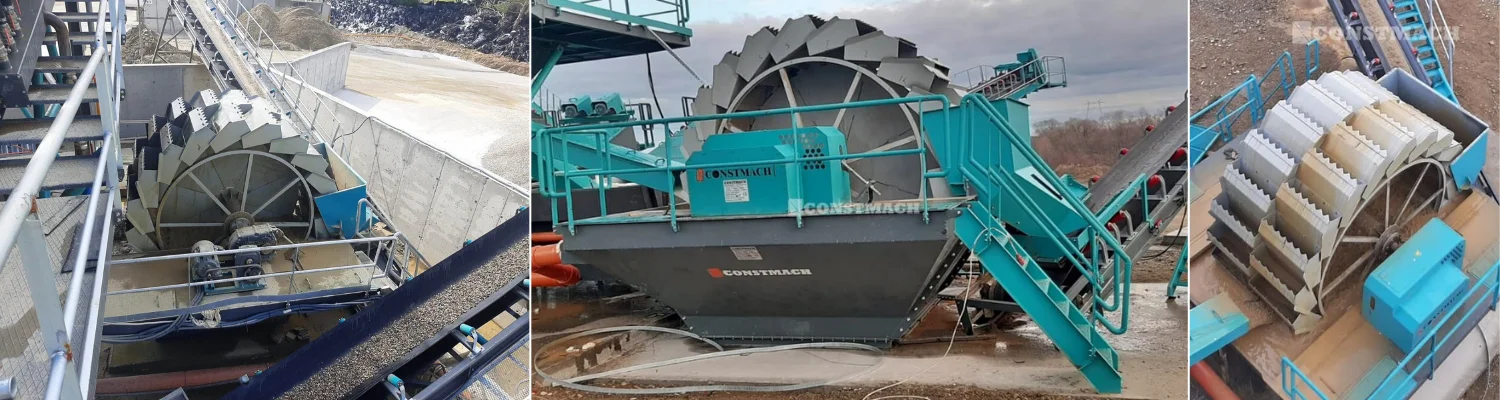

The CBW-800 is used to wash clay and silt out of sand in order to raise its quality, and it is the best choice when the feed carries a high clay content. It is widely used on river-sand and alluvial deposits and on dirty pit-run sand where a screw washer alone would struggle. The wheel scoops settled clean sand from a tank while the clay floats off in the overflow water. Rated at 80–90 m³/h, it is the standard model in the CBW range.
What does it wash and produce?
The CBW-800 treats the sand fraction (broadly 0–5 mm) and produces washed sand suitable for concrete and plaster once it has been dewatered. The 40 perforated buckets of 800 x 550 mm lift the clean sand out of the agitated tank, draining some water as they rise, and tip it into the discharge chute. The clay, silt and organic fines leave with the overflow water for settling.
How much water and power does the CBW-800 use?
Low consumption of both is the hallmark of the bucket wheel. The CBW-800 is driven by just a 5.5 kW motor turning the wheel at 2.5 rpm, so power draw is modest. Water use is also low because washing happens in a recirculating tank rather than a once-through wash; with a settling pond the fresh-water make-up is small. This makes the CBW-800 the most economical washer to operate on heavily clay-bound feed.
How much clay can it handle, and how dry is the output?
The bucket wheel is specifically suited to high-clay feed — more than a screw washer can comfortably clean — because the long residence time in the tank lets stubborn clay disperse before the sand is lifted out. The trade-off is that sand leaving the wheel is fairly wet, generally in the 20–30% moisture range, since the buckets drain only briefly. A dewatering screen downstream is the usual way to bring the product down to a stackable 12–15%.
Bucket-wheel washer vs screw washer vs dewatering screen
Bucket-wheel washer (CBW-800) — best for high-clay feed; lowest water and power use; gentle 2.5 rpm action; output is wetter and loses some fines.
Screw washer — inclined spiral; good for light to moderate clay; gives a drier discharge and a longer scrubbing path, but is less able to cope with very high clay loads.
Dewatering screen — does not wash; a high-frequency screen and hydrocyclone that removes residual water and recovers 90-micron fines from already-washed sand, normally fitted after the wheel.
For a dirty, high-clay deposit the typical line is the CBW-800 for washing followed by a dewatering screen for drying and fines recovery.
What maintenance does the CBW-800 need?
The simple structure means few wear points. Routine attention covers the bucket liners and the wheel bearings, plus periodic checks of the drive and the tank for sand build-up. The slow 2.5 rpm rotation and low 5.5 kW load place little stress on the mechanism, so with basic upkeep the CBW-800 runs reliably at its 80–90 m³/h rating for long periods.