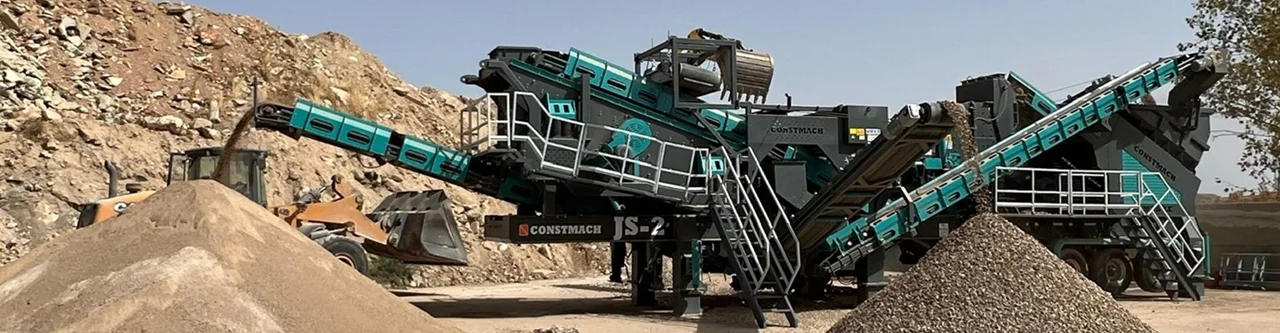
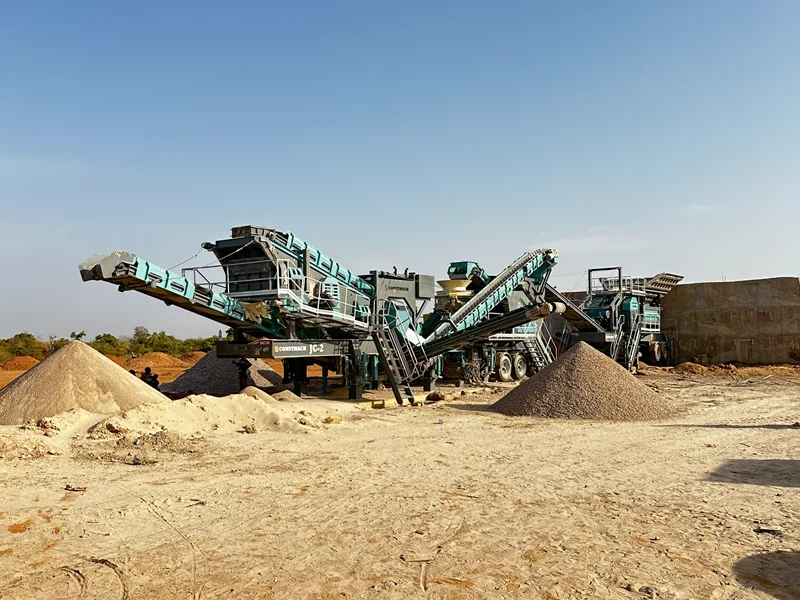
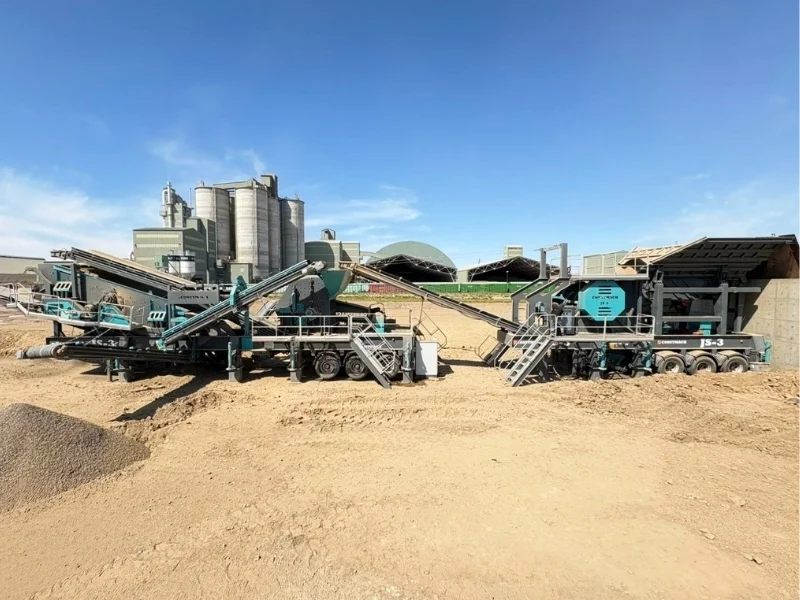
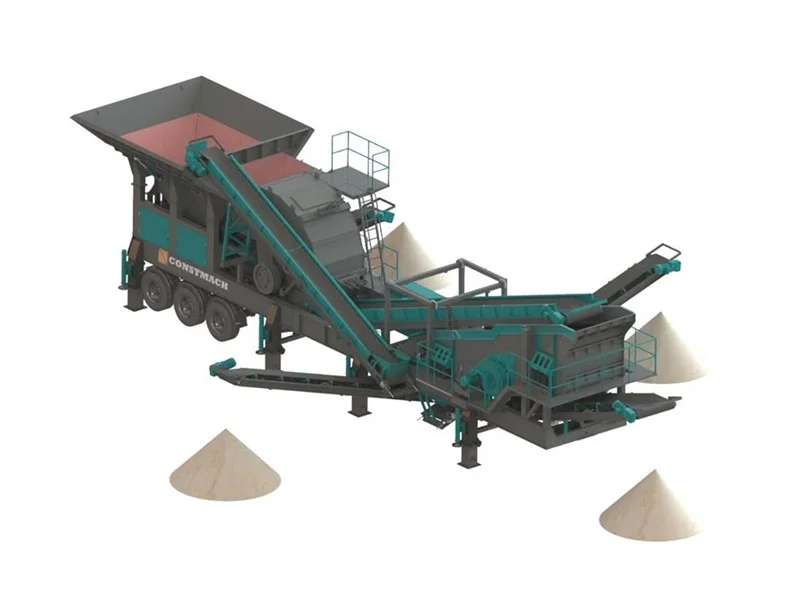
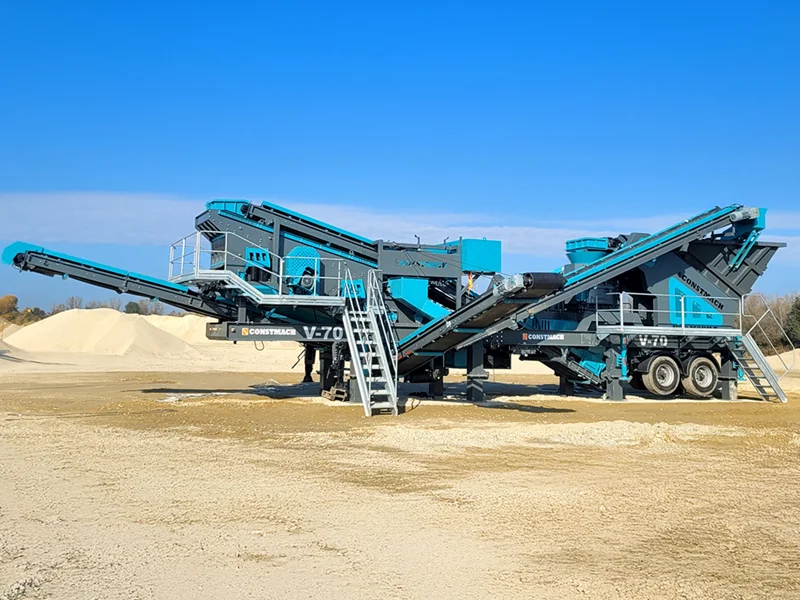
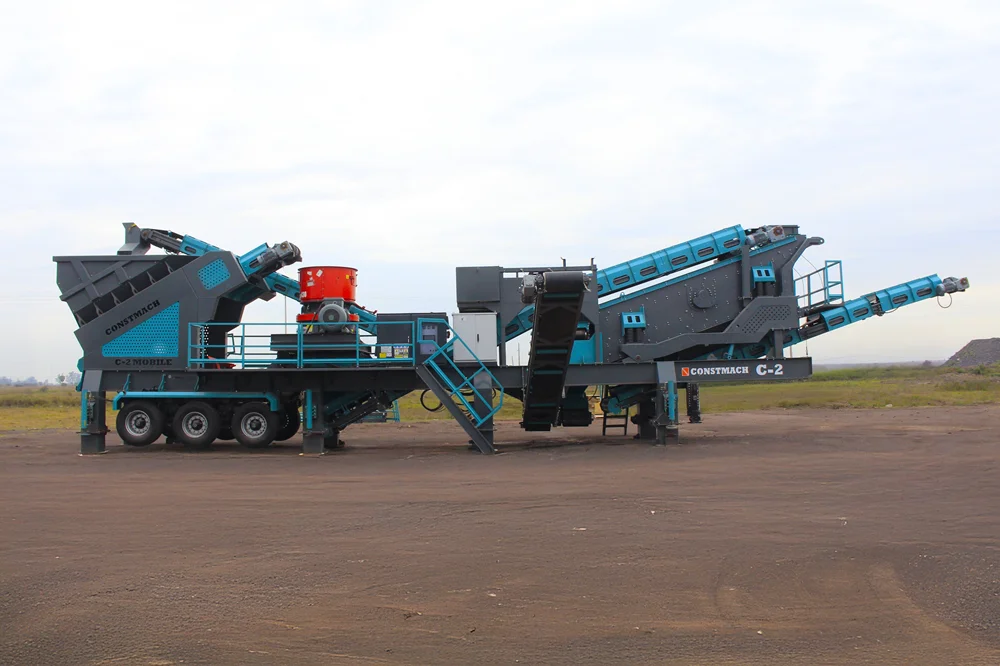
Mobile crushing plants are relocatable, wheel-mounted crushing and screening units that move between sites and start producing aggregate within hours rather than weeks. Each plant sits on a chassis with hydraulic support legs, needs no heavy foundation, and typically carries a feeder, crusher or crushers, a screen and stockpile conveyors. Constmach builds four families covering hard stone, medium-hard rock, manufactured sand and limestone, with capacities of roughly 60 to 300 t/h.
What a Mobile Crushing Plant Actually Is
A mobile crushing plant is a complete crushing and screening line assembled onto a wheeled chassis. Instead of pouring concrete foundations and bolting separate machines into a fixed layout, the feeder, crusher, screen and conveyors travel together as one or more transport-ready units. Once on site, the operator lowers the hydraulic support legs, levels the chassis, connects power and feed, and the plant is ready to run.
The defining trait is mobility without giving up a real production line. A single chassis can hold a vibrating feeder, a primary crusher, a screen and stockpile conveyors, so the plant takes raw rock at one end and discharges sized, screened product at the other. Larger configurations split the work across two or three wheeled chassis when the process needs more crushing stages.
That distinction matters more than it first appears. A mobile plant is not a single machine bolted to wheels; it is an engineered line, sequenced the same way a fixed plant would be, but packaged so it can be folded up and driven to the next job. Everything between the feed hopper and the final stockpile has already been sized to work together, so the plant arrives as a working system rather than a kit of parts.
How a Mobile Crushing Plant Works
Feed rock is loaded into the vibrating feeder, usually by excavator or wheel loader. The feeder meters material at a steady rate and, on most units, scalps off fines and undersize before the rock reaches the crusher. This protects the crusher from overload and keeps clean fines out of the crushing chamber.
The primary crusher reduces run-of-mine rock to a coarser intermediate size. Depending on the family, that primary is a jaw or a primary impact crusher. Secondary and tertiary crushers, a cone, an impact or a VSI, then bring the material down to the target product sizes. A screen separates the crushed stream into graded fractions; oversize returns to a crusher for another pass, and on-spec product runs out to stockpile conveyors.
Because everything is pre-engineered and pre-wired on the chassis, the internal transfer points, chute angles and conveyor runs are already matched to the machines. There is no on-site layout design to get wrong, and no trial-and-error fitting of one supplier's crusher to another supplier's screen. The flow that leaves the factory is the flow that runs on site.
A closed-circuit arrangement is common on the finer-product plants. Here the screen sits after the last crusher and returns anything above the target size for a second pass, so the plant keeps recirculating oversize until it meets spec. Open circuit, where material passes through once and out, suits coarser products and higher throughput. The screen, its deck count and its mesh sizes are chosen to suit the product split the operator is selling, and the recirculating load is one of the numbers that sets real, sustained output.
Why Choose Mobile Over Stationary
Mobile plants follow the work. A contractor moving from one road project to the next, a quarry that relocates as a deposit is worked out, or a job with a defined duration all benefit from a plant that can be packed up and redeployed. The hydraulic support legs and wheeled chassis remove the cost and time of civil foundations entirely.
Stationary crushing plants still win where output and permanence matter most. A fixed installation, anchored to concrete and laid out for one location, delivers the highest sustained tonnage and is the right answer for a long-life quarry feeding a single market. The choice is rarely about which is better in the abstract; it is about how long the plant stays in one place and how fast it has to start earning.
There is also a cash-flow argument that is easy to overlook. A mobile plant earns from the day it is levelled and connected, while a stationary installation carries weeks of civil works and erection before it produces a single tonne. On a project measured in months, those weeks are a large share of the schedule. On a quarry measured in decades, they are a rounding error, and the higher sustained output of a fixed plant repays the wait many times over. The honest comparison weighs setup time and relocation against sustained tonnage over the life of the work, not a single headline number.
| Factor | Mobile Crushing Plant | Stationary Crushing Plant |
|---|
| Foundation | None; hydraulic support legs on a wheeled chassis | Engineered concrete foundations |
| Commissioning time | Hours, once levelled and connected | Weeks, including civil works |
| Relocation | Moves between sites with the work | Fixed in one location |
| Best fit | Contractors, relocating quarries, defined-duration projects | Long-life quarries, highest sustained output |
| Sustained throughput | High and flexible across sites | Highest, optimised for one site |
The Constmach Mobile Crushing Plant Range
Constmach groups its mobile plants into four families, each matched to a rock type and a duty. Choosing the right family is mostly a question of how hard and how abrasive your feed is, and what final product you are selling.
Mobile Hard Stone Crushers
Built for hard, abrasive rock such as granite and basalt. The JC series pairs a primary jaw with a secondary cone, the configuration that holds up best against abrasive feed. The JCV series adds a VSI as a third stage, jaw plus cone plus VSI, when the job needs well-shaped cubical product or manufactured sand from the same hard rock. These are the plants to specify when wear is the main enemy, because the jaw and cone combination keeps abrasive material in compression crushing, where wear costs stay predictable, rather than in impact, where hard rock punishes blow bars quickly.
Mobile Jaw and Impact Crushers
The JS series handles medium-hard rock with a primary jaw followed by a secondary impact crusher. Impact crushers give a high reduction ratio and good product shape on rock that is not heavily abrasive, so this family is an efficient, cost-effective answer for medium-hard stone where a cone would be more machine than the duty requires. The trade is simple: on the right feed the JS series produces cubical product in fewer stages and at lower capital cost, but push it onto hard abrasive rock and the impact stage pays for it in wear parts.
Mobile Sand Making Plants
Dedicated to manufactured sand. The V series uses a VSI to shape and reduce material into clean, well-graded sand, while the T series uses a tertiary impact crusher for the same goal on suitable feed. These plants take crushed aggregate and turn it into a saleable sand product on site, which matters where natural sand is restricted or costly. The VSI route, with its rock-on-rock or rock-on-anvil action, gives the rounded grain shape and controlled grading that concrete and asphalt mixes reward, while the tertiary impact route suits softer feed where the duty is reduction more than fine shaping.
Mobile Limestone Crushers
The PI series is a mobile primary impact crusher for limestone and other low-abrasion stone. Limestone breaks readily and is gentle on wear parts, so a primary impact crusher can do in one stage what harder rock needs two or three stages to achieve. That makes the PI series a high-output, lower-cost route for the right material. On low-abrasion stone a single impact crusher can take large feed straight down to a saleable, well-graded product, which is why limestone operations so often reach for this family first.
Single, Double and Triple Chassis Configurations
The number of wheeled chassis follows the number of crushing and screening stages. A single chassis suits a one-crusher plant: feeder, crusher, screen and conveyors on one frame. A two-stage line, primary plus secondary, often splits across two chassis. Three-stage configurations such as jaw plus cone plus VSI may run across three.
More chassis means more transport movements and more set-up time, but also more crushing stages and finer, better-shaped product. Matching the chassis count to the real process need keeps both capital cost and mobilisation effort in proportion to the job. A single-chassis plant that travels as one load is the cheapest to move and the quickest to start, while a three-chassis line gives the size control and product shape that a single crusher cannot, at the cost of more loads on the road and more time spent aligning units on site.
Build, Wear and Quality Features
Because a mobile plant moves and starts often, reliability at start-up matters as much as peak output. Constmach mobile plants include automatic lubrication, which keeps bearings and wear points fed correctly without relying on an operator to remember a grease round during a busy mobilisation. That alone removes one of the most common causes of premature bearing failure on relocating plant.
Metal detectors guard the crushing chambers. Tramp metal, an excavator tooth, a broken ground-engaging part, a stray bar, can wreck a cone or impact crusher in an instant. Detecting it before it enters the chamber protects the most expensive components on the plant and avoids the downtime of clearing a jammed crusher far from the workshop.
These two features look small on a spec sheet and matter enormously in the field. A plant that moves every few weeks loses more production to start-up faults and avoidable damage than to any shortfall in rated capacity, so the systems that protect bearings and chambers earn their keep every time the plant is set down on new ground.
Capacity and Sizing
Across the range, mobile plants cover roughly 60 to 300 t/h depending on the model and configuration. The right figure depends on feed size, rock hardness, the number of stages and the product split you need. Headline capacity is set by the slowest stage in the line, so a plant is only as fast as its tightest crushing or screening bottleneck.
Size the plant to the duty, not to a brochure peak. A plant chosen for the absolute top of its range with no margin will struggle on hard feed or sticky material; one with sensible headroom holds its rate through variable conditions and gives room to grow. Feed that arrives wetter, harder or coarser than the design assumed will pull real output below the rated figure, so the prudent buyer reads the capacity range as a band tied to conditions, not a single promised number.
How a Mobile Plant Fits a Crushing Line
A mobile plant can run as a complete standalone line or as one part of a larger operation. On a small or short job, a single mobile unit does everything from feed to stockpile. On bigger sites, mobile units work alongside each other, one feeding the next, to build a multi-stage line that can still be broken down and moved.
The chassis layout already fixes the internal flow, so integration mostly comes down to matching capacities between units and positioning them so conveyors land product where you want it. Constmach application engineering helps lay out which families and how many chassis a given feed and product specification actually need. Where a mobile line runs alongside a fixed installation, the mobile units often take the overflow, the satellite deposits or the awkward corners of a site that do not justify their own permanent plant.
Materials and Applications
Each family targets a material band. Hard, abrasive rock such as granite and basalt goes to the hard stone crushers. Medium-hard rock suits the jaw and impact family. Limestone and other low-abrasion stone fit the primary impact route. Manufactured sand, whether from hard rock or softer feed, comes from the sand making plants.
- Granite and basalt: Mobile Hard Stone Crushers (JC, JCV).
- Medium-hard rock: Mobile Jaw and Impact Crushers (JS).
- Manufactured sand: Mobile Sand Making Plants (V, T).
- Limestone and low-abrasion stone: Mobile Limestone Crushers (PI).
Typical end uses span aggregate for concrete and asphalt, road base, drainage stone and manufactured sand. The product specification, not just the rock type, drives the family and stage count. A buyer selling a single coarse road-base product makes a very different choice from one selling several clean graded fractions plus a concrete sand, even when both are crushing the same quarry face.
Maintenance on a Plant That Moves
Maintenance discipline on a relocating plant differs from a fixed one. Each move is a chance for things to loosen, so a check of fasteners, hydraulic legs, conveyor tracking and chute liners at every set-up pays for itself. Automatic lubrication handles routine greasing, but the operator still owns daily inspection.
Wear parts, jaw plates, cone liners, impact blow bars and aprons, wear at a rate set by your rock. Abrasive granite and basalt eat liners far faster than limestone. Keeping the right wear parts on hand and changing them on a planned schedule, rather than on failure, keeps the plant earning and protects the chamber behind the wear surface.
Transport itself is part of the maintenance picture. Road shock loosens fasteners, shifts liners and unsettles conveyor tracking in ways a static plant never sees, so the first running hours after every move deserve closer watching than the same hours on a plant that has stayed put. A short shakedown check after each relocation catches the small faults before they grow into a breakdown on a site with no workshop nearby.
Common Mistakes When Buying Mobile
The most frequent error is matching the wrong family to the rock. Running an impact-based plant on hard abrasive granite burns through blow bars; oversizing a cone plant for soft limestone wastes capital and capacity. The second mistake is buying for peak capacity with no headroom, then running short the moment feed gets harder or wetter.
Two more recur. Underestimating chassis count, hoping one unit will do a three-stage job, leaves product out of spec. And neglecting tramp-metal protection or lubrication discipline turns a small oversight into a wrecked crusher far from any workshop. Each is avoidable at the specification stage.
A fifth mistake is forgetting the site itself. A plant sized perfectly for the rock still falls short if the ground will not carry it, if there is no room to stockpile under the conveyors, or if trucks cannot reach the discharge to haul product away. Working footprint, ground bearing and haul access belong in the buying decision alongside crusher selection, not as an afterthought once the plant has arrived.
How to Choose the Right Mobile Crushing Plant
Start with the feed: how hard and how abrasive is the rock. That decides the family, hard stone, jaw and impact, sand making, or limestone. Then define the product: sizes, shape and whether you need manufactured sand. That sets the stage count and therefore the chassis count.
Layer in capacity with realistic headroom, the mobility you actually need, and how long the plant will stay in one place. If it stays put for years at high tonnage, a stationary plant may serve better; if it follows the work, mobile is the clear answer. The best plant is the one whose family, stages and capacity match your material and duty rather than the largest one that fits the budget.
Work the decision in that order and the rest tends to follow. Feed sets the family, product sets the stages, duty and site set the capacity and chassis count, and the time the plant spends in one place decides mobile against stationary. Reverse the order, start from a budget or a headline tonnage, and you risk a plant that crushes the wrong rock the wrong way. Get the sequence right and the specification almost writes itself.