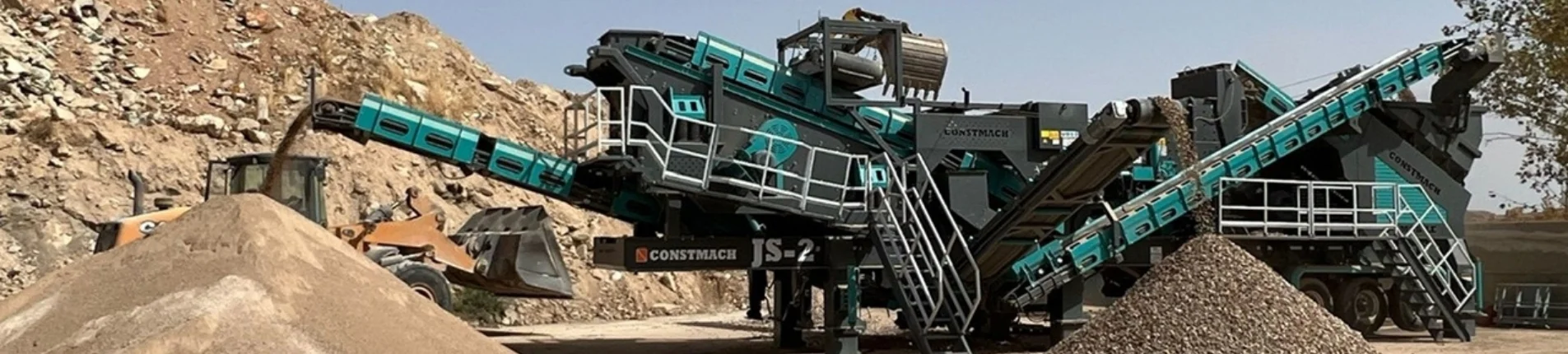
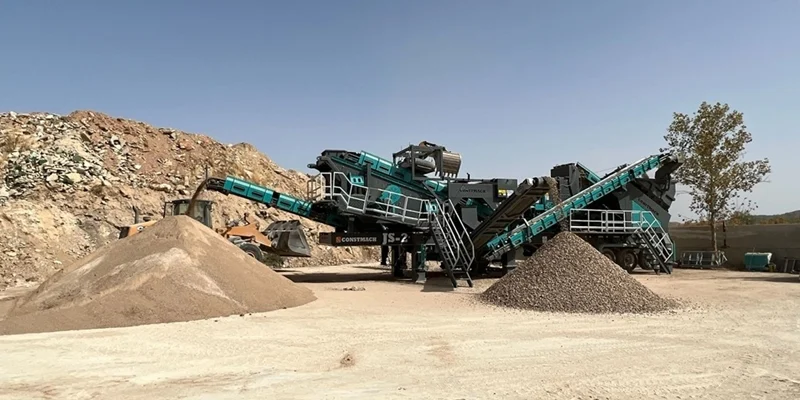
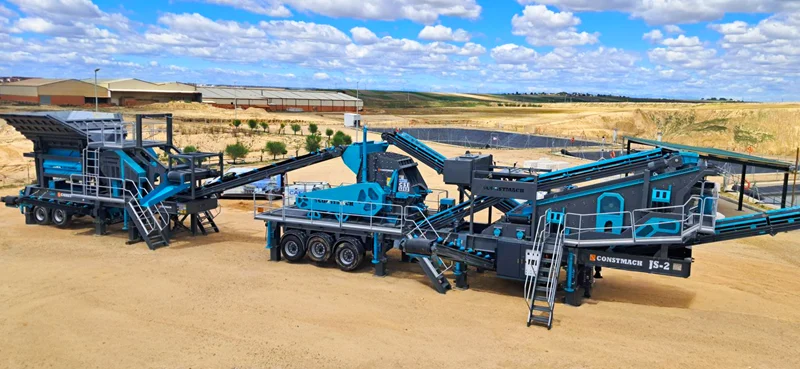
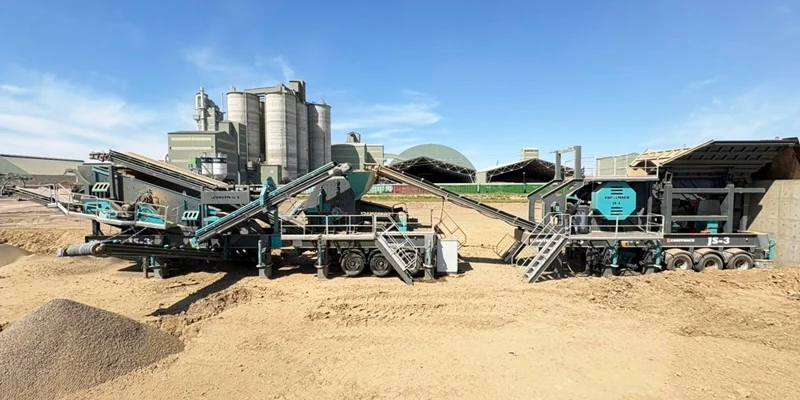
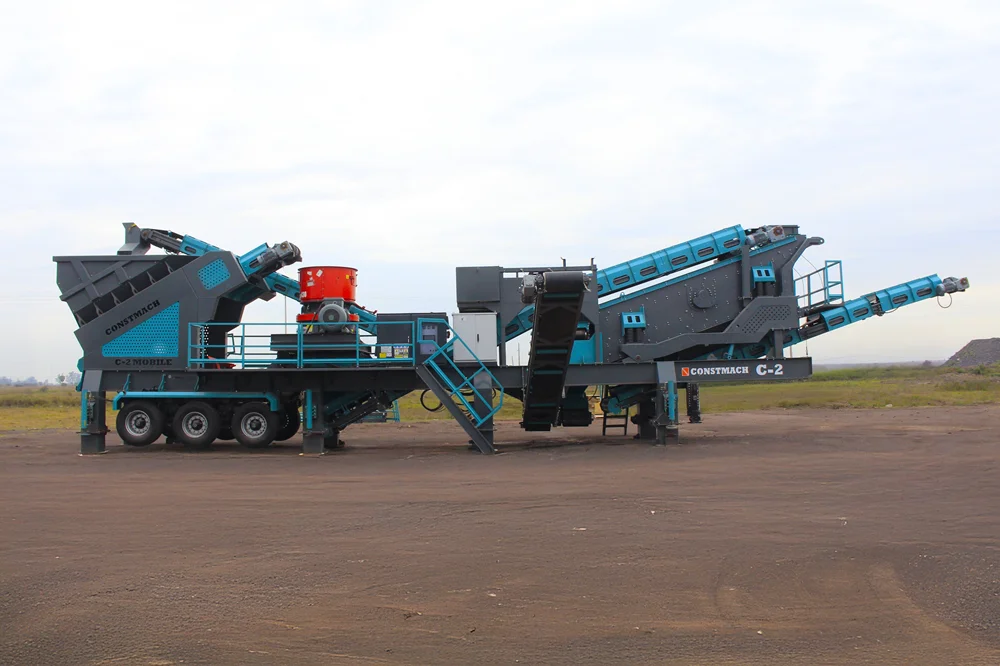
Constmach mobile jaw and impact crushers, sold as the JS series, are wheel-mounted crushing and screening plants that pair a primary jaw crusher with a secondary impact crusher across two chassis, with an integrated screen. The jaw makes the coarse first reduction by compression. The impact crusher then reshapes that feed into a high-quality cubical product. This combination is built for medium-hard, low-to-medium abrasion rock.
What a Mobile Jaw and Impact Crusher Is
A mobile jaw-and-impact plant is a two-stage crushing line built onto wheeled chassis so it can be towed between sites and set up in hours rather than weeks. The first machine is a jaw crusher that takes raw quarry feed and breaks it down by squeezing it between a fixed and a moving jaw plate. The second machine is a horizontal-shaft impact crusher that throws the pre-crushed stone against hard blow bars and breaking plates to reduce it further and shape it.
The Constmach JS series puts the primary group on one chassis and the secondary impact crusher plus screen on a second chassis. Hydraulic legs lift the units off their wheels and level them on site. Because the plant is modular and self-supporting, there is no large concrete foundation to pour, which is a big part of why these machines move so quickly from one job to the next.
How the Two-Stage Process Works
Feed enters the primary jaw crusher, usually through a vibrating feeder that meters the rock evenly and lets fine material bypass the crushing chamber. The jaw reduces large run-of-quarry blocks down to a manageable intermediate size. That product is carried by conveyor to the secondary impact crusher, where high-speed rotor blow bars do the real shaping work.
The impacted material then passes over the integrated screen. Sized fractions drop onto product conveyors. Oversize is returned to the impact crusher in a closed circuit so nothing leaves the plant above specification. The result is a clean, graded, cubical aggregate produced in one continuous pass.
- Primary jaw crusher: coarse reduction by compression.
- Transfer conveyor: moves intermediate product to the second group.
- Secondary impact crusher: high reduction ratio and cubical shaping.
- Integrated screen: separates the product into saleable sizes.
- Closed-circuit return: oversize goes back to the impact crusher.
Why Pair a Jaw with an Impact Crusher
Each crusher does what it is good at. A jaw crusher is the right tool for the first cut because it handles big, irregular blocks and high tonnage cheaply. But a jaw alone produces a flaky, elongated product with a limited reduction ratio. Putting an impact crusher second fixes both problems. It delivers a much higher reduction ratio and turns slabby stone into cubical aggregate that meets concrete and asphalt shape requirements.
This pairing is the correct choice for medium-hard, low-to-medium abrasion rock such as limestone and similar stone. On that kind of feed, blow bar wear stays reasonable and the impact crusher earns its keep through product quality and tonnage.
When Jaw-and-Impact Is the Wrong Choice
Material selection matters more here than any other decision. Impact crusher blow bars wear quickly on hard, abrasive feed. If you are crushing hard abrasive rock such as granite or basalt, a jaw-and-cone hard stone plant is the better answer, because a cone crusher reduces by compression with steel that lasts far longer on abrasive stone. The JS jaw-and-impact series is for medium-hard, low-to-medium abrasion feed. Putting it on the wrong rock means frequent blow bar changes and poor wear economics. Constmach application engineers will steer you to the right plant for your specific stone.
The Constmach JS Series Range
The JS series is built around three configurations. Each pairs a specific primary jaw with a matched secondary impact crusher, so capacity steps up cleanly from entry level to the top of the range. The table below sets out the pairings.
| Model |
Primary jaw crusher |
Secondary impact crusher |
Position in range |
| JS-1 |
CJC-60 |
CSI-1210 |
Entry level |
| JS-2 |
CJC-90 |
CSI-1212 |
Mid range |
| JS-3 |
CJC-110 |
CSI-1215 |
Highest capacity in JS series |
All three share the same layout philosophy: two wheeled chassis, hydraulic legs and an integrated screen. Stepping up the range means a larger jaw feed opening and a bigger impact crusher, which raises throughput and lets you handle larger top-size feed. The right model depends on your target tonnes per hour, your feed size and the products you need to make.
Build and Wear Parts
The two areas that decide running cost on this type of plant are the jaw plates and the impact crusher wear parts. The jaw uses replaceable manganese-steel jaw plates that can be reversed and then swapped when worn. The impact crusher relies on blow bars on the rotor and breaking plates in the chamber. These are the fastest-wearing parts and the reason feed hardness is so important.
Constmach manufactures these plants in-house and supports them with a spare parts supply, so wear items are available when you need them. Keeping a set of blow bars and jaw plates on the shelf means a worn part never stops production for long.
How It Fits a Crushing Line
A mobile jaw-and-impact plant can run as a complete, self-contained line on its own two chassis, taking raw feed in at the jaw and discharging finished, screened aggregate. It can also slot into a larger operation. The primary group can feed other mobile units, or the whole plant can sit downstream of a separate primary station on a big quarry.
Because the units are wheel-mounted with hydraulic legs, you can reposition them as the working face moves, which keeps haul distances short and trucking costs down. That mobility is the main operational advantage over a fixed installation.
Stationary or Mobile
The choice between a mobile plant like the JS series and a stationary installation comes down to how long you stay in one place and how much tonnage you need. The points below summarise the trade-offs.
- Foundation: the JS plant levels on hydraulic legs with no major concrete, while a stationary plant needs an engineered concrete foundation.
- Relocation: the JS plant is fast to move and towed between sites, while a stationary plant is fixed in place.
- Setup time: the JS plant needs hours to days, while a stationary plant takes weeks.
- Best fit: the JS plant suits multiple sites and contract crushing, while a stationary plant suits a single long-life quarry.
Capacity and Sizing
Sizing a plant is not just a tonnage figure. You need to match the jaw feed opening to your maximum feed block size, then make sure the impact crusher and screen can keep up with what the jaw delivers. If the secondary stage is undersized, the jaw will outrun it and the plant will choke. If the screen area is too small, finished product backs up.
Within the JS series, JS-1 suits smaller operations and modest tonnage, JS-2 covers mid-range duty, and JS-3 gives the highest output in the family. Tell Constmach your feed size, target products and required tonnes per hour, and the application team will recommend the model that balances all three.
Materials and Applications
These plants are made for producing aggregate for concrete and asphalt from medium-hard, low-to-medium abrasion rock. Typical feed is limestone and comparable stone where the impact crusher shaping ability is a real benefit and abrasion stays manageable. On medium-hard limestone a well-fed JS plant turns out base course, sub-base and several clean chipping sizes from a single line, which is the everyday work these plants are bought for.
- Graded aggregate for concrete and asphalt production.
- Base and sub-base material for road construction.
- Cubical chippings where shape specification matters.
- General quarry and contract crushing on suitable stone.
For hard, abrasive feed, choose a jaw-and-cone hard stone plant instead. The shaping advantage of the impact crusher is only worth having when wear cost stays under control.
Feed Quality and Product Gradation
What goes into the jaw decides a lot about what comes off the product conveyors. Clean, dry, well-blasted feed with a consistent top size lets the plant run steadily and hold its gradation. Feed that is dirty, wet or wildly variable in size forces the operator to slow the feeder, and that costs tonnage. On a jaw-and-impact plant the screen does the final grading, so screen media selection and deck angle have a direct effect on the cut points you can hold. Adjusting the apron settings on the impact crusher shifts the product curve toward coarser or finer material, which gives you a useful lever when the market for a given size changes.
A practical operator learns the plant sweet spot for each product. Run it too hard and the gradation drifts while the recirculating load climbs. Run it too gently and you leave tonnage on the table. The closed circuit is what keeps the top size honest, returning anything oversize to the impact crusher rather than letting it slip into a finished stockpile that a customer will reject.
Dust, Noise and Site Management
A crushing and screening plant generates dust at every transfer and discharge point, so dust suppression is part of running one responsibly. Most operators fit water spray bars at the feeder, the crusher discharges and the screen, sometimes with a dosing pump so the spray only runs when material is moving. Good housekeeping around the plant, keeping spillage cleared from under conveyors and transfer points, both reduces dust and prevents the build-up that causes belt tracking problems.
Noise and traffic also need planning on a working site. Position the plant so loading shovels and haul trucks have clear, short routes, and keep stockpiles arranged so the loader is not crossing the feed path. These are not glamorous details, but they are what separates a site that runs smoothly from one that loses hours to avoidable stoppages and reshuffling.
Maintenance and Daily Checks
Good maintenance on a jaw-and-impact plant is mostly about staying ahead of wear. Check blow bars and jaw plates regularly and plan changes before they reach the point where product shape or size drifts out of spec. Watch the closed-circuit screen for blinding and keep conveyors and transfer points clean.
- Inspect blow bars and breaking plates for the impact crusher each shift on abrasive duty.
- Reverse and replace jaw plates before they wear through.
- Lubricate bearings on schedule and monitor temperatures.
- Check screen media for wear and blinding.
- Keep hydraulic legs and the leg circuit clean and leak-free.
Commissioning and Operator Training
The first days on a new plant set the tone for its working life. A proper commissioning run checks that the feeder, crushers, screen and conveyors are sequenced correctly, that interlocks stop the line safely if a downstream unit trips, and that the closed circuit balances at the intended tonnage. Getting the impact crusher rotor speed and apron gaps right at this stage saves a lot of fiddling later. It is sensible to run representative feed through the plant during commissioning rather than trusting a paper gradation, because real rock always behaves slightly differently from the spec sheet.
Operator training pays for itself quickly. An operator who understands why the plant chokes when overfed, what a rising recirculating load looks like, and how to read wear on the blow bars will keep the plant producing on-spec material with far fewer stoppages. Constmach supports the handover with commissioning and guidance so the crew starts with the plant set up correctly rather than learning by trial and error.
Common Mistakes to Avoid
The most expensive mistake is running an impact crusher on hard abrasive rock it was never meant for, which burns through blow bars. The second is overfeeding the jaw so the secondary stage and screen cannot keep up. The third is neglecting the closed circuit, letting oversize escape into the product. None of these are faults of the plant. They come from sizing or feeding it wrongly.
- Feeding hard abrasive stone into an impact secondary.
- Choking the plant by overfeeding the primary jaw.
- Running worn blow bars and jaw plates too long.
- Ignoring screen blinding in the closed circuit.
How to Choose the Right Plant
Start with your rock. If it is medium-hard with low-to-medium abrasion, the JS jaw-and-impact series is a strong fit. If it is hard and abrasive, ask about a jaw-and-cone plant. Next, fix your maximum feed size, which sets the jaw you need. Then settle on target tonnes per hour and the products you want to sell, which points to JS-1, JS-2 or JS-3.
Match the plant to the work, not the work to the plant. With the right model on the right stone, a mobile jaw-and-impact plant delivers cubical, on-spec aggregate at low running cost and moves with you as the job changes. Constmach application engineers, in-house manufacturing and after-sales support are there to make sure the plant you buy is the one your material actually calls for.