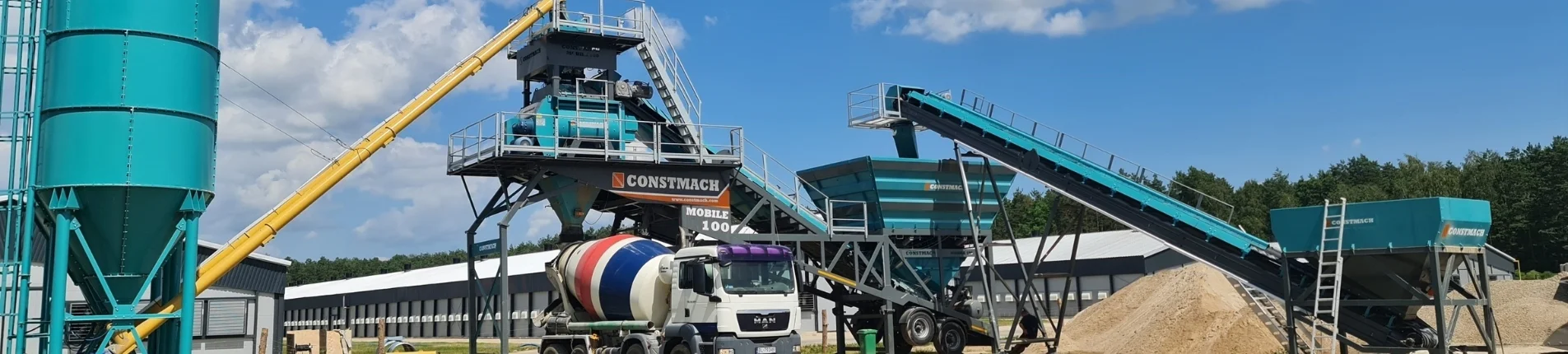
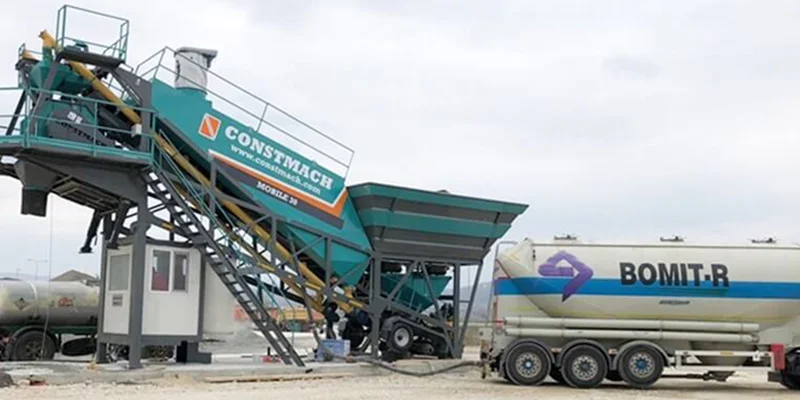
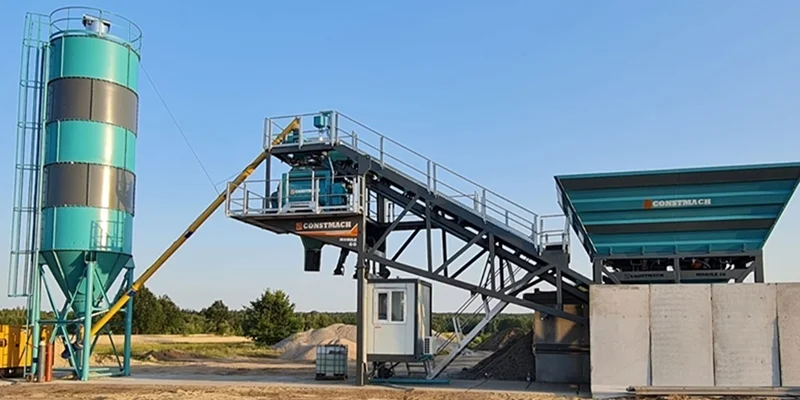
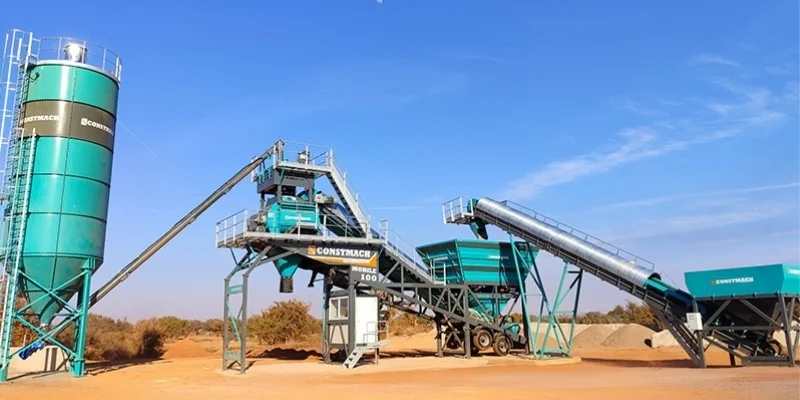
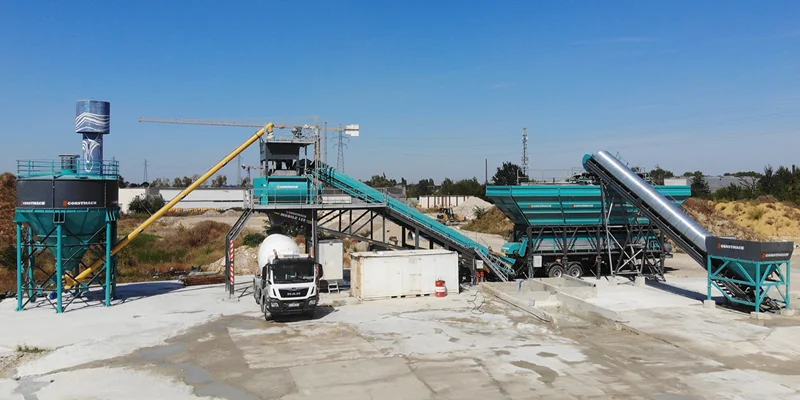
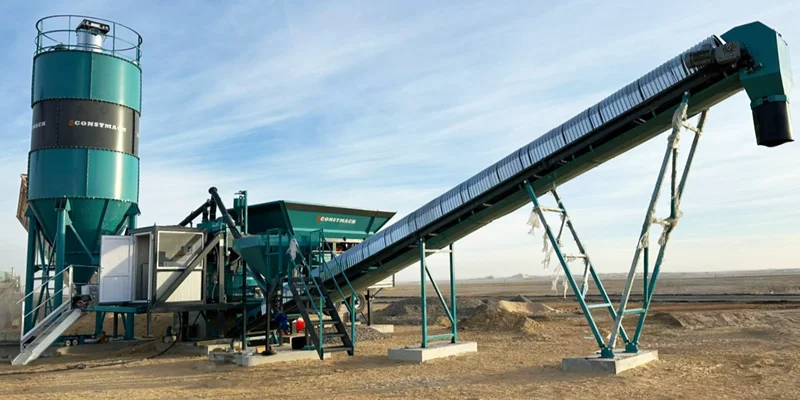
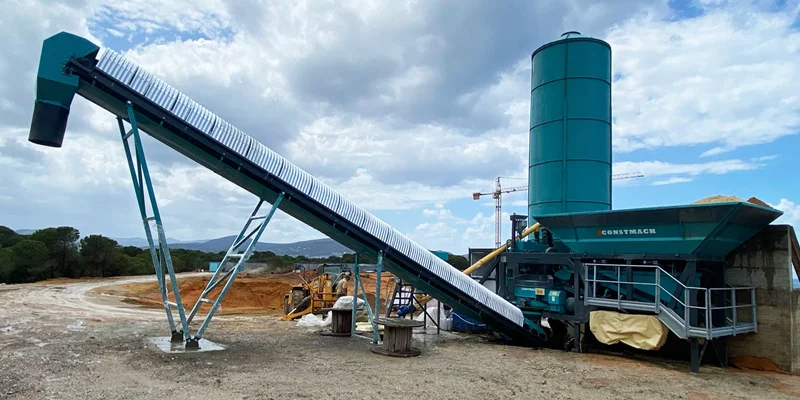
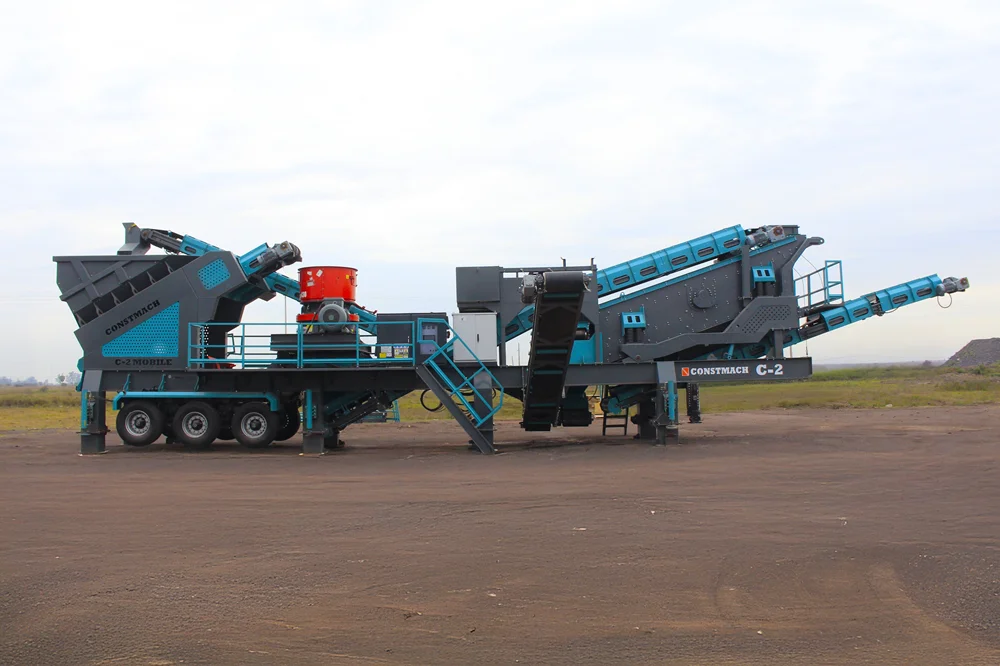
A mobile concrete batching plant produces ready concrete from a towable, chassis-mounted unit that can be set up, run, and moved to the next site with very little civil work. Constmach mobile concrete plants cover 30 to 120 m³/h across the Mobile and ultra-compact Mobicom ranges, with the weighing, mixing and often the cement silo carried on the chassis itself so the plant reaches production in a short time.
What Is a Mobile Concrete Batching Plant?
A mobile concrete batching plant, also called a portable concrete plant, carries the core concrete-production equipment on a wheeled chassis. The aggregate bins, the weighing systems, the mixer and the control unit travel together, and on many models the cement silo is mounted on the same frame. The plant is towed to site, levelled, connected to power and water, and put into production quickly.
The appeal is straightforward. A contractor who works across several sites, or on projects that finish and move on, can take the plant along instead of building a new fixed plant each time. Constmach mobile concrete batching plants are among the company's most requested models for that reason, and the range is wide enough to match most project sizes.
Mobile vs. Stationary: What Changes
The difference is mobility against permanence. A stationary concrete plant reaches the highest sustained outputs and carries larger aggregate and cement storage, but it needs an engineered foundation and weeks of civil work before the first pour. A mobile concrete plant arrives mostly pre-assembled and asks for little more than firm, level ground.
That trade has a clear logic. If the work is fixed and high-volume for years, a stationary concrete batching plant earns its foundation. If the work moves, or a project runs for months rather than decades, a mobile concrete batching plant removes the cost and delay of building and later dismantling a fixed installation. For many contractors, the mobile concrete plant is simply the more practical asset.
How Does a Mobile Concrete Plant Work?
A mobile concrete batching plant runs the same batching cycle as a fixed one, only the equipment is folded onto a transportable frame:
- Aggregate feeding. Sand and stone sit in chassis-mounted bins, released by feed gates onto a weigh conveyor or into a weigh hopper.
- Weighing. Aggregates, cement, water and admixtures are each weighed on load-cell scales to match the mix design.
- Cement supply. Cement is drawn from the silo, which on smaller models is mounted on the same chassis, and fed by screw conveyor to its weigh hopper.
- Mixing. The weighed materials combine in the mixer until the batch is uniform.
- Discharge. Finished concrete drops into a truck mixer or transfer point for placing.
Once the plant is levelled and connected, an operator selects a recipe and the PLC-based control system repeats it load after load, with the same accuracy you would expect from a stationary concrete plant.
The Constmach Mobile Range
The classical Mobile series spans four outputs, so the plant can be matched to demand rather than over- or under-sized.
| Model | Output | Configuration | Built-in cement silo |
|---|
| Mobile 30 | 30 m³/h | Single-trailer | Yes |
| Mobile 60 | 60 m³/h | Single-trailer | Yes |
| Mobile 100 | 100 m³/h | Single-trailer | Yes |
| Mobile 120 | 120 m³/h | Two-chassis | Separate silo |
The Mobile 30, 60 and 100 fit on a single wheeled chassis, which keeps transport and setup simple. The Mobile 120 reaches the top of the mobile output range and uses a two-chassis layout to carry the larger equipment, while still avoiding the heavy civil work of a stationary concrete batching plant.
The Mobicom Series: Ultra-Compact and Road-Legal
The Mobicom 30 and Mobicom 45 are Constmach's new-generation mobile concrete plants, built for the easiest possible transport. Each packs a full batching plant into a road-legal footprint about 8 metres long, so the unit travels like a standard load and needs minimal assembly on arrival. Outputs are 30 and 45 m³/h. For contractors who relocate often, or who work where access is tight, the Mobicom range cuts setup and transport effort to a minimum without giving up automated batching. Because the unit moves as a single road-legal load, there is no abnormal-transport planning for most journeys, and a small crew can have it producing concrete soon after it reaches the site. It is the choice when speed of redeployment matters more than the very highest output.
Built-In Cement Silos and Integrated Design
On the Mobile 30, Mobile 60 and Mobile 100, a 27-ton cement silo is built onto the chassis. Carrying the silo with the plant matters more than it first appears: it removes a separate unit to transport, erect and connect, and it shortens the path from delivery to production. Fewer standalone components also means less to align and commission on site. The integrated approach is a large part of why these plants set up so quickly.
Main Components of a Mobile Concrete Batching Plant
- Chassis-mounted aggregate bins with feed gates
- Weigh conveyor or weigh hopper with load cells
- Cement silo (on-chassis for smaller models) and screw conveyor
- Cement, water and admixture weighing
- The concrete mixer
- Automated control cabin with PLC
- Dust collection on the silo and mixer
Mixer Options
The mixer sets batch quality, and Constmach can fit a mobile concrete plant with the type that suits the work. Twin-shaft mixers give fast, intensive mixing for stiff and high-strength concrete and are a common choice where output matters. Single-shaft and pan mixers suit lighter or more specialised mixes. Matching the mixer to the concrete you produce keeps quality high without paying for capacity you will not use.
Automation, Recipes and Batch Records
What turns a mobile concrete batching plant from a set of conveyors and hoppers into a reliable producer is its control system. Constmach mobile concrete plants run PLC-based automation that stores mix recipes, weighs each material within set tolerances, and corrects the added water for the moisture already in the aggregate so the water-to-cement ratio stays on target.
The operator selects a recipe and the plant repeats it without re-entering figures, which removes a common source of error during long pours. The control software also logs every batch. That record gives the producer a traceable history for quality control and for any question over a delivered load. On a mobile concrete batching plant that may serve several clients in a single season, clear documentation is part of the service, not an extra.
Keeping Concrete Consistent When the Plant Moves
Relocation is where a mobile concrete plant is tested. Each new site brings different aggregate, water and weather, and the plant has to hold its mix design through all of it. Accurate weighing on load cells, automatic moisture correction and recipe-driven control are what keep the concrete consistent from one location to the next. After a move, recalibrating the scales and checking the moisture settings is a short job that protects quality, and it is far easier than chasing a strength problem once the concrete is in place.
Fast Setup and Minimal Site Infrastructure
Speed is the main reason contractors choose mobile. A Constmach mobile concrete batching plant needs only minimum site preparation: a flat, firm area able to carry the plant's load, a three-phase power connection and a water supply. There is no engineered concrete foundation and no long civil-works programme. The plant is towed in, levelled, connected and brought into production in a short time, which can be decisive on a project with a tight start date.
The Prefeeding Conveyor: No Loading Ramp Needed
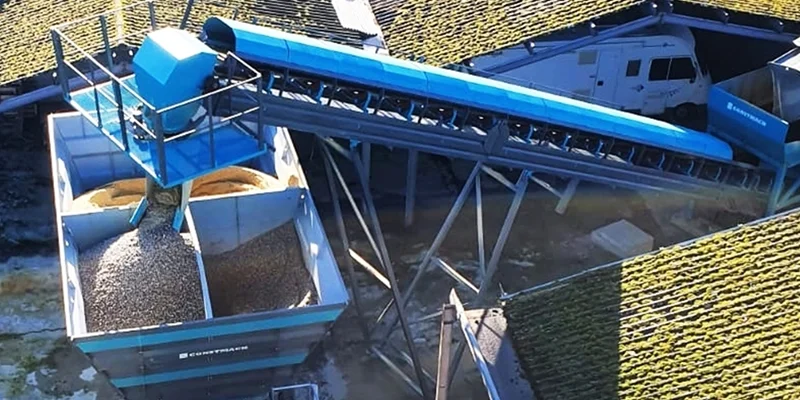
Fixed plants usually need a built loading ramp so a loader can charge the aggregate bins. That ramp is itself a civil-work item. The Constmach Prefeeding Conveyor removes it by transferring aggregate to the plant at ground level, so a wheel loader can feed the plant directly without an earth ramp. On a mobile setup, this keeps site preparation to a minimum and saves both time and cost at every new location.
Transport and Relocation
Mobile concrete plants are designed to move. The single-trailer models tow as one unit, the Mobicom plants travel as a road-legal load, and the whole range is built to be folded down, transported and set up again without rebuilding. For a contractor moving between projects, one plant can serve site after site, which spreads the investment across far more work than a fixed plant tied to a single location.
Production Capacity and Output
The mobile range covers 30 to 120 m³/h. As with any plant, the rated figure assumes ideal conditions, while real output depends on truck cycle times, the mix and how smoothly the site runs. Size the plant to your peak hourly demand with some margin so it keeps up on the busiest pours, and remember that a mobile concrete batching plant is meant to balance output against transportability rather than chase the very highest capacity.
The Economics of Owning a Mobile Concrete Plant
A mobile concrete batching plant changes the cost picture of concrete supply. Building and later dismantling a fixed plant for each project carries real expense in foundations, civil works and time. A mobile concrete plant avoids most of that, and because one unit can move from site to site, the purchase is spread across far more work than a plant tied to a single location.
For contractors who would otherwise buy ready-mix at a premium on remote sites, producing concrete on site can pay back quickly. The integrated design adds to the saving: built-in silos and the Prefeeding Conveyor cut the labour and groundwork needed at every new setup. When you compare a mobile concrete batching plant against repeated ready-mix purchase or a series of temporary fixed plants, count the full cost of setup, transport and supply over the life of the equipment, not just the purchase price.
Where Mobile Concrete Plants Are Used
Mobile concrete plants suit any job where supply has to follow the work. Road, bridge and pipeline projects move along their route and benefit from a plant that moves with them. Remote or rural sites, where buying ready-mix concrete is slow or expensive, gain reliable on-site supply. Short and medium-term contracts avoid the cost of a permanent installation, and rental and contracting fleets value a plant they can redeploy as projects come and go.
Site Requirements
The site needs are modest. A level, compacted area able to bear the plant load is enough for the base; no deep foundation is required. The plant runs on a three-phase industrial supply sized to the model, and it needs a clean water source for batching and washdown. Constmach provides the exact load, power and utility figures for the chosen model so the site can be ready when the plant arrives.
Common Mistakes to Avoid When Choosing a Mobile Concrete Batching Plant
A few errors come up again and again. The first is sizing for average demand rather than peak, which leaves the plant struggling on the busiest days; size for the peak with margin. The second is underestimating cement storage. A silo too small for the pour rate forces stops that can show up as cold joints, so match the silo to how fast you place concrete.
The third is ignoring how often the plant will actually move. A contractor who relocates monthly is better served by the ultra-compact Mobicom range than by a larger plant that is slower to transport. The fourth is treating site preparation as an afterthought; even a mobile concrete plant needs firm, level ground and the right power and water, and planning these early prevents delays at the start of a job.
How to Choose the Right Mobile Concrete Batching Plant
Three questions usually settle the choice:
- How much concrete, at peak? Match the output to your busiest demand, not the average. Mobile 30 to 120 covers most needs.
- How often will it move? If you relocate frequently or work with tight access, the ultra-compact Mobicom range transports with the least effort. If you move less and want higher output, the classical Mobile models fit better.
- What site work do you want to avoid? Built-in silos and the Prefeeding Conveyor cut on-site preparation, which is worth the most when you set up often.
Settling these at the order stage gives you a plant that matches how you actually work, rather than one that looks right only on paper.