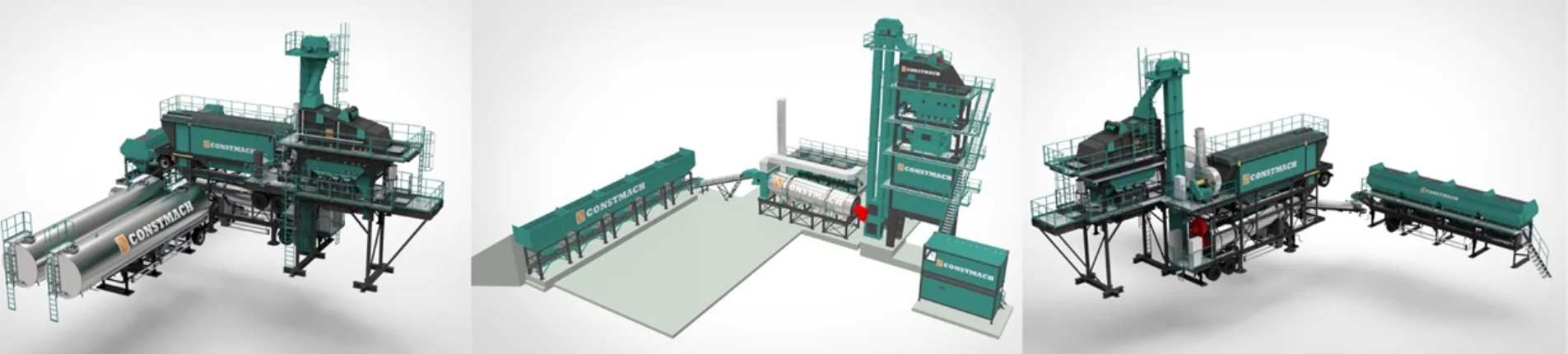
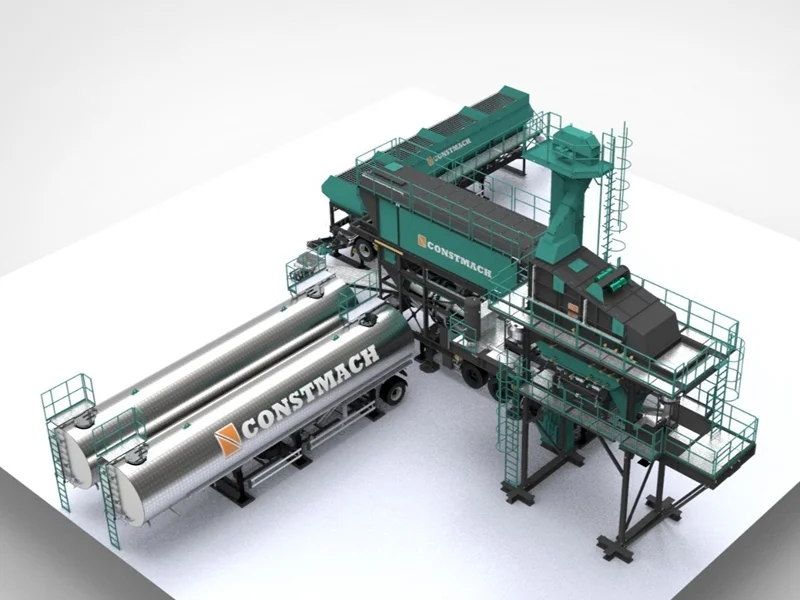
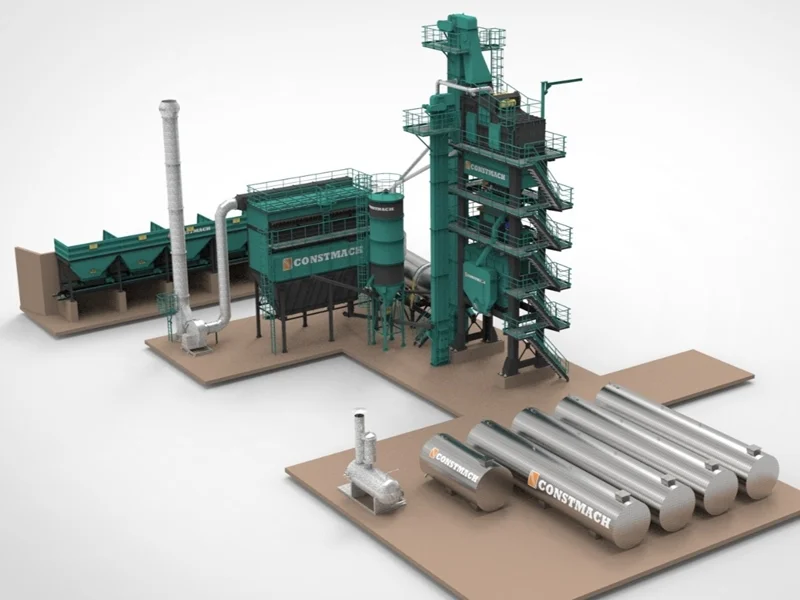
A Constmach asphalt plant is a batch-type, tower hot-mix plant that produces hot-mix asphalt in discrete, precisely weighed batches rather than a continuous stream. Cold aggregate is dried in a rotary drum, re-graded over a screen into hot bins, then aggregate, mineral filler and hot bitumen are weighed to the recipe and blended in a twin-shaft pugmill mixer. The plant is built in mobile and stationary versions, and every unit is configured to the tonnage, the mixes and the local aggregate of the project it will serve.
What a batch-type asphalt plant is
The term batch-type describes how the asphalt is produced. Instead of running material through in one steady flow, the plant makes asphalt one batch at a time. Each batch is assembled from individually weighed quantities of aggregate fractions, mineral filler and hot bitumen, mixed together, then discharged before the next batch begins.
This matters because it gives you direct control over every batch. The plant weighs each ingredient against the mix design before it goes into the mixer, so the recipe is verified on every cycle rather than estimated from flow rates. For road authorities and contractors who must meet a tight specification, that batch-by-batch accuracy is the reason batch plants remain the standard for quality hot-mix.
The layout is a tower because the process is largely gravity-fed once material is lifted. The hot elevator raises dried aggregate to the top, and from there it falls through the screen, hot bins, weigh hoppers and mixer in sequence. That vertical arrangement keeps the footprint compact and the transfers short, which is one reason the same tower concept works whether the plant is a relocatable mobile unit or a fixed installation.
How the process works, stage by stage
Production starts at the cold side and finishes at the discharge point. Cold aggregate of different sizes is held in the cold-feed bins, each bin metering its fraction onto a feed conveyor. The blended cold feed travels to the rotary dryer drum, where a burner heats the aggregate and drives off moisture. Drying is critical. Bitumen will not coat wet stone properly, so moisture has to leave before mixing or the bond between binder and aggregate fails.
The hot elevator lifts the dried, heated aggregate to the top of the tower. There a vibrating screen re-grades the material into separate hot bins by size. This second screening corrects any variation in the cold feed and gives clean, sized fractions to draw from, which is what lets the weighing stage hit the recipe accurately.
From the hot bins, material is drawn into the weigh hoppers. Aggregate fractions, mineral filler and hot bitumen are each weighed separately to the mix recipe. The weighed ingredients drop into the twin-shaft pugmill mixer, which blends aggregate, filler and bitumen into a uniform asphalt. The finished mix is discharged to a waiting truck or sent to a storage silo to hold until trucks arrive. The storage silo decouples production from haulage, so the plant can keep cycling even when trucks are delayed.
The main components
Each Constmach asphalt plant is built from the same functional building blocks, sized and arranged to the project:
- Cold-feed bins - hold and meter the different cold aggregate sizes onto the feed conveyor.
- Dryer drum and burner - heat the aggregate and remove moisture before mixing.
- Hot elevator - lifts dried hot aggregate to the top of the tower.
- Vibrating screen - re-grades the dried aggregate into sized fractions.
- Hot bins - store the re-graded fractions ready for weighing.
- Weigh hoppers - weigh aggregate fractions, mineral filler and hot bitumen to the recipe.
- Twin-shaft pugmill mixer - blends the weighed ingredients into uniform asphalt.
- Bitumen storage and heating tanks - keep bitumen at working temperature.
- Mineral filler silo - stores and meters filler into the weigh system.
- Dust collection (baghouse or cyclone) - captures dust from the dryer and tower for emission control.
- PLC control room - runs recipes, sequencing and weighing from a central panel.
The batch process at a glance
| Stage | Equipment | What happens |
|---|
| 1. Cold feed | Cold-feed bins and feed conveyor | Cold aggregate sizes are metered onto the conveyor. |
| 2. Drying | Dryer drum and burner | Aggregate is heated and moisture is driven off. |
| 3. Elevation | Hot elevator | Dried hot aggregate is lifted to the top of the tower. |
| 4. Re-grading | Vibrating screen and hot bins | Aggregate is screened into sized fractions and stored. |
| 5. Weighing | Weigh hoppers | Aggregate, mineral filler and bitumen are each weighed to the recipe. |
| 6. Mixing | Twin-shaft pugmill mixer | Weighed ingredients are blended into uniform asphalt. |
| 7. Discharge | Truck or storage silo | Finished mix is loaded out or stored for later loading. |
Mobile versus stationary plants
Constmach builds the asphalt plant in two versions, and the choice is driven by the job rather than by preference. A mobile plant is built on modular, road-transportable chassis so it can be relocated quickly. That suits work that moves, such as highway sections, where the plant follows the project from one stretch to the next and is dismantled and re-erected with minimal civil work.
A stationary plant is a fixed, permanent installation. It is the choice where you need higher capacity and consistent long-term output from one site, supplying a region or a major continuous programme. The components and process are the same; what changes is the structure, the foundations and how easily the plant moves.
Choosing between the two
If your contract spans many kilometres of road and the work front advances, the mobile version saves haul distance and re-mobilisation time. If you are feeding a city, a quarry-tied operation or a long programme from a single yard, the stationary version gives you the permanence and volume to match. The modular plant trades a little ultimate capacity for speed of relocation; the fixed plant trades mobility for the heavier structure and foundations that sustain high output year after year.
Why a batch plant rather than continuous production
Batch production verifies the recipe on every cycle. Because each ingredient is weighed before mixing, you have a record and a check for each batch, and you can switch mix designs between batches without flushing a continuous line. That flexibility is useful when a single site produces several mixes for different layers in a day.
The trade-off is that batching is a cyclic process with discrete steps, where a continuous plant runs in one flow. For specification road work, the weighing accuracy and recipe control of the batch tower are what justify the approach. A continuous drum can be cheaper to run at a single steady recipe, but it gives up the per-batch proof that paving contracts increasingly require.
Accurate weighing and recipe control
Quality in hot-mix comes down to three things: the right materials, the right temperature and the right proportions. The plant addresses proportions through separate weigh hoppers for the aggregate fractions, the mineral filler and the bitumen, each weighed to the mix design. Temperature is managed through the dryer and the heated bitumen tanks. The PLC control room ties these together, holding the recipes and sequencing the cycle so that each batch repeats the last.
The re-grading screen above the hot bins is part of quality too. By re-sizing the dried aggregate before weighing, it corrects feed variation so the fractions going onto the scales are clean and consistent. Without that step, a swing in the incoming cold feed would carry straight through to the finished mix.
Emission and dust control
Heating and handling dry aggregate generates dust, so dust collection is built in rather than added on. A baghouse or cyclone draws dust off the dryer and the tower, cleaning the air before it leaves the plant and, in many cases, returning collected fines to the process. For sites near towns or under strict environmental limits, the dust collection system is one of the first things to size correctly. An undersized filter shows up twice over: as visible emissions, and as a dryer that cannot draw properly and so loses drying capacity.
How the plant fits into an aggregate line
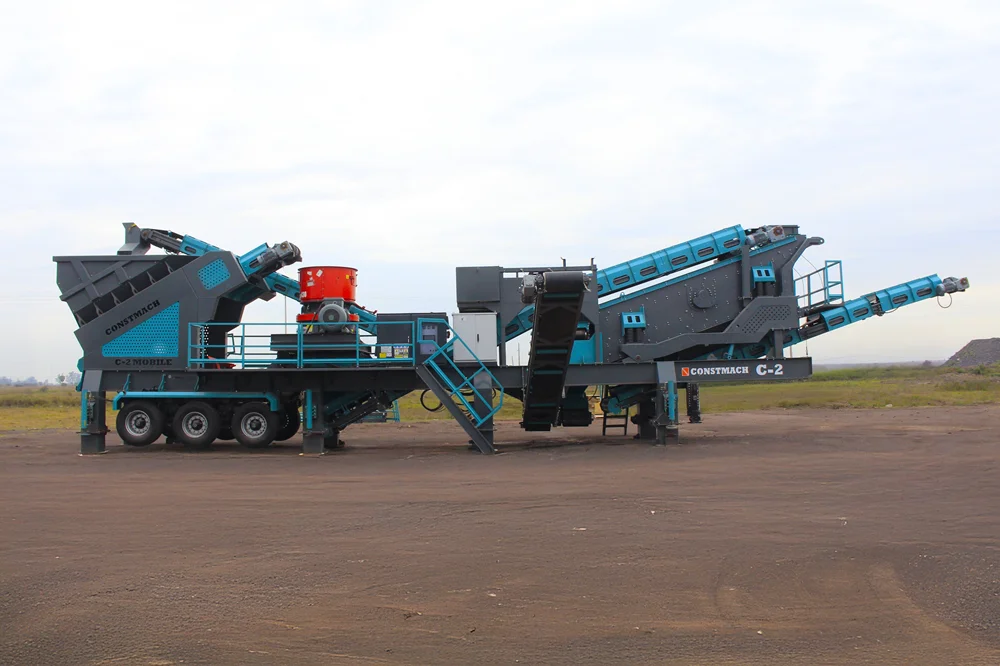
An asphalt plant does not produce its own stone. The sized aggregate it needs is supplied by a crushing and screening plant, which turns quarried rock into the clean, graded fractions the cold-feed bins are filled with. In practice the two sit together: the crushing and screening plant produces and stockpiles the aggregate sizes, and the asphalt plant draws from those stockpiles into its cold feed.
Because Constmach builds both, the aggregate side and the asphalt side can be specified to work together, with the gradations from the crushing plant matched to the mix designs the asphalt plant will run. That avoids the common problem of an asphalt plant starved of, or mismatched to, its feed. Where the rock is wet, dirty or marginal, a washing stage on the aggregate line can be added so the stone reaching the cold bins is clean enough for the surface mixes.
Capacity and sizing
Capacity is project-dependent and is configured to the job rather than sold as a single fixed number. The figures that drive sizing are your required output, the mixes you need to produce, the moisture in your aggregate and the hours you intend to run. Wetter aggregate, for example, demands more drying energy and can limit throughput, so the dryer and burner are matched to local material.
The honest approach is to start from the tonnage your contract or supply commitment requires, then size the dryer, mixer, bitumen storage and bin capacities around it with margin for the worst-case material. Constmach's application engineering exists for exactly this: translating a tonnage and a set of mixes into a correctly sized plant. A plant rated on dry stone in mild weather will disappoint the first time it meets a wet winter feed, so the sizing is done against the conditions the plant will actually face.
Materials and applications
The plant produces hot-mix asphalt, the bound material used for road bases, binder courses and surface courses, as well as for car parks, airfields, industrial yards and similar paved areas. The inputs are graded mineral aggregate, mineral filler and bitumen as the binder. The same crushed rock that ends up in concrete can serve here, but in an asphalt plant the stone is dried and coated with bitumen rather than bound wet with cement.
Different layers in a pavement use different mixes, with different aggregate gradations and binder contents. Because the batch plant weighs to a recipe, a single plant can produce the range of mixes a paving programme needs, switching designs between batches as the work moves from base to surface. A heavy, coarse base mix and a fine, polymer-modified wearing course can come off the same tower on the same day.
Build, wear and maintenance
The hardest-working parts of an asphalt plant are the ones in constant contact with hot, abrasive aggregate: the dryer drum lifting flights, the screen media, the hot elevator and the pugmill mixer tips and liners. These are wear items and are planned for, with replacement on a schedule rather than to failure.
Routine maintenance
Daily and weekly attention covers the burner, the bag filter elements, the bitumen heating and pumping, lubrication of the elevator and conveyors, and inspection of the mixer tips and liners. Keeping the baghouse healthy protects both emissions and the draught the dryer needs. Constmach supports plants through installation and commissioning, after-sales service and spare parts, so wear parts can be planned and held rather than chased after a breakdown. A short, predictable shutdown to swap a known wear part is always cheaper than an unplanned stop mid-shift.
Common mistakes to avoid
- Under-sizing for wet aggregate. Rating a plant on dry-stone throughput and then feeding it damp material leaves you short of capacity. Size the dryer to the real moisture.
- Neglecting the dust collection. An under-specified baghouse or cyclone costs you in emissions and in dryer performance. Treat it as core, not optional.
- Ignoring the feed. An asphalt plant is only as good as the aggregate it gets. Match it to the crushing and screening plant that supplies it.
- Skipping bitumen storage and heating. Too little heated storage interrupts production; plan tank capacity around supply intervals and consumption.
- Choosing mobile or stationary by habit. Let the project length and required volume decide, not what was bought last time.
How to choose your plant
Begin with the work. A moving road programme of many kilometres points to a mobile plant that follows the front; a fixed, high-volume supply from one yard points to a stationary plant. Then fix the required tonnage, the mixes you must produce, and the moisture of your local aggregate, because those set the dryer, mixer and storage sizing. Confirm how the aggregate will be supplied, ideally from a matched crushing and screening plant, and size the bitumen storage and dust collection to your site and its limits.
From there the detail is engineering: matching bin and silo capacities, burner rating and control to the duty. Constmach's role is to take the tonnage, the mixes and the site and configure a plant that meets them, supported through installation, commissioning and after-sales. The right plant is the one sized to your material and your programme, not the largest brochure number.