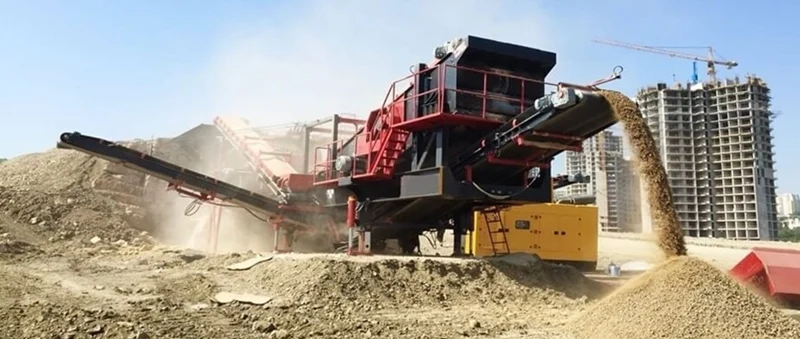
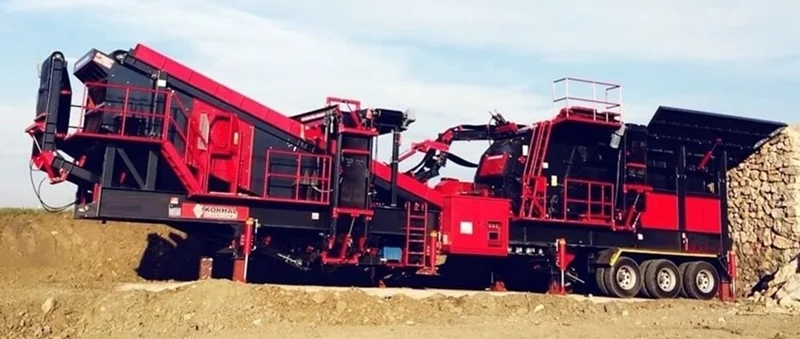
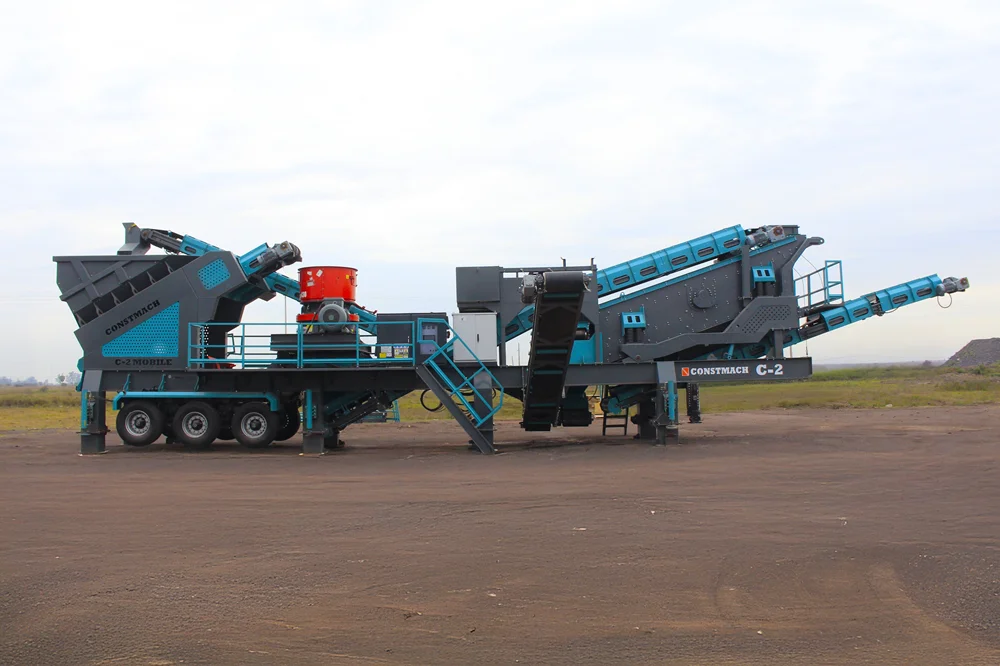
Constmach mobile limestone crushers are wheel-mounted primary impact crushing and screening plants built for limestone and other low-abrasion, medium-hardness stone. The primary impact crusher delivers a high reduction ratio and a cubical product, so on soft limestone you can often reach finished aggregate in fewer stages than hard rock would need. Two models, the PI-1 and the PI-2, cover 150 to 300 t/h.
What a Mobile Limestone Crusher Is
A mobile limestone crusher in the Constmach PI series is a complete primary crushing and screening line mounted on a wheeled chassis. Feed material drops into a primary impact crusher, the broken stone passes onto an integrated screen, and sized aggregate comes off the discharge conveyors. The whole unit travels as one and sets up on hydraulic legs, so it can be moved between limestone quarries and job sites without rebuilding the plant each time.
The "PI" in the model names stands for primary impact. That choice of crusher type is deliberate and matters for limestone, which we explain further below. These plants are sized for limestone and similar stone: low in abrasion, medium in hardness. They are not built for hard, abrasive rock such as granite or basalt, where a jaw-based hard stone plant is the correct tool.
How a Primary Impact Crusher Breaks Limestone
Inside the crusher, a heavy rotor spins fast and throws the feed against fixed breaker plates using manganese blow bars fitted to the rotor. The stone fractures along its natural planes on impact rather than being squeezed between two surfaces, which is how a jaw or cone crusher works. Limestone responds well to this because it is relatively soft and breaks cleanly.
Impact breaking gives two things that matter to an aggregate producer. First, a high reduction ratio: a large feed lump comes out much smaller in a single pass, so you need fewer crushing stages overall. Second, a cubical product shape, which is what concrete and asphalt mixes want. Flaky, elongated particles are the enemy of a good mix design, and impact crushing produces far fewer of them than other primary methods.
There is a second mechanism at work as well. As stone leaves the blow bars it strikes the breaker plates, rebounds, and is struck again before it drops out the bottom. That repeated impact inside one chamber is what lets a single machine do work that a squeezing crusher would split across two stages. The faster the rotor turns and the tighter the breaker plate is set, the finer the product; open the gap and slow the rotor and the product runs coarser. Those two adjustments are the main levers an operator has over gradation without changing the screen.
Why Impact and Not Jaw for Limestone
The reason comes down to wear and product quality. A jaw crusher squeezes rock and is the right answer for hard, abrasive material because it has a low wear rate on tough stone. But on limestone, a jaw under-uses the material's natural breakability and tends to give a coarser, less cubical product that needs more downstream crushing.
An impact crusher would chew through wear parts quickly on hard abrasive rock, which is why nobody runs one there. Limestone is different. Its low abrasion means manganese blow bars and breaker plates last a reasonable service life, so the impact route is both practical and economical. You get the high reduction ratio and the cubical shape, and the wear cost stays sensible. That trade-off is the whole logic behind the PI series.
The Constmach PI Series Range
Two models cover the common limestone duties. The PI-1 is the standard primary impact plant for small to mid-size quarries and contractors. The PI-2 is the larger unit for higher tonnage and bigger feed. Both are wheel-mounted with hydraulic legs and carry an integrated screen, so the difference between them is throughput and feed opening, not configuration.
| Model | Crusher type | Capacity | Maximum feed size | Typical use |
|---|
| PI-1 | Primary impact | 150-200 t/h | 900 x 900 mm | Small to mid-size limestone quarries and contract crushing |
| PI-2 | Larger primary impact | 250-300 t/h | ~1,300 x 1,300 mm | Higher-tonnage limestone production and larger feed lumps |
Pick the model by your required tonnage and, just as important, by the size of the largest stone your quarry produces. A feed lump that exceeds the crusher opening will bridge and stall the plant, so the maximum feed size figures above are a hard constraint, not a guideline.
Wheel-Mounted Mobility and Setup
Both models sit on a wheeled chassis and deploy on hydraulic legs. That means the plant can be towed between sites and quarry faces, levelled on its legs, and brought into production without civil foundations or a long build. For an operator working several limestone deposits, or a contractor moving from job to job, that relocation speed is the core advantage over a fixed installation.
The integrated screen is part of the same machine, so feed, crushing and sizing all travel together. There is no separate screening unit to transport, position and connect, which keeps the moving and commissioning effort low. In practice a move means towing the plant to the new face, lowering and levelling the hydraulic legs on a prepared pad, reconnecting the discharge conveyors, and feeding. There is no foundation to pour and cure, so a relocation that would take weeks with a stationary plant can be measured in days.
Build and Wear Parts
The parts that take the punishment are the manganese blow bars on the rotor and the breaker plates they throw stone against. These are consumables: they wear with use and are replaced on a schedule. Because limestone is low in abrasion, blow-bar life is reasonable, which is exactly the condition that makes the impact crusher viable here.
Blow bars can usually be rotated to use both faces before replacement, which stretches the working life of each set. Keeping the rotor balanced and the breaker plate gaps set correctly protects product shape and keeps the crusher running smoothly. Constmach manufactures its plants in-house and supplies spare wear parts directly, so replacement blow bars and breaker plates come from the people who built the machine.
Manganese is chosen for the blow bars because it work-hardens. The surface toughens under the repeated hammering of the feed, so the bar holds its edge longer than a plain steel casting would. Higher-manganese grades suit heavier, coarser feed; a moderate grade is usually enough for clean limestone. The breaker plates wear in sympathy with the bars, and replacing or reversing both together keeps the crushing geometry even, which is what holds product shape steady across the life of a set.
Product Sizes and the Integrated Screen
The integrated screen separates the crushed stone into finished fractions and returns anything still oversize. On soft limestone, the high reduction ratio of the primary impact crusher often means you can produce a saleable aggregate without a second crushing stage, where a hard rock plant would need a secondary crusher to hit the same sizes. That is a real saving in equipment, power and fuel per tonne.
The exact cut points depend on the screen media fitted. Mesh and panel sizes are matched to the products you sell, whether that is a single road-base grading or several concrete and asphalt fractions off one pass. Oversize that does not pass the top deck is returned for re-crushing rather than wasted, so the closed loop between crusher and screen is what lets one machine deliver finished sizes. If you change the products you sell, you change the screen media, not the plant.
Capacity and Sizing
Rated throughput is 150-200 t/h on the PI-1 and 250-300 t/h on the PI-2. Treat those as design figures for well-fed, in-spec limestone. Real output depends on feed gradation, how much fine material is already in the feed, the product sizes you are screening to, and how steadily the plant is charged. A feeder that surges or starves will pull average tonnage below the rated band.
Size the plant against both your tonnage target and your largest feed lump. If your quarry routinely produces stone close to or above the PI-1 opening, the PI-2's larger feed size may be the deciding factor even if your tonnage would fit the smaller machine. It is also worth leaving headroom: buying a plant that only just meets today's tonnage means running flat out with no margin for a busy month or a coarser-than-usual feed, and a plant run constantly at its ceiling wears faster than one with a little room to spare.
Materials and Applications
These plants are built for limestone and other low-abrasion, medium-hardness stone. The cubical product they make is well suited to the markets that buy crushed aggregate:
- Aggregate for concrete, where particle shape affects workability and strength
- Aggregate for asphalt, where cubical chips improve the mix
- Road base and sub-base material for construction
What they are not for is hard, abrasive rock. Running granite, basalt or similar through an impact crusher destroys wear parts fast and makes no economic sense. For that material the right answer is a jaw-based hard stone plant, and Constmach can advise on the correct line for your deposit.
Fitting the Plant into a Line
For many limestone operations the mobile primary impact plant is the whole line: feed in, crush, screen, stockpile finished product. Because the unit already integrates crushing and screening, a single machine often does what would otherwise take several stationary units plus connecting conveyors.
Where you need more separated products or higher tonnage, the plant feeds downstream conveyors and stockpiles cleanly, and additional screening or washing can be added behind it. The relocatable format also lets you stage production: move the plant to the active face rather than hauling raw stone across the quarry to a fixed crusher. Where the finished aggregate has to meet a tight cleanliness spec, a washing stage downstream takes the dust and clay off the product; the crusher and screen do the sizing, and the wash does the cleaning, each kept to the job it does best.
Operating Cost on Soft Limestone
The cost case for the PI series rests on three numbers that move together. Fewer crushing stages means less installed power, so the energy drawn per tonne is lower than a multi-stage hard rock line pulls for the same product. Low abrasion means wear parts last, so the spend on blow bars and breaker plates per thousand tonnes stays modest. And one integrated machine instead of several separate stations means fewer drives to power, fewer transfer points to maintain, and one plant to move rather than a yard full of equipment.
None of that is automatic. A plant fed unevenly, run with worn-out bars, or pushed past its feed-size limit will burn money on all three counts. The economics are good when the plant is matched to the stone and run within spec, which is why model selection and basic operating discipline matter as much as the published capacity figures.
Maintenance Routine
Day-to-day maintenance centres on the wear parts and the screen. Check blow bars and breaker plates for wear at sensible intervals, rotate or replace blow bars before they wear past their usable face, and reset the breaker plate gap after changes so product shape stays consistent.
- Inspect blow bars and breaker plates on a regular schedule and act before wear runs out
- Keep the rotor balanced and clear of build-up
- Check screen media and conveyor belts for wear and tracking
- Service the hydraulics that drive the legs and any adjustment functions
- Keep feed in spec; oversize lumps and tramp metal damage the crusher
A short, disciplined daily check costs far less than the unplanned downtime a missed blow-bar change causes. It helps to keep a simple log of hours run against each set of blow bars, because once you know roughly how many tonnes a set lasts on your stone you can order and change parts on a plan rather than waiting for product shape to drift and tell you the bars are gone.
Common Mistakes to Avoid
The most expensive mistake is choosing an impact plant for the wrong material. If your rock is hard and abrasive, the impact crusher is not the machine, no matter how attractive the cubical product looks; the wear bill will tell the real story. Match the crusher to the stone.
Other recurring errors: feeding lumps larger than the crusher opening, which bridges and stalls the plant; running the feeder unevenly, which drags down average tonnage; and letting blow bars wear past their face, which hurts both product shape and rotor balance. None of these is complicated to avoid once the operator knows what to watch.
One more worth naming is neglecting tramp metal. A loader bucket tooth or a length of drill steel in the feed can crack a blow bar or a breaker plate in a single pass, and the damage is sudden rather than gradual. A magnet over the feed conveyor and a habit of watching what goes into the hopper pay for themselves the first time they catch something.
How to Choose Your Model
Start with your material. Confirm it is limestone or comparable low-abrasion, medium-hardness stone; if it is hard and abrasive, you need a different plant. Then take your two hard numbers: the tonnage you need per hour and the largest feed lump your quarry produces. The PI-1 covers 150-200 t/h with a 900 x 900 mm opening; the PI-2 covers 250-300 t/h with roughly a 1,300 x 1,300 mm opening.
If both your tonnage and your feed size fit inside the PI-1, that is the economical choice. If either pushes past it, step up to the PI-2. From there, the products you intend to sell set the screen media. Constmach's application engineers can match a model and screen configuration to your deposit, and with in-house manufacturing, export experience across more than 85 countries, installation and commissioning, and direct after-sales and spare-part supply, the support behind the plant matters as much as the model number you pick.