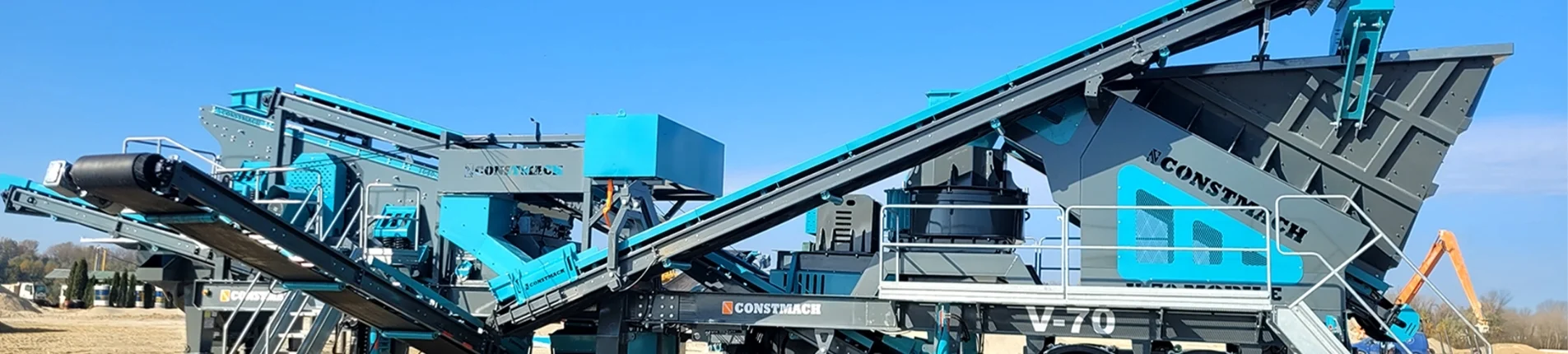
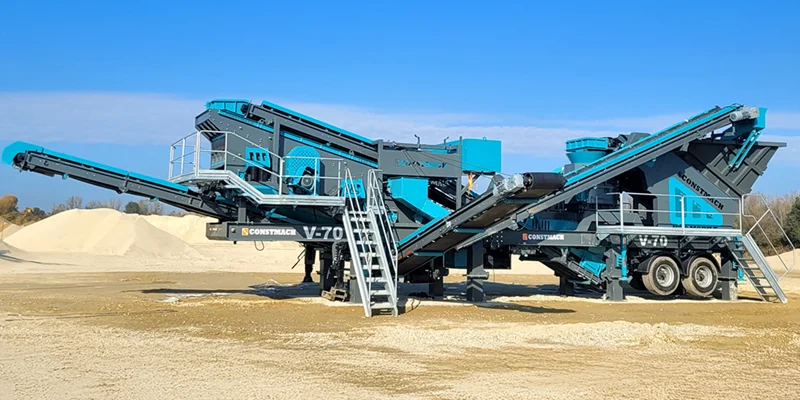
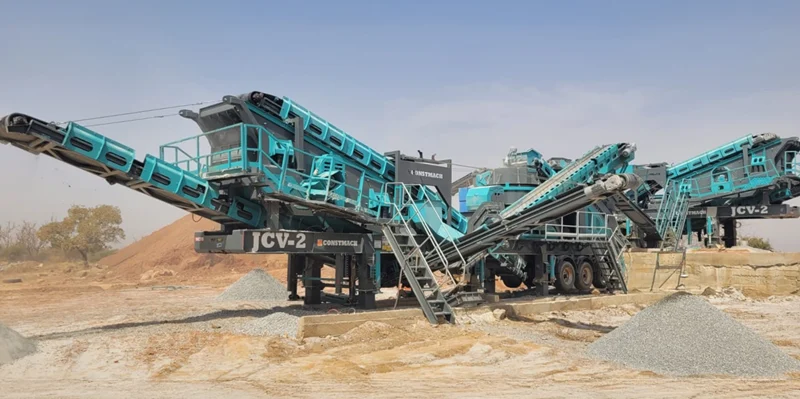
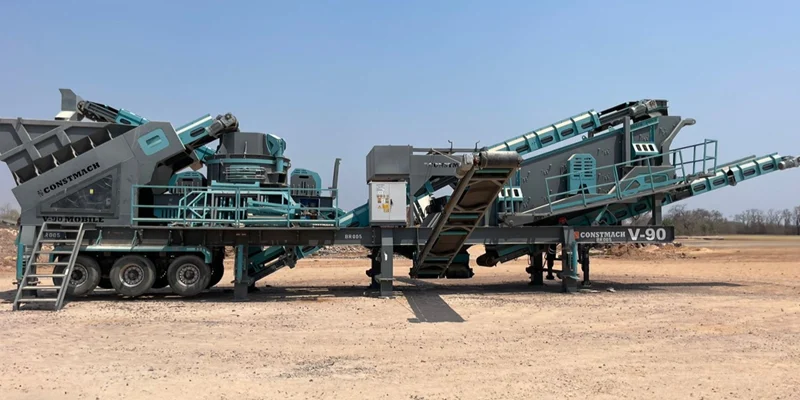
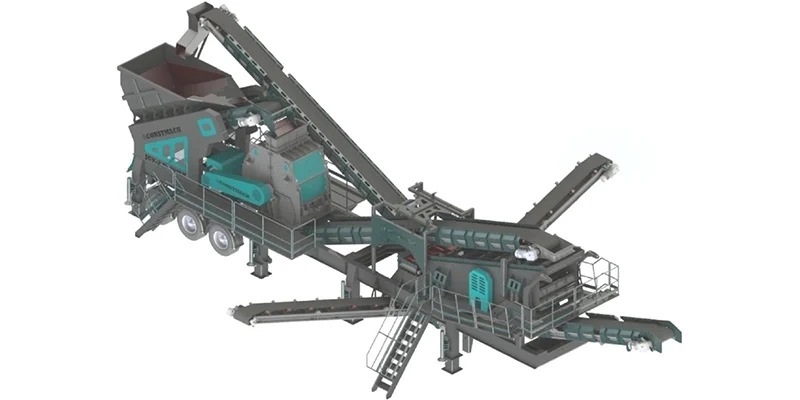
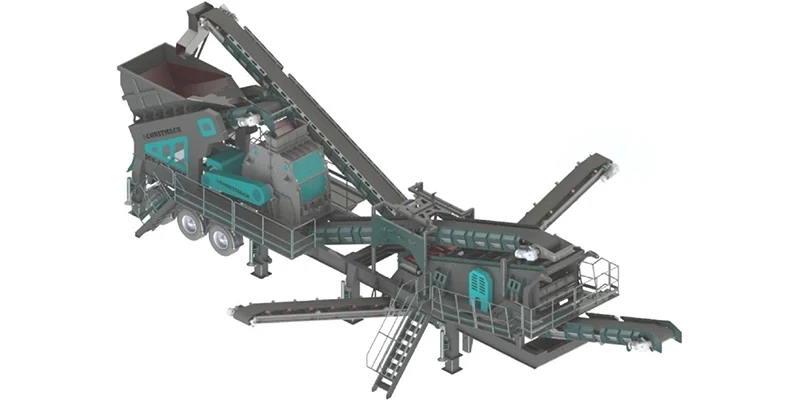
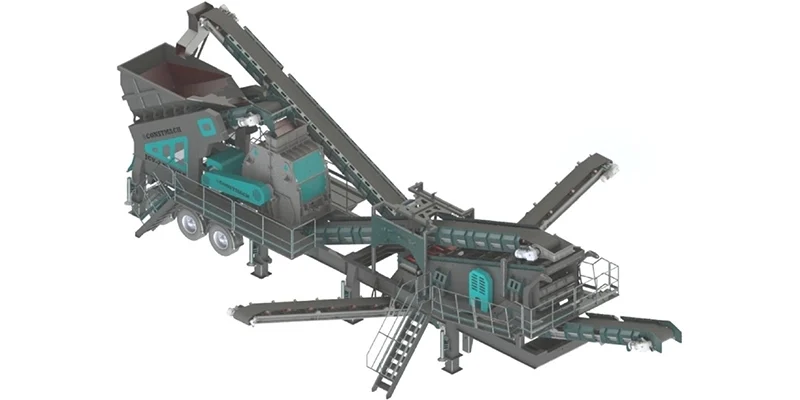
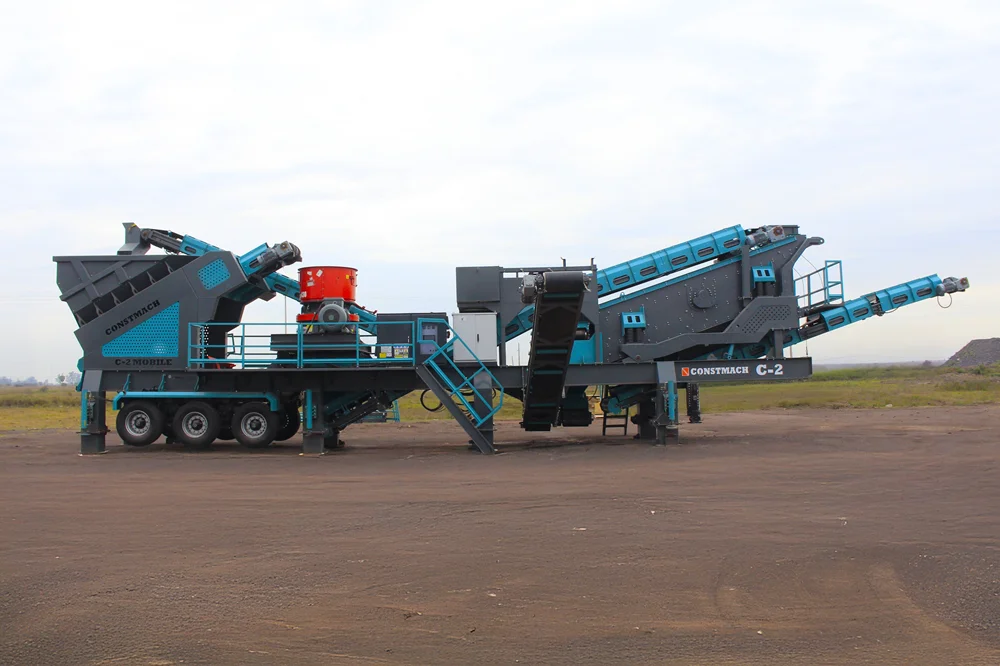
A Constmach mobile sand making plant turns crushed aggregate into manufactured sand on a single wheeled chassis, combining a sand-shaping crusher with an on-board three-deck screen. Two families cover the work: the V series, built around a VSI vertical shaft impact crusher, and the T series, built around a tertiary impact crusher. Both are fed by an upstream primary and secondary line, and both deliver a graded, saleable sand product without the civil works a fixed plant demands.
What a mobile sand making plant actually does
Natural sand is running short in many regions, and what remains is often poorly graded or expensive to haul. A sand making plant answers that by producing manufactured sand from hard rock or quarry feed. The machine takes a controlled-size feed, reduces and reshapes it into a fine, well-graded product, then screens the result so the saleable sand fractions are separated from oversize and any coarse return. The output is a consistent product you can sell into concrete and asphalt instead of chasing dwindling river sand.
The mobile version puts the crusher, screen, conveyors and drive on one relocatable chassis. You can move it between quarry faces, follow a project, or rent it out to several sites without pouring permanent foundations each time. The trade-off against a fixed installation is a tighter footprint and a set layout, which Constmach manages by matching the right series and model to your feed and tonnage. For operators who change sites or want to redeploy capital equipment, that mobility is the whole point.
V series and T series: two ways to make sand
The choice between the two series comes down to one question: how big is the feed reaching the sand maker, and how cubical does the final product need to be. The V series uses a VSI crusher, which throws material against rock or a steel anvil at high speed. That action gives the most cubical particle shape and the best control of fines, which is exactly what concrete and asphalt mixes want. Because the VSI is a shaping machine, it takes a smaller maximum feed.
The T series uses a tertiary impact crusher. It accepts a much larger feed, up to 150 mm, so it can both reduce and shape in one pass. That makes the T series a good fit where the upstream line delivers coarser material, or where you want fewer stages ahead of the sand maker. Both series carry a three-deck screen on the chassis to cut the product into the fractions you sell. The series names track the crusher inside: V for the VSI, T for the tertiary impact.
How the process flows through the chassis
Feed enters the on-board crusher, which reduces and reshapes the rock into sand-sized particles. The discharge climbs to the three-deck screen, where it is split into separate fractions. Saleable sand and the fine aggregate sizes come off as product; oversize is returned for further crushing, either within the plant cycle or back to the upstream line. The result is a graded manufactured sand ready for concrete and asphalt production.
- Pre-sized feed from the primary and secondary line is delivered to the plant.
- The VSI or tertiary impact crusher reduces and shapes the material into sand.
- The three-deck screen separates the crushed flow into distinct size fractions.
- Oversize is returned for recrushing; the finished sand fractions are stockpiled.
That closed flow matters because sand making is a recirculating job. Not every grain reaches the target size on the first pass, so a steady oversize return keeps the crusher fed at the right rate and protects the grading of the finished product. A plant that returns oversize cleanly will hold its spec far better than one that lets coarse material slip through to the stockpile.
The Constmach mobile sand making plant range
Two series, six models. The V series numbers reflect the VSI crusher fitted; the T series numbers track the tertiary impact crusher and its screen. Capacities below are the plant throughputs given for each model, with the maximum feed size that the on-board crusher will accept.
| Model | Series / crusher | Capacity (t/h) | Max feed (mm) | Installed power |
|---|
| V-70 | V series, VSI-700-CR | 100-150 | 35 | - |
| V-80 | V series, VSI-800-CR | 150-200 | 40 | 390 kW total |
| V-90 | V series, VSI-900-CR | 200-250 | 45 | 440 kW total |
| T-75 | T series, tertiary impact | 60-80 | 150 | - |
| T-100 | T series, tertiary impact | 80-135 | 150 | 220 kW total |
| T-120 | T series, tertiary impact | 120-170 | 150 | 270 kW total |
Note the pattern in the V series feed sizes: 35 mm on the V-70, 40 mm on the V-80, 45 mm on the V-90. The maximum feed stays small because a VSI is shaping pre-reduced material, not breaking large rock. The T series accepts 150 mm because the tertiary impact crusher does more of the reduction itself. Reading the table from the throughput column, the V-70 and T-100 overlap in the middle of the range, so the deciding factor between them is usually feed size and product shape rather than tonnes per hour alone.
Why a VSI gives the best sand
A vertical shaft impact crusher accelerates feed in a rotor and throws it outward, so particles break along natural fracture lines and the corners knock off. That produces a cubical grain with a clean, consistent shape. For manufactured sand, shape matters because cubical particles pack better, need less water and cement in concrete, and improve workability. The V series exists for buyers who want that premium product quality.
The cost of that quality is feed size. A VSI works best on material already reduced to 45 mm or below, which is why the V series sits at the end of a primary and secondary line. If your upstream stages cannot deliver that consistently, the T series is the more forgiving choice. A VSI also lets you trade throughput for shape by adjusting rotor speed: run it harder and you get more fines and a rounder grain, ease off and you protect tonnage. That control is part of why the V series suits operators selling into demanding mixes.
Why the tertiary impact route suits coarser feed
A tertiary impact crusher uses hammers on a rotor and impact aprons to break and shape rock. It tolerates a 150 mm feed, so it carries more of the size-reduction load and can run with a shorter upstream line. The T series both reduces and makes sand, which is useful where the feed is variable, where space for extra crushing stages is limited, or where the product spec is less demanding than a top-grade concrete sand.
You give up a little particle-shape perfection compared with a VSI, but you gain flexibility on what you can feed and how you stage the plant. For many quarries that balance is exactly right. The tertiary impact crusher also handles softer and mid-hardness rock well, where a VSI's wear economics can get expensive, so the T series often wins on running cost for limestone and similar feeds.
What makes a good manufactured sand
Manufactured sand is judged on grading, particle shape and fines content, and a sand plant is really a tool for controlling those three things. Grading is the spread of particle sizes; a well-graded sand packs tightly and needs less paste to fill the gaps. Shape decides how the grains slide past each other in a fresh mix, which drives workability and water demand. Fines, the material below about 75 microns, are useful up to a point because they fill voids, but too many fines drive up water demand and can weaken the result.
The three-deck screen and the crusher work together to hit those targets. The crusher sets the shape and produces the fines; the screen sets the grading by cutting the flow at chosen sizes. Change a mesh and you shift the product; adjust the crusher and you shift the shape and fines balance. That is why two sites running the same model can sell quite different sands. Understanding which knob to turn is the difference between fighting your grading and dialling it in.
Dry plant operation and moisture
A mobile sand making plant is a dry, crushing-and-screening unit: it shapes and grades sand but does not wash it. Feed moisture still matters. Damp feed blinds screen meshes, so apertures clog and the cut drifts coarse, and very wet material can pack in chutes and transfer points. Most operators run the sand plant on reasonably dry feed and, where the market demands low fines or a washed product, add a separate sand washing stage downstream.
If your specification calls for washed sand with controlled fines, plan the wash plant as a distinct stage rather than expecting the sand maker to do it. The sand plant gets the grading and shape right; a downstream washer removes excess fines and clay. Keeping those jobs separate keeps each machine doing what it does well and makes troubleshooting far simpler when a product slips out of spec.
Build, wear parts and the screen
Sand making is abrasive work, and wear is the running cost that matters. In the V series the high-wear items are the rotor tips, the wear plates and the anvil ring or rock shelf, depending on how the VSI is set to run. In the T series the blow bars and impact aprons take the punishment. Both wear in proportion to feed abrasiveness and tonnage, and both are designed as replaceable items rather than parts that condemn the machine.
The three-deck screen is the quality gate. Three decks let you cut the crushed flow into multiple fractions in one pass, so you can pull out a clean sand product and return oversize without a separate screening unit. Mesh selection on each deck sets your final grading, and it is one of the easiest things to change when your product spec moves. Keep the decks tensioned and clear, and the screen will hold your cut; let meshes slacken or peg, and the product drifts even when the crusher is running perfectly.
How it fits into a crushing and screening line
A sand making plant is a finishing stage, not a standalone operation. Ahead of it you need a primary crusher to break run-of-quarry rock and a secondary stage to bring the feed down to the size the sand maker accepts. The mobile sand plant then takes that pre-sized material and converts it into product.
Because the unit is wheeled, it can be positioned to receive feed by conveyor or loader and discharge to product stockpiles with short, simple material moves. Matching its capacity to the output of the upstream line is the key sizing decision; a sand maker starved of feed or flooded beyond its rated tonnage will not produce a stable product. The cleanest setups feed the sand plant from a surge stockpile, which buffers the upstream line and keeps the crusher choke-fed at a steady rate even when the front end pauses.
Capacity and sizing
Start from two numbers: the tonnes per hour of sand you need, and the maximum feed size your upstream line can guarantee. Within the V series, the V-70 covers 100-150 t/h, the V-80 covers 150-200 t/h, and the V-90 covers 200-250 t/h, with feed limits of 35, 40 and 45 mm respectively. Within the T series, the T-75 covers 60-80 t/h, the T-100 covers 80-135 t/h, and the T-120 covers 120-170 t/h, all accepting up to 150 mm.
Read the capacity figures as ranges, not fixed outputs. Actual tonnage depends on rock hardness, feed grading, moisture and the product cut you are targeting. Size for your normal duty with headroom for the hardest material you expect to run, and confirm the installed power your site can supply: 390 kW on the V-80, 440 kW on the V-90, 220 kW on the T-100 and 270 kW on the T-120. A plant sized only for the easy days will fall short the moment the rock gets hard or the spec tightens, so build the headroom in from the start.
Materials and applications
The core application is manufactured sand to replace or supplement scarce natural sand. That sand goes into concrete and asphalt, where consistent grading and good particle shape directly affect mix performance. Suitable feeds include hard rock such as basalt, granite, gabbro and quarried limestone, along with river gravel and other competent aggregate.
Where you need the most cubical, premium concrete sand, the VSI-based V series is the better answer. Where the feed is coarser or more variable and the spec allows a little more tolerance, the tertiary-impact T series does the job with less upstream staging. The same plant that supplies concrete sand can produce asphalt sand by changing the screen cut, so many operators run one mobile unit across several products by adjusting meshes and crusher settings rather than buying separate machines.
Transport, setup and relocation
The wheeled chassis is built to move on the road and set up quickly on site. Because the crusher, screen and conveyors travel as one integrated unit, on-site work is mainly positioning the plant, connecting power, and arranging feed and discharge, rather than assembling separate machines. That cuts the time between arrival and first production compared with erecting a stationary plant.
When you relocate, the same logic runs in reverse: fold or secure the conveyors, disconnect services, and tow the unit to the next position. The standing area does the heavy lifting here. A firm, level, well-drained pad that can carry the plant weight and take loader traffic is what keeps the chassis stable and the screen running true. Spend time getting the ground right and the plant rewards you with steady, accurate screening; skimp on it and you chase vibration and grading problems that have nothing to do with the machine.
Dust, noise and site practicalities
Making sand from dry rock generates dust, and managing it keeps both your workforce and your neighbours onside. Spray bars at transfer points and the crusher discharge knock down airborne fines, and enclosing the worst transfer points helps further. The same water that suppresses dust also adds moisture to the product, so there is a balance to strike between a clean site and a dry, screenable feed.
Noise and stockpile layout deserve a thought too. Position the plant so loaders have clear, short runs to the feed and from the product stockpiles, and keep the oversize return path tight to avoid double-handling. A well-laid-out site with short material moves does more for your cost per tonne than almost any single setting on the machine.
Maintenance and daily checks
Routine care keeps a sand plant producing to spec. Inspect the crusher wear parts on a schedule tied to tonnage, and replace them before they wear through to backing components. Keep the screen decks clear of pegging and blinding, check mesh tension and condition, and watch conveyor belts, idlers and chutes for wear at transfer points where abrasive sand concentrates.
- Check and rotate or replace crusher wear parts before they reach the backing.
- Clean and inspect all three screen decks; confirm mesh tension and condition.
- Monitor belts, idlers, bearings and drives for wear, heat and vibration.
- Keep feed grading and size within the plant's stated limits.
- Track wear-part consumption per tonne to forecast spares and cost.
Good records turn maintenance from guesswork into planning. Log wear-part life against tonnage and you can order spares before you run out, schedule changes during planned stops, and spot a feed change early when consumption jumps. That habit pays back many times over across a plant's life.
Common mistakes to avoid
The most frequent error is overfeeding the crusher above its maximum feed size, especially on the V series where 35 to 45 mm is a hard practical limit. Oversize feed wrecks shape control and accelerates wear. A second mistake is mismatching the sand plant to the upstream line, so it is either starved or overloaded. A third is running worn screen meshes, which lets oversize into the product and quietly fails your grading. Finally, ignoring wear-part replacement until performance drops costs more in lost product than the parts ever would.
How to choose between V series and T series
Pick the series first, then the model. Choose the V series when product quality is the priority, your upstream line reliably delivers feed at 45 mm or below, and you want the most cubical manufactured sand for concrete and asphalt. Choose the T series when feed is coarser or variable up to 150 mm, when you want fewer crushing stages ahead of the sand maker, or when the spec gives you a little more room.
Then size the model to your tonnes per hour and your available power, leaving headroom for hard rock and peak demand. With the series and model settled against real feed and output numbers, the plant will deliver a consistent manufactured sand for years, and the right choice up front is far cheaper than correcting an undersized or mismatched plant later.