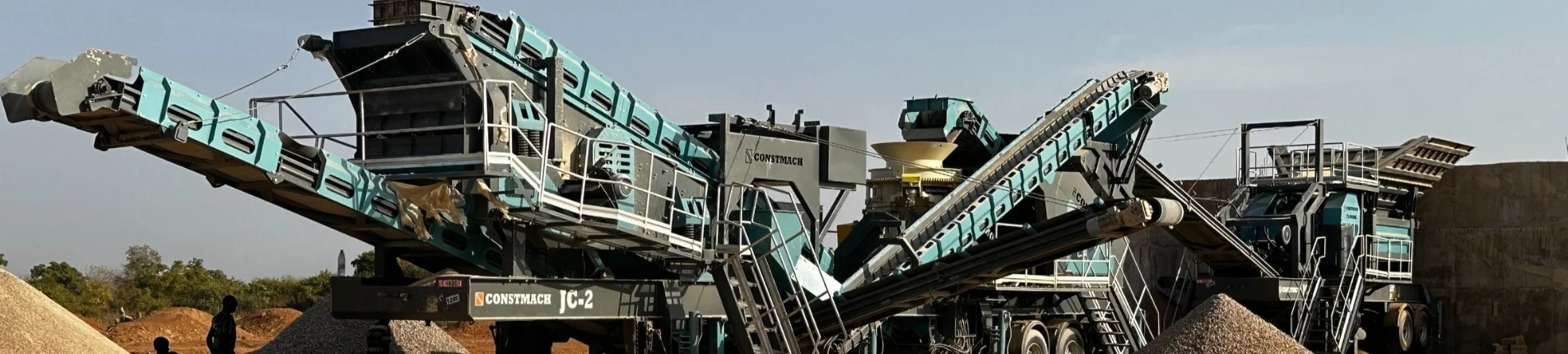
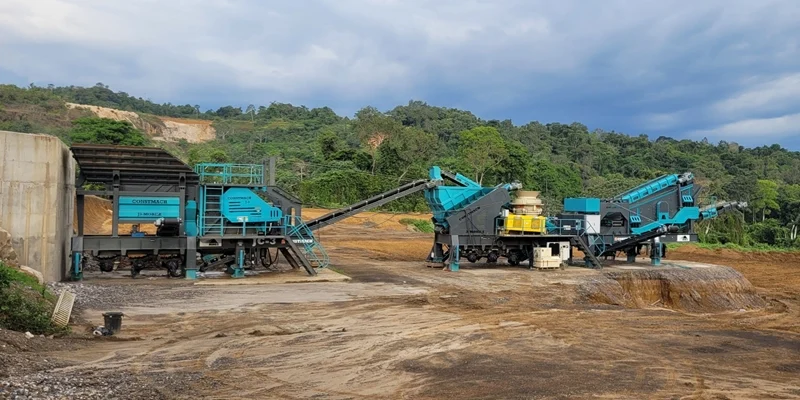
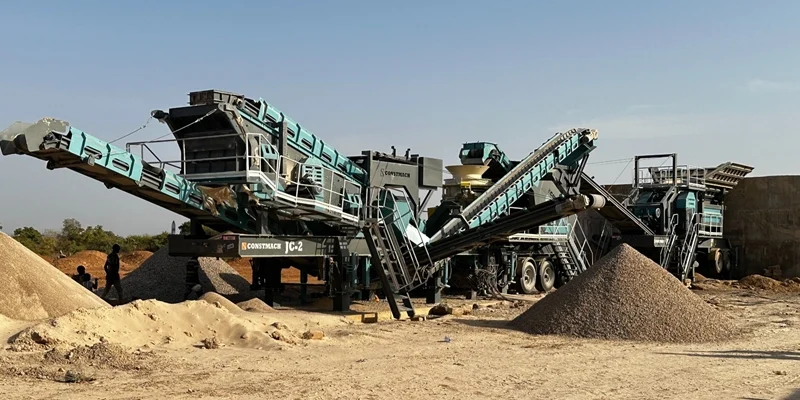
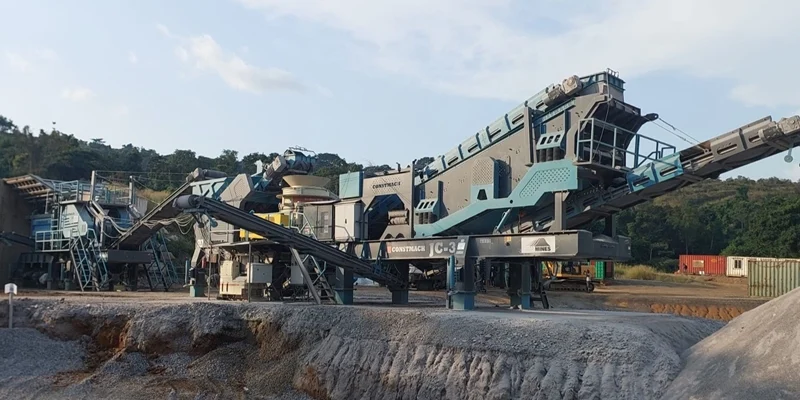
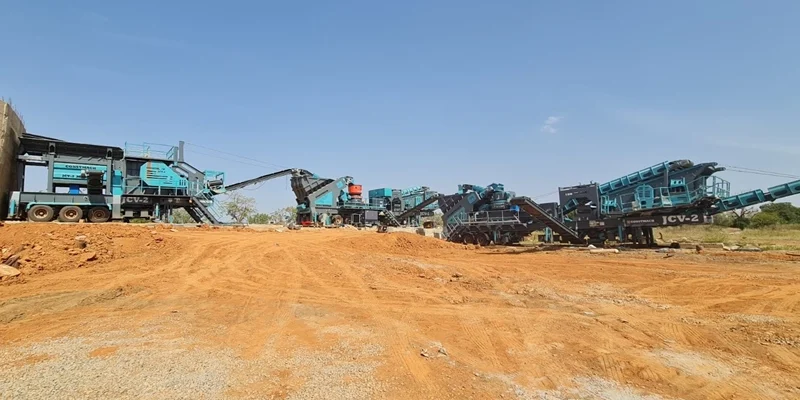
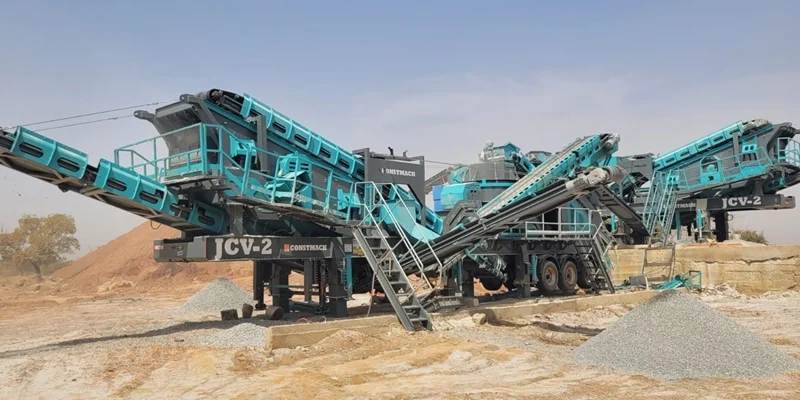
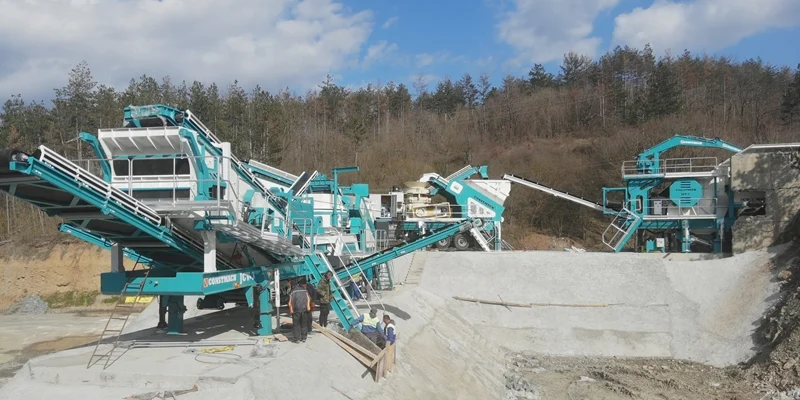
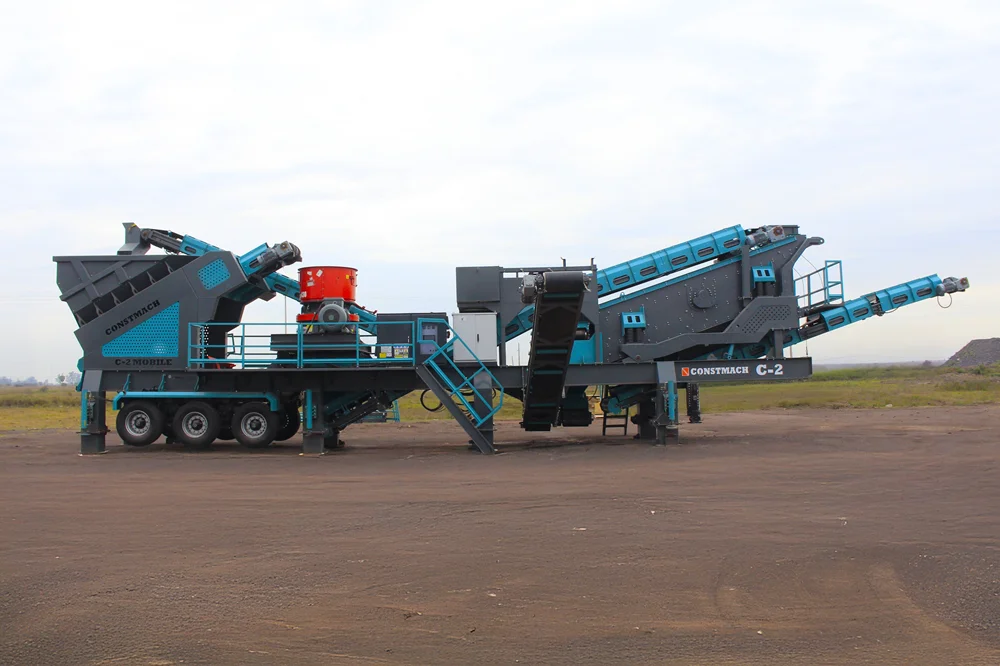
Constmach mobile hard stone crushers are relocatable, wheel-mounted crushing plants built specifically for hard, abrasive rock such as granite, basalt and hard river stone. They pair a primary jaw crusher with a secondary cone crusher in closed circuit; the JCV models add a VSI third stage for manufactured sand. Hydraulic support legs and a wheeled chassis mean fast setup and easy relocation between sites.
What a Mobile Hard Stone Crusher Is
A mobile hard stone crusher is a complete crushing line carried on a road-towable chassis instead of fixed on a concrete foundation. The whole plant, feeder, primary jaw, secondary cone, screens and conveyors, travels as one unit (or, in the JCV range, as a coordinated set of chassis) and is levelled on hydraulic legs at the new site.
The "hard stone" designation is not marketing. The machine selection inside these plants is chosen for rock that is both hard and abrasive. That single requirement drives almost every engineering decision in the range, from the crushing principle at each stage to the wear parts you will order over the plant's life. Get that selection wrong and the plant still crushes, but it costs far more to run; get it right and the running cost stays predictable for years.
Why Jaw Plus Cone for Hard, Abrasive Rock
The primary stage is always a jaw crusher. A jaw reduces material by compression between a fixed and a moving plate, which suits hard abrasive feed because the contact is slow and the wear is concentrated on replaceable jaw plates rather than on fast-moving parts. It accepts large run-of-quarry blocks and breaks them down to a manageable size for the next stage.
The secondary stage is a cone crusher, not an impact crusher. This is the most important choice in the whole plant. On granite or basalt, an impact crusher's blow bars wear out very quickly because the rock is abrasive and the bars take the full energy of impact. A cone crusher reduces by compression inside a chamber, so it wears far less on the same hard, abrasive material. The difference in wear cost over a year of production is large, which is why every Constmach hard stone plant uses a cone in the secondary position.
How the Plant Works, Stage by Stage
Feed enters through a vibrating feeder that meters material into the jaw and scalps out fines and dirt. The jaw takes the first big reduction. Crushed product is conveyed to the cone crusher, which is run in closed circuit with a screen. The screen separates on-spec product from oversize; oversize is returned to the cone for another pass, while finished sizes are carried away to stockpile conveyors.
On the JCV plants a vertical shaft impactor (VSI) takes a portion of the cone product and shapes it into cubical manufactured sand. The VSI sits as a third stage and is fed from the closed-circuit material, so the sand it produces is already a controlled size before it is shaped. The result is a fine aggregate with a cubical particle shape, which behaves better in a concrete mix than the flaky, elongated particles a poorly chosen crusher can leave behind.
What "Closed Circuit" Means in Practice
Closed circuit means the screen and the cone work as a loop. Nothing oversize leaves the plant; it is screened, returned and crushed again until it passes. This gives a tight, consistent product gradation and keeps the cone fully fed, which is how you reach the rated tonnage. Open-circuit plants are simpler but cannot hold a product spec as tightly on hard rock. The cost of the closed circuit is the extra screen, the return conveyor and a little more power for the recirculating load, and on hard rock that cost buys you a product you can actually sell to a gradation.
The Constmach JC Series (Jaw + Cone)
The JC series is a two-stage plant, jaw plus cone, on a double-wheeled chassis. It is the workhorse choice where the end product is graded aggregate rather than manufactured sand. Three sizes cover small contractor duty up to large quarry throughput. The JC-1 takes a CJC-60 jaw with a 610 x 380 mm feed opening and a cone in the order of a Metso HP100, the JC-2 steps up to a CJC-90 jaw at 900 x 650 mm, and the JC-3 carries a CJC-110 jaw at 1,100 x 850 mm for the heaviest duty in the range.
The Constmach JCV Series (Jaw + Cone + VSI)
The JCV series adds the VSI third stage on a triple-chassis arrangement. It is the choice when manufactured sand is part of the product mix, common where natural sand is restricted or where concrete and asphalt customers want a controlled, cubical fine aggregate. The jaw and cone stages match the JC range size for size; the VSI is what sets the JCV apart. The JCV-2 pairs a CJC-90 jaw with a Metso HP200 cone and a VSI-800-CR sand unit, and the JCV-3 pairs a CJC-110 jaw with a Metso HP300 cone and a VSI-900-CR.
Model Range and Throughput
The table below sets out the published configurations across both series. Throughput figures are typical ranges for hard rock and depend on feed size, target gradation and rock characteristics.
| Model | Series | Primary Jaw | Secondary Cone | Third Stage | Feed Opening | Capacity |
|---|
| JC-1 | Jaw + Cone | CJC-60 | Metso HP100 or equivalent | — | 610 x 380 mm | 60–80 t/h |
| JC-2 | Jaw + Cone | CJC-90 | Cone (closed circuit) | — | 900 x 650 mm | 120–150 t/h |
| JC-3 | Jaw + Cone | CJC-110 | Cone (closed circuit) | — | 1,100 x 850 mm | 250–300 t/h |
| JCV-1 | Jaw + Cone + VSI | Jaw + cone | Cone (closed circuit) | VSI (sand) | — | 60–80 t/h |
| JCV-2 | Jaw + Cone + VSI | CJC-90 | Metso HP200 | VSI-800-CR | 900 x 650 mm | 120–150 t/h |
| JCV-3 | Jaw + Cone + VSI | CJC-110 | Metso HP300 | VSI-900-CR | 1,100 x 850 mm | 250–300 t/h |
The entry plant, JC-1, runs around 200 kW installed and is typically powered by a generator in the order of 400 kVA where grid supply is not available. Larger models draw proportionally more. Match the generator to the full installed load with headroom for starting currents, not just the running figure.
Build, Wear and the Real Cost of Ownership
On hard abrasive rock, wear parts are the largest running cost after fuel or power. The jaw consumes fixed and swing jaw plates and cheek plates. The cone consumes mantle and concave liners. Because both stages crush by compression, these parts have a long, predictable life compared with the blow bars an impact crusher would burn through on the same feed. That predictability is the whole reason for choosing this plant configuration.
Liner life depends on feed gradation, choke feeding the cone, and how close to spec you run. Keeping the cone chamber full (choke fed) gives the most even mantle and concave wear and the best product shape. Running the chamber starved wears liners unevenly and wastes capacity. The manganese grade of the liners matters too: a higher manganese mantle work-hardens under the crushing load and lasts longer on abrasive rock, though it costs more up front.
A Worked View of Operating Cost
It helps to think about cost per tonne rather than the purchase price alone. Three lines dominate: power or fuel, wear parts, and labour. Power scales with installed load and how hard the plant is run; a choke-fed cone uses its energy efficiently because every revolution does useful crushing work. Wear parts are where the jaw-plus-cone choice pays back, since compression liners on a cone outlast blow bars on an impactor by a wide margin on granite and basalt. Labour is largely fixed per shift, so the more tonnes you push through within spec, the lower the labour cost per tonne. A plant that is correctly sized and kept choke fed will show a markedly lower cost per tonne over a year than a cheaper plant that wears fast and stalls on oversize.
The lesson from the cost breakdown is that the cheapest plant to buy is rarely the cheapest plant to own on hard rock. The wear-part line item, multiplied across a year of production, dwarfs the purchase-price saving from picking the wrong secondary crusher.
How It Fits Into a Crushing Line
A mobile hard stone plant can run as a self-contained line on its own or feed into, and be fed by, other mobile units. A common arrangement is a separate primary mobile jaw plant feeding a mobile cone-and-screen plant, with stockpile conveyors between them. Because the plants are wheel-mounted, the line can be re-laid out as the quarry face moves, which is the core advantage over a fixed installation.
Where manufactured sand demand grows later, a JC line can be complemented with a VSI stage rather than replaced, keeping the original investment working.
Transport, Setup and Permitting
Mobility is only useful if the plant moves easily and starts quickly. The wheeled chassis is road-towable, so a model can be hauled between quarries or contract sites on its own running gear rather than craned onto low-loaders piece by piece. At the new site the sequence is short: position the chassis, deploy the hydraulic support legs, level the plant, connect the conveyors and power, and run in. Because there is no concrete to pour and cure, the plant can be producing far sooner than a fixed installation of the same capacity.
Plan the layout before the plant arrives. Leave room on the feed side for the loader or excavator to charge the feeder without slewing over the machine, set the product conveyors so stockpiles do not grow back into the plant, and keep a clear truck loop for haulage. Site permitting varies by country, but the relocatable nature of these plants often suits temporary or rolling permissions better than a permanent structure, because the plant leaves no fixed foundation behind when the work is done.
Screen Media and Gradation Control
The closed-circuit screen is what turns crushed rock into saleable product, so the screen media earns its keep. Aperture size sets the cut between on-spec product and the oversize that returns to the cone. Panel material is a balance: wire mesh cuts sharply and is cheap but wears fast on abrasive rock, while polyurethane and rubber panels last far longer and run quieter, at the cost of a slightly less precise cut and some open area. On hard stone, many operators run modular polyurethane on the heavy-duty decks and reserve wire only where a very sharp cut is needed.
Gradation drifts as media wears. A panel with a worn or holed aperture lets oversize slip through and quietly breaks your product spec, which is why screen panels belong on the daily inspection round. Tensioning matters on tensioned decks; a slack panel flexes, blinds and cracks early. Match the throw and slope of the screen to the material so the bed stratifies and the fines present themselves to the deck rather than riding over the top.
Dust and Water Management
Hard rock crushing generates dust, and managing it is both an operating requirement and, in most places, a legal one. Water spray bars at transfer points and at the crusher discharges knock down airborne fines before they leave the plant. Where the product must stay dry, or water is scarce, dry dust extraction with a filter unit is the alternative. The VSI stage in particular liberates fines as it shapes sand, so JCV plants benefit from spray at the sand discharge.
Water also has a place in the process where washed product is required, though the hard stone plants in this range are primarily dry crushing and screening lines. Where a customer needs a low-fines, washed aggregate or sand, a washing stage can be added downstream of the closed circuit, fed from the same product conveyors.
Capacity and Sizing
Pick the model by the bottleneck, which is usually the primary jaw's feed opening versus your largest feed block, and the required finished tonnage. JC-1 and JCV-1 cover 60–80 t/h for contractors and smaller quarries. JC-2 and JCV-2, with a 900 x 650 mm jaw opening, cover 120–150 t/h. JC-3 and JCV-3, with a 1,100 x 850 mm opening, cover 250–300 t/h for high-output quarry work.
Always size on the worst-case feed: hardest rock, largest blocks, finest required product. A plant sized only on average conditions will fall short of its rated tonnage when conditions tighten.
Materials and Applications
These plants are built for the hard end of the rock spectrum: granite, basalt and hard river stone. Typical products are graded construction aggregates, road base, railway ballast feedstock, and, on the JCV plants, manufactured sand as fine aggregate for concrete and asphalt. The same plant that produces coarse aggregate can be reconfigured on screen media and closed-side settings to shift the gradation toward finer products.
Commissioning and Running In
Commissioning a new plant is more than switching it on. The cone arrives with a starting closed-side setting that is checked against the target product before production begins. The feeder rate is set so the cone runs choke fed but not flooded, and the screen is observed under load to confirm the cut is clean and the oversize return is balanced. Belt tracking is set on every conveyor so belts run centred and do not spill at the edges. The first hours of production are run at a measured rate while these settings are trimmed, because a plant that is rushed into full output before it is dialled in will produce off-spec material and load the return circuit unevenly.
Once the plant is settled, the operating settings are recorded so they can be restored after each relocation. That record turns the next setup from a fresh commissioning into a quick repeat, which is exactly what a mobile plant is meant to deliver.
Maintenance and Daily Operation
Daily checks centre on the wear surfaces and the lubrication and hydraulic systems. Inspect jaw plates and cone liners for wear and even contact, check the cone lubrication and the hydraulic support legs, and confirm the screen media is sound so oversize is genuinely being returned. Keep the feed consistent; surges and oversized blocks are the main cause of unplanned stops on hard rock.
- Inspect and rotate or replace jaw plates and cheek plates on a tracked schedule.
- Monitor cone mantle and concave wear; reset the closed-side setting as liners wear to hold product size.
- Keep the cone choke fed for even liner wear and good particle shape.
- Check screen panels and return conveyors so the closed circuit stays closed.
- Service the hydraulic legs and wheeled chassis before each relocation.
Common Mistakes to Avoid
The costliest mistake on hard abrasive rock is specifying an impact crusher in the secondary stage to save on the purchase price. The blow bar wear cost erases that saving within months. A second common error is undersizing the primary jaw for the actual feed block size, which forces operators to break oversize by hand and kills throughput. A third is running the cone starved instead of choke fed, which wastes both capacity and liner life.
- Do not put an impact crusher second on granite or basalt; use the cone.
- Do not size the jaw on average blocks; size on the largest feed.
- Do not undersize the generator; cover full installed load plus starting current.
- Do not skip the closed-circuit screen; it is what holds the product spec.
How to Choose the Right Plant
Start with the product. If you sell graded aggregate, a JC plant is the direct answer. If manufactured sand is part of the mix now or soon, choose a JCV with its VSI stage. Then match throughput: 60–80, 120–150 or 250–300 t/h. Confirm the jaw feed opening clears your largest feed block, confirm power availability against the installed load, and confirm the closed-circuit screen gives the gradation your customers want.
For hard, abrasive rock the jaw-plus-cone (plus VSI where sand is needed) configuration is the sound engineering choice, and the right model is the one that matches your rock, your feed size and your output target rather than the one with the lowest sticker price.