







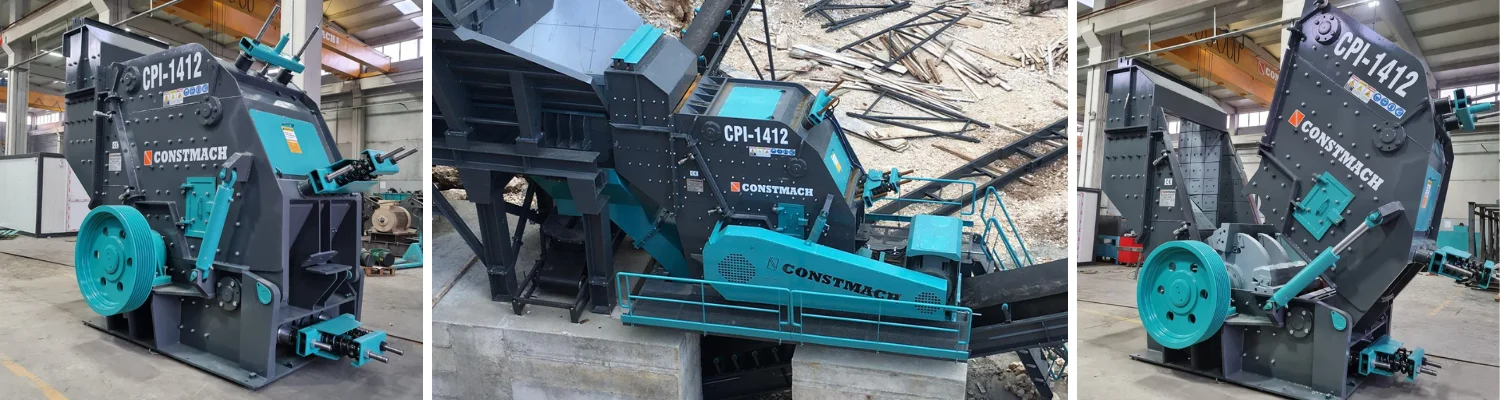

CPI - 1415 | Primary Impact Crusher

CPI-1415 is the mid-range model in the CONSTMACH primary impact crusher range, designed as a first-stage machine for crushing medium-hardness materials such as limestone and dolomite. With a 1,400 x 1,540 mm rotor, a maximum feed size of 1,000 x 1,000 mm, a 315 kW drive and a capacity of 350 to 400 t/h, it offers a meaningful step up in throughput and feed acceptance over the entry-level CPI-1412 while retaining the cubical product shape and high reduction ratio that define impact crushing.

The crusher reduces material by impact rather than compression. Feed entering the large inlet is struck by manganese steel impeller (blow) bars on the high-speed rotor, thrown against adjustable breaker plates and fractured along its natural cleavage planes. The wider 1,540 mm rotor face increases the working volume compared with the CPI-1412, which is the main reason for the higher capacity, and the impact action delivers the well-shaped cubical particles valued for concrete and asphalt aggregate together with a reduction ratio that can limit the need for a separate secondary stage on softer feed.

Product size is controlled by the adjustable breaker bars, which set the gap and therefore the output gradation, while a chain curtain across the inlet contains rebounding material. Hydraulic setting keeps adjustment and maintenance access straightforward, letting the operator re-set the crushing gaps as the blow bars and breaker plates wear and the product drifts coarser.

The CPI-1415 is built for an abrasive duty. The rotor is arc-welded and then thermally stress-relieved, the side sheets are thick with manganese liners in the wear zones, and the rotor turns on large self-aligning spherical roller bearings driven by the 315 kW motor. The unobstructed discharge opening lets crushed material clear the chamber freely so the machine can sustain its 350-400 t/h output without packing.

At an operating weight of approximately 28,000 kg, the CPI-1415 remains shipping-friendly, with a modular structure suited to transport in standard truck trailers and 40 ft containers. It integrates into a medium-capacity stationary plant as the primary crusher, feeding screens and, where the application requires, a secondary crusher to finish the product range. Its high reduction ratio means that on softer limestone the plant can often be configured around a single crushing stage, simplifying the layout and lowering installed cost.

In service, the CPI-1415 takes medium-hard feed up to 1,000 x 1,000 mm and produces a cubical primary product sized by the breaker bar setting, ready for screening into concrete and asphalt aggregate fractions and base material. As with all impact crushers, performance and wear cost depend on the feed being non-abrasive and not excessively hard, which makes it well matched to limestone and dolomite rather than granite or basalt. For producers crushing limestone at medium tonnage who need a cubical product and higher capacity than the entry model, the CPI-1415 is the appropriate choice.

CPI - 1415 Technical Specifications

Rotor Sizes (mm)1.400 x 1.540 mm
Max Feeding Size (mm)1.000 x 1.000 mm
Capacity (ton/hour)350 - 400 t/h
Motor Power (kW)315 kW
Weight (kg)28.000 kg

CPI - 1415 General Layout

FAQ

The CPI-1415 primary impact crusher is a mid-capacity first-stage machine for medium-hardness materials. This section covers the feed it accepts, the products it generates, its industries, wear-part management and how it compares with a jaw crusher.

What Materials Can the CPI-1415 Process?

The CPI-1415 is designed for medium-hardness, low-abrasion feed, most commonly:

  • Limestone
  • Dolomite
  • Other soft to medium-hard sedimentary rock

It is not suited to hard, abrasive rock such as granite or basalt, which would cause rapid wear of the blow bars and breaker plates. Feed must be within the 1,000 x 1,000 mm maximum size; the larger inlet over the entry model lets bigger run-of-quarry limestone blocks be charged directly.

What Products Does It Produce?

The CPI-1415 produces a cubical, well-shaped primary product. Its high reduction ratio means the output is often fine enough on softer limestone to reduce the need for a separate secondary crusher. The product is screened into concrete and asphalt aggregate fractions and base course material. The cubical shape is a specific advantage for concrete and asphalt mixes, where flaky or elongated particles weaken the mix and raise binder demand.

Which Industries Use This Crusher?

  • Limestone and dolomite quarries at medium capacity
  • Concrete and asphalt aggregate producers needing cubical shape
  • Cement raw-material preparation
  • Road base and construction aggregate supply

At approximately 28,000 kg with a 315 kW drive, it suits medium-capacity limestone producers needing more throughput than the entry model delivers while keeping the same cubical-product benefit.

How Are Wear Parts Managed?

The principal wear parts are the manganese steel blow (impeller) bars, the breaker plates and the chamber liners. Blow bars wear fastest and are rotated or replaced as they round off, with the breaker bar setting adjusted to hold product size between changes. Keeping the feed to low-abrasion limestone-type material is the main lever for controlling wear-part cost. Checking the feed for tramp metal is also important, as iron can damage the high-speed rotor and bars.

What Should Be Considered During Operation?

Steady feed and an intact chain curtain keep the impact process efficient and the rotor balanced. The breaker bar gaps should be checked and re-set as wear progresses. The unobstructed discharge must stay clear to prevent packing, and bearing lubrication maintained under the higher load of the 315 kW drive. Rotor balance should be confirmed after each blow-bar change, since an unbalanced rotor at speed causes vibration and shortens bearing life. Operating at the correct rotor speed for the feed and product target also keeps energy use and wear in balance.

Impact Crusher Versus Jaw Crusher

A primary impact crusher like the CPI-1415 reduces by impact, gives a cubical product and a high reduction ratio, and is best for medium-hardness, low-abrasion limestone and dolomite. A jaw crusher reduces by compression and is the better primary for hard, abrasive granite or basalt, where an impact crusher would wear quickly. Feed hardness and abrasiveness drive the choice between the two: limestone with a cubical-product requirement favours the impact crusher, while hard or abrasive feed favours the jaw crusher for its lower wear cost.

Frequently Asked Questions

whatsapp gorsel 2024 01 10 saat 15 28 30 bf9fc1cb 9474
Quick Contact

Leave a request, and our expert team will as soon as possible get back to you

Fill out the form for detailed information about concrete plants, crushing-screening plants, or our other products — or contact us directly.

By leaving a request, you consent to the processing of your personal data.

or directly

What's new on Constmach

Our expert team is ready to provide a solution tailored to your project. We're just a phone call away — call us now.