





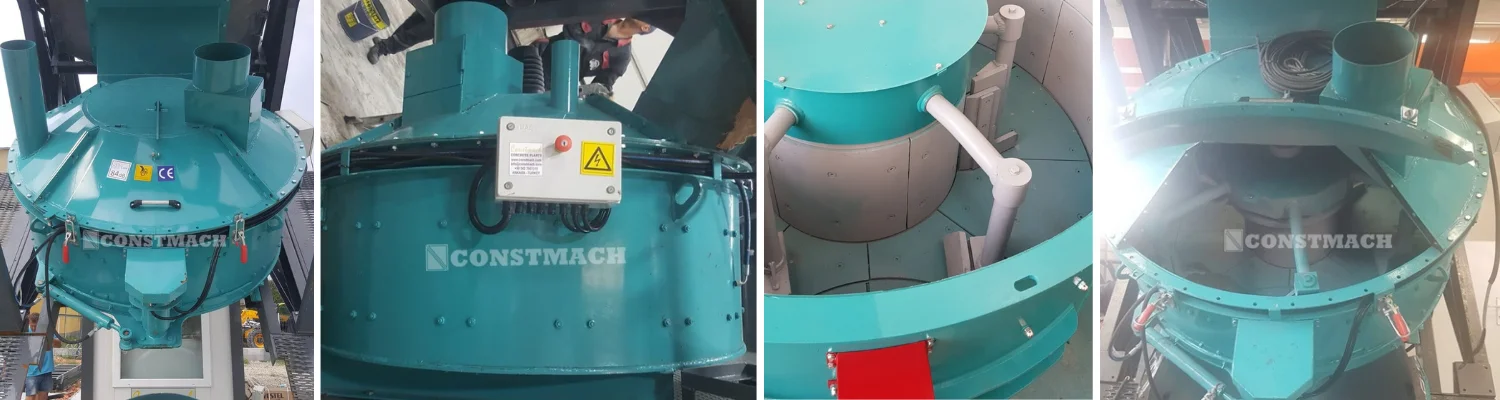

The CONSTMACH CPM-2 is a pan type concrete mixer rated at approximately 2,000 litres of compacted concrete per batch. The sections below summarise what it produces, its principal specifications, where it is applied, how the pan mixing principle differs from other mixer types, and the maintenance considerations associated with its wear components.
What does the CPM-2 do?
The CPM-2 is a batch mixer that combines cement, water, fine and coarse aggregates and admixtures into a homogeneous concrete or mortar within an enclosed circular pan. The rotating mixing arms and scraper blades force material through repeated shearing and folding actions, which distributes the cement paste evenly and is well suited to demanding mixes such as those used in precast and dry-cast production.
What are the main specifications?
- Charging (dry feed) volume: 3,000 litres
- Fresh concrete volume: 2,500 litres
- Compacted concrete volume: approximately 2,000 litres (2 m3) per batch
- Motor power: 55 kW
- Side body wearing plates: 12 mm Hardox 450
- Bottom wearing plates: 12 mm St 52
- Mixing arm wearing plates: 25 mm Ni-Hard
What are the typical applications?
The CPM-2 is used in precast concrete factories, concrete block and paving manufacturing plants, and as the mixing unit within stationary concrete batching plants. Its intensive mixing action makes it appropriate for stiff, low-slump and zero-slump mixes, coloured concrete and fibre-reinforced concrete, where uniform distribution of cement and pigments is important.
How does a pan mixer differ from other mixer types?
A pan mixer concentrates the mixing action in a shallow circular drum where eccentrically or concentrically arranged arms and scrapers work the material. Compared with drum (free-fall) mixers, it provides a more forced, intensive mixing action that handles stiff mixes more effectively. Compared with twin-shaft mixers, pan mixers are typically used for smaller to medium batch sizes and are common in precast and block-making environments. The CONSTMACH planetary (CPLN) series is a separate product line; the CPM is a pan-type design.
What maintenance and wear factors apply?
Abrasion is concentrated on the pan floor, side walls and mixing arms. These surfaces are protected by replaceable wear plates: 12 mm Hardox 450 on the side body, 12 mm St 52 on the bottom and 25 mm Ni-Hard on the mixing arms. Routine maintenance includes inspecting and replacing wear plates and arm tips, checking the SKF/FAG bearings, cleaning the pan to prevent concrete build-up and verifying the discharge door and safety switches.
How do the CPM models compare?
The three CPM models share the same pan mixing principle and differ in batch size and installed power. The CPM-0.5 produces about 500 litres of compacted concrete with a 22 kW motor, the CPM-1 about 1,000 litres with a 37 kW motor, and the CPM-2 about 2,000 litres with a 55 kW motor. Selection depends on the required output per batch and the overall plant cycle time.