







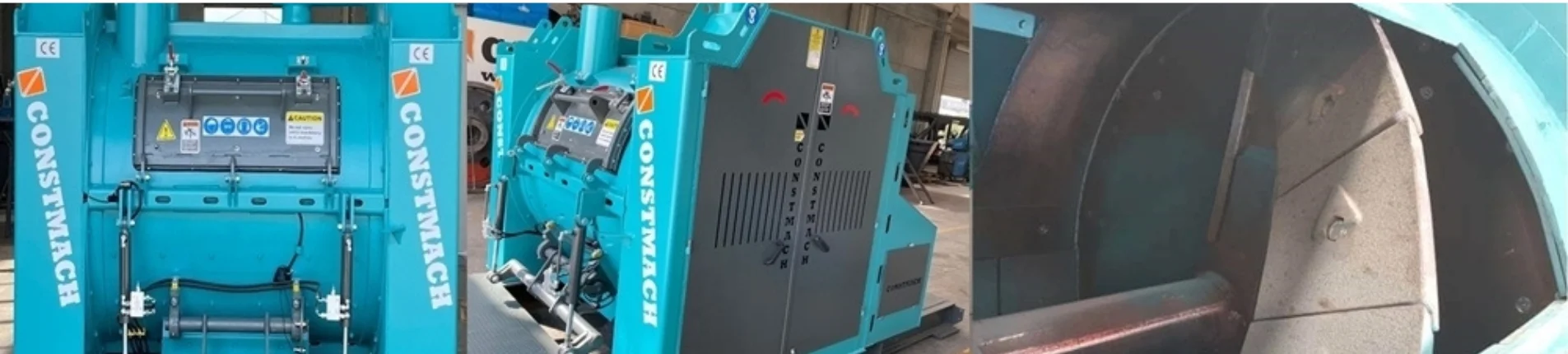

CSS - 2 | Single Shaft Concrete Mixer

CSS-2 is the largest single shaft mixer in the CONSTMACH range, sized for high-volume ready-mix plants that need large batches with the economy of single shaft mixing. It accepts a 3,000-litre charge and produces 2,500 litres of fresh concrete, equal to 2,000 litres of compacted concrete, in each cycle. At this capacity the mixer suits central plants supplying continuous concrete to major building, road and infrastructure sites where batch frequency and total daily output are the governing requirements.

The unit follows the same horizontal single shaft principle as the smaller models, but with a longer chamber and more mixing arms to move the larger material mass. The replaceable arms fold aggregate, cement and water through the chamber to disperse clusters and produce a homogeneous batch. Single shaft mixing remains the most economical method for general-purpose concrete, and at 2 m³ the CSS-2 delivers large-batch ready-mix at a lower equipment and operating cost than twin-shaft or planetary mixers of comparable volume.

The CSS-2 is driven by a 37 kW motor and gearbox transmitting through the heavy-duty pulley-chain mechanism to the main shaft. On the 2 m³ class, CONSTMACH offers a twin-motor arrangement so that production can continue on a single drive should one motor require attention, an important consideration for central plants where unplanned downtime is costly. The drive isolates the gearbox from the abrasive chamber while sustaining mixing speed under the larger compacted load.

Wear protection is the heaviest in the single shaft range, reflecting the greater volume and impact at this capacity. The CSS-2 carries 15 mm Hardox 450 side body wearing plates, 20 mm Ni-Hard main body plates and 30 mm Ni-Hard mixing arm plates. The thicker 20 mm main body and 30 mm arm liners extend service intervals under the higher tonnage of aggregate passing through the chamber each shift. All liners are replaceable as individual sections, so worn surfaces are renewed without retiring the mixer body.

An automatic lubrication system supplies grease to the shaft bearings throughout operation, protecting the SKF or FAG heavy-duty bearings and reducing manual greasing on a unit that runs long hours. The hydraulic discharge door opens under controlled pressure to manage the larger discharge flow into transit mixers and to clear the full chamber at the end of each batch.

For maintenance safety, the CSS-2 is fitted with a maintenance door safety switch that de-energises the drive when the access hatch is opened, together with an emergency stop button. Given the size of the chamber, this isolation is essential before any internal inspection or liner replacement. With its 2 m³ batch, twin-motor option, reinforced wear package and matched drive, the CSS-2 provides high-volume producers with a serviceable, economical single shaft mixer for demanding central ready-mix operations.

CSS - 2 Technical Specifications

Charging Volume3.000 lt
Fresh Concrete Volume2.500 lt
Compacted Concrete Volume2.000 lt
Motor Power37 kW
Side Body Wearing Plates15 mm Hardox 450
Main Body Wearing Plates20 mm
Mixing Arm Wearing Plates30 mm
Automatic Lubrication SystemAVAILABLE
Hydralulic Discharge DoorAVAILABLE
Maintanence Door Safety SwitchAVAILABLE

CSS - 2Video

FAQ

The CONSTMACH CSS-2 single shaft mixer is the 2 m³ flagship of the single shaft line, intended for high-throughput central ready-mix plants. Its applications, output, installation requirements and servicing are set out below.

Where the CSS-2 Is Used

This capacity is selected where large, frequent batches are needed to sustain continuous supply. Typical settings include:

  • Central ready-mix plants feeding fleets of transit mixers on major construction programmes
  • Large infrastructure projects such as highways, bridges, dams and ports requiring sustained concrete volume
  • High-rise and industrial building sites with heavy daily pour schedules
  • Regional batching hubs supplying multiple delivery routes from a single location

What It Produces

Each cycle delivers 2,500 litres of fresh concrete, or 2,000 litres compacted, across standard structural and ready-mix designs. The single shaft action gives reliable homogeneity for plastic and semi-dry concrete at high volume; for large-batch dry-cast or high-strength specialist work, a planetary mixer remains the more suitable mixing technology.

Installation and Power

The CSS-2 requires a three-phase supply matched to its drive, and where the twin-motor option is specified the supply and control panel must serve both motors. The mixer is a substantial mass and is mounted high in the plant tower above the discharge point, so foundations and supporting steelwork must be engineered for the static and dynamic loads of a full 2 m³ batch. Generous access for liner handling should be planned given the chamber size.

Maintenance and Wear Parts

The reinforced wear package, 15 mm Hardox 450 side plates, 20 mm Ni-Hard main body plates and 30 mm Ni-Hard arm plates, is designed to lengthen replacement intervals under heavy duty, with each liner replaceable individually. The automatic lubrication system services the shaft bearings during operation, while reservoirs, seals and lines need scheduled checks. The twin-motor option supports continued running on one drive during maintenance, but both motors and the safety switch should be inspected on a regular programme.

Comparison With Other Mixer Types

At 2 m³ the CSS-2 offers the most economical large-batch route for general concrete. A pan mixer is not typically built at this scale and remains a small-batch precast and laboratory tool, while a 2 m³ planetary mixer provides higher consistency and cement saving for demanding mixes at significantly greater cost and installed power. The CSS-2 is the choice for producers whose priority is high-volume ready-mix economy.

Cycle and Throughput Considerations

At 2 m³ the mixer moves a large mass each cycle, so the surrounding plant must be able to weigh, dose and deliver materials fast enough to keep charging time short. The twin-motor option supports sustained running, but realised throughput still depends on aggregate weighing capacity, cement screw rates and water metering. A central plant is normally engineered around the CSS-2's batch size so that charging, mixing and discharge form a continuous cadence feeding a fleet of transit mixers without the mixer waiting for materials.

Because of its size and long running hours, the CSS-2 also benefits from planned wear monitoring: tracking liner thickness lets producers schedule replacement during planned stoppages rather than reacting to failures during peak production.

CONSTMACH provides foundation loads, layout drawings and spare-part planning to integrate the CSS-2 into a central batching plant configuration.

Frequently Asked Questions

whatsapp gorsel 2024 01 10 saat 15 28 30 bf9fc1cb 9474
Quick Contact

Leave a request, and our expert team will as soon as possible get back to you

Fill out the form for detailed information about concrete plants, crushing-screening plants, or our other products — or contact us directly.

By leaving a request, you consent to the processing of your personal data.

or directly

What's new on Constmach

Our expert team is ready to provide a solution tailored to your project. We're just a phone call away — call us now.