






The CTC-1210 Tertiary Impact Crusher serves the final crushing stage, where shaping and fines generation are the goal. The following covers feed materials, output products, applications, wear-part service and comparisons with alternative final-stage crushers.
What materials can the CTC-1210 process?
The CTC-1210 is built for medium-hard, non-abrasive stone already reduced by a secondary crusher. Typical feed includes:
- Limestone, dolomite and similar sedimentary rock
- Secondary-crushed natural stone and gravel
- Pre-crushed material needing final shaping and fines
Maximum feed size is 120 mm. It is not intended for highly abrasive rock, which sharply raises blow-bar wear; for hard, abrasive stone a vertical shaft impactor is the preferred final-stage machine.
What products does it make?
The CTC-1210 produces a cubical, well-graded product down to around 0.5 mm with roughly 60 percent passing in one pass. This covers fine concrete-grade aggregate and the fine fraction used as manufactured-sand feed. The high crush count yields a strongly cubical grain shape that improves concrete strength, workability and compliance with shape specifications.
Which industries and applications use it?
- Concrete aggregate production requiring cubical shape
- Manufactured-sand and fine-aggregate generation
- Asphalt aggregate with tight shape control
- Closed-circuit finishing of secondary-crushed stone
How are wear parts replaced and how long do they last?
The principal wear parts are the rotor blow bars and the breaker plate liners, both interchangeable. High rotor speed and fines generation mean steady wear that depends on feed hardness and tonnage. The hydraulic opening mechanism exposes the rotor and liners for replacement without dismantling the machine, keeping downtime low.
How does a tertiary impact crusher compare with a VSI?
Both shape material in the final stage. A tertiary impact crusher uses a horizontal rotor with blow bars and breaker plates, giving strong reduction with cubical shaping, and suits non-abrasive stone. A vertical shaft impactor (VSI) accelerates material against anvils or a rock bed and is stronger at manufactured sand from harder, abrasive rock with lower wear when run rock-on-rock. The CTC-1210 is the economical choice for non-abrasive feed where cubical product and fines are wanted, and it can run in series with a VSI where both cubical aggregate and a high sand yield are required.
How does it compare with a cone crusher in the final stage?
A cone crusher reduces by compression and handles harder, more abrasive rock, but produces more flaky particles and a lower fines yield than the CTC-1210. For non-abrasive stone where cubical shape and fines are the priority, the tertiary impact crusher delivers a better-shaped product in one pass, at a lower purchase price and with simpler maintenance.
How does the CTC-1210 relate to the other CTC models?
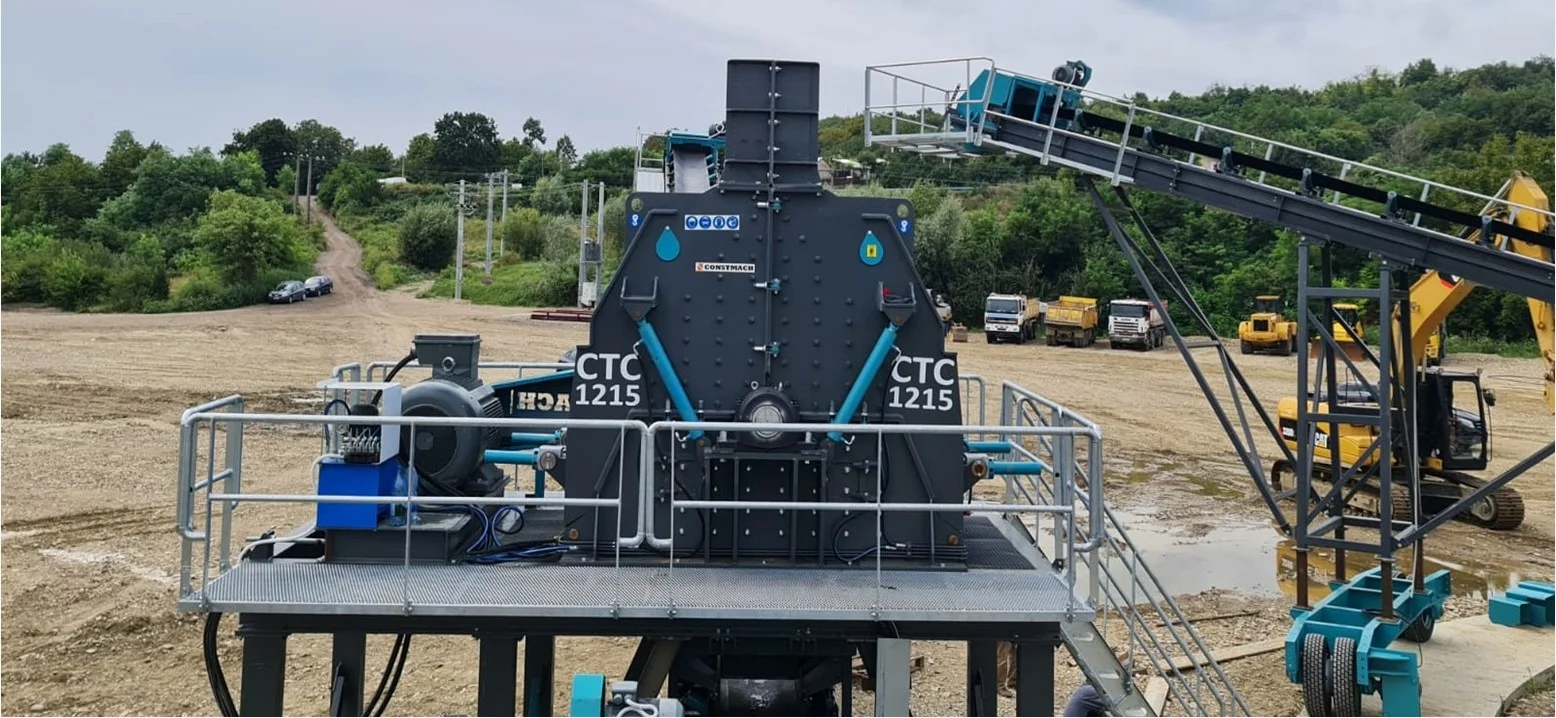
The CTC-1210 is mid-range, with a 1,100 x 1,000 mm rotor, 120 mm feed and 80-135 t/h. The CTC-1275 is the compact unit (100 mm feed, 60-80 t/h), while the CTC-1212 (120-170 t/h) and CTC-1215 (230-250 t/h) use larger rotors for higher capacity. All share the 800-900 rpm rotor speed, selective crushing and hydraulic adjustment, so the choice follows required tonnage and feed size.