







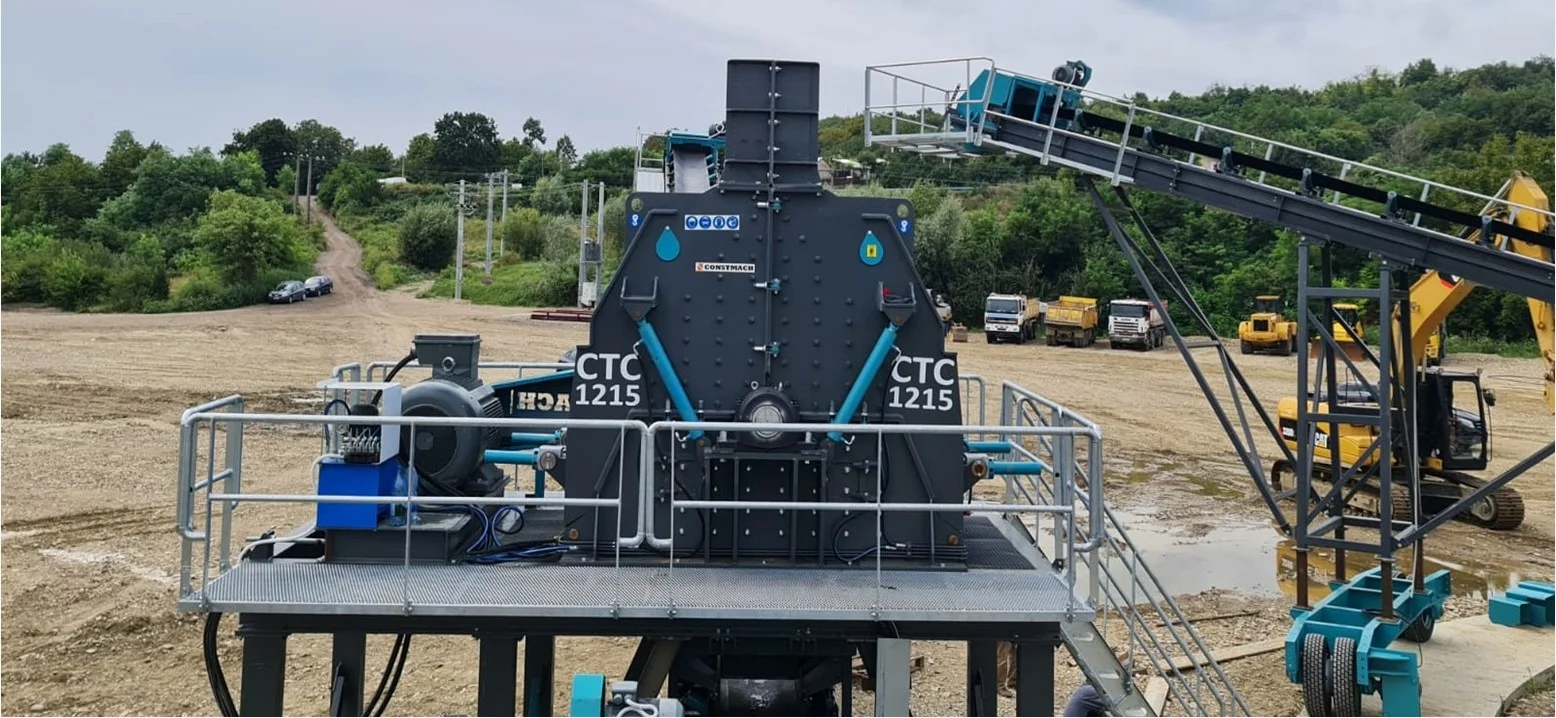

CTC - 1275 | Tertiary Impact Crusher

CTC-1275 Tertiary Impact Crusher is the compact model in CONSTMACH's tertiary impact crushing line, intended for the final crushing stage where particle shape and a high proportion of fines matter more than coarse reduction. It pairs a 1,100 x 750 mm rotor turning at 800-900 rpm with a 110 kW drive, and at an operating weight of 9,500 kg it is the lightest tertiary unit in the family, well suited to smaller plants and closed-circuit duty.

In a crushing and screening line the tertiary stage refines what the primary and secondary crushers have already reduced, so the emphasis shifts from breaking large stone to shaping and generating fines. The CTC-1275 is sized to perform this finishing role at modest tonnage with low installed power, which makes it economical to run and easy to fit into a compact plant or a closed-circuit loop around a screen.

As a third-stage machine, the CTC-1275 accepts a maximum feed size of 100 mm, taking the product of a secondary crusher and reducing it to a cubical, well-graded output. The high rotor speed is the defining feature of tertiary impact crushing: blow bars on the fast-turning rotor strike the feed and drive it against the breaker plates at high velocity, so each particle receives intense impact that shapes it into a cube and generates a large share of fine material in a single pass.

Rated capacity is 60 to 80 tonnes per hour, set by feed gradation, material hardness and the selected settings. The CTC-1275 is designed for medium-hard, non-abrasive materials and can reduce them to a cubical, well-graded product around 0.5 mm with roughly 60 percent passing in one pass. This makes it effective both for final concrete-grade aggregate and for generating the fine fraction used as manufactured-sand feed.

Selective crushing is achieved through rotor speed and breaker plate adjustment, giving the operator direct control over the balance between product shape and fines content. A hydraulic adjustment and opening mechanism lets the breaker plate gap be changed for tuning and opened for service. Because of its added control over the upper product sizes and a high reduction ratio, the CTC-1275 works efficiently in closed circuit, where oversize is screened off and returned for further crushing until the target gradation is met.

For maintenance, the hydraulic opening mechanism gives access to the rotor and the interchangeable wear parts without dismantling the machine, keeping downtime short. The wear parts are designed to be interchanged as a routine task, which is important in tertiary duty where the high-speed impact and fine product generation place steady demand on the blow bars and liners.

The CTC-1275 ships in a modular configuration that fits within closed truck trailers and 40 ft open-top containers, controlling transport cost. In a complete CONSTMACH plant it sits after the secondary crusher and ahead of, or in place of, a vertical shaft impactor, feeding screens that separate the finished fractions. Operators needing higher throughput can step up through the CTC-1210, CTC-1212 and CTC-1215, which share the same crushing principle at larger rotor sizes.

CTC - 1275 Technical Specifications

Rotor Sizes(mm)1.100 x 750 mm
Rotor Speed(rpm)800 - 900
Maximum Feeding Size(mm)100 mm
Capacity(ton/hour)60 - 80 t/h
Motor Power(kW)110 kW
Weight(kg)9.500 kg
FAQ

The CTC-1275 Tertiary Impact Crusher handles the final crushing stage in an aggregate line, where shaping and fines generation are the goal. The information below covers feed materials, output products, applications, wear-part service and comparisons with alternative final-stage crushers.

What materials can the CTC-1275 process?

The CTC-1275 is built for medium-hard, non-abrasive stone already reduced by a secondary crusher. Typical feed includes:

  • Limestone, dolomite and similar sedimentary rock
  • Secondary-crushed natural stone and gravel
  • Pre-crushed material requiring final shaping and fines

Maximum feed size is 100 mm. The machine is not intended for highly abrasive rock; abrasive feed sharply increases blow-bar wear, and for hard, abrasive stone a vertical shaft impactor is the better final-stage choice.

What products does it make?

The CTC-1275 produces a cubical, well-graded product down to around 0.5 mm with roughly 60 percent passing in a single pass. This covers fine concrete-grade aggregate and the fine fraction used as manufactured-sand feed. The high crush count gives a strongly cubical grain shape, which improves concrete strength and workability and helps mixes meet shape specifications.

Which industries and applications use it?

  • Concrete aggregate production where cubical shape is specified
  • Manufactured-sand and fine-aggregate generation
  • Asphalt aggregate requiring tight shape control
  • Closed-circuit finishing of secondary-crushed stone

How are wear parts replaced and how long do they last?

The main wear parts are the blow bars on the rotor and the breaker plate liners, which are interchangeable. Tertiary duty runs at high rotor speed and generates fines, so wear is steady and depends on feed hardness and tonnage. The hydraulic opening mechanism exposes the rotor and liners for replacement without dismantling, keeping downtime low.

How does a tertiary impact crusher compare with a VSI?

Both are final-stage shaping machines. A tertiary impact crusher uses a horizontal rotor with blow bars and breaker plates and gives strong reduction with cubical shaping; it is well suited to non-abrasive stone. A vertical shaft impactor (VSI) accelerates material against anvils or a rock bed and excels at manufactured sand from harder, more abrasive rock with lower wear when run rock-on-rock. The CTC-1275 is the economical choice for non-abrasive feed where a cubical product and fines are the goal, and it can be run in series with a VSI when both cubical aggregate and a high sand yield are required.

How does it compare with a cone crusher in the final stage?

A cone crusher works by compression and handles harder, more abrasive rock, but it produces a higher proportion of flaky particles and a lower fines yield than the CTC-1275. For non-abrasive stone where cubical shape and fines are the priority, the tertiary impact crusher gives a better-shaped product in a single pass, and at lower purchase price and simpler maintenance.

How does the CTC-1275 relate to the larger CTC models?

The CTC-1275 is the compact unit, with a 1,100 x 750 mm rotor, 100 mm feed and 60-80 t/h. The CTC-1210 (120 mm feed, 80-135 t/h), CTC-1212 (150 mm feed, 120-170 t/h) and CTC-1215 (150 mm feed, 230-250 t/h) use larger rotors for higher capacity, all sharing the same 800-900 rpm rotor speed, selective crushing and hydraulic adjustment. Selection follows the required tonnage and the feed size delivered by the secondary stage.

Frequently Asked Questions

whatsapp gorsel 2024 01 10 saat 15 28 30 bf9fc1cb 9474
Quick Contact

Leave a request, and our expert team will as soon as possible get back to you

Fill out the form for detailed information about concrete plants, crushing-screening plants, or our other products — or contact us directly.

By leaving a request, you consent to the processing of your personal data.

or directly

What's new on Constmach

Our expert team is ready to provide a solution tailored to your project. We're just a phone call away — call us now.