





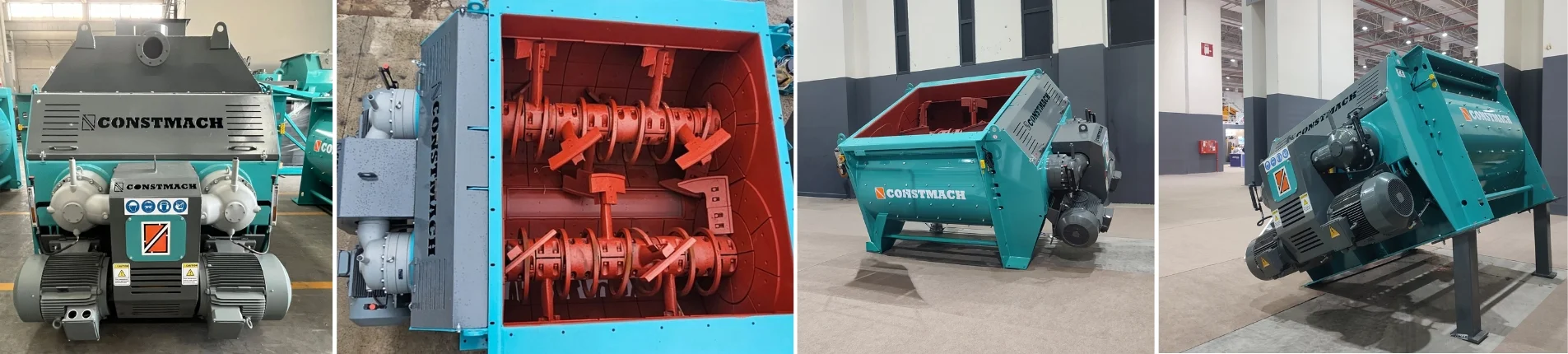

The CTS-2 Twin Shaft Mixer sits one step above the entry model, and choosing it correctly means confirming that a 2 m³ compacted batch and twin 37 kW drives match the plant's planned throughput and product mix. The points below answer what buyers ask beyond the specification sheet.
Where It Is Used
- Medium-capacity stationary ready-mix plants serving urban and regional construction
- Regular precast element production: beams, panels, manholes and similar units
- Paver, kerbstone and block plants running multi-shift schedules
- Plants that have outgrown a 1 m³ mixer but do not require a central-mix machine
- Operations needing a dependable 2 m³ batch with reasonable electrical demand
What It Produces
Each cycle delivers 2,000 lt (2 m³) of compacted concrete from a 3,000 lt charge. The mixer handles standard structural and ready-mix concrete as well as stiffer precast and block mixes; the counter-rotating arms keep low-slump material moving and distribute cement, water, pigment and fibre evenly through the batch. The 2 m³ size is convenient for filling standard transit mixers in two or three discharges.
Installation And Power
The two 37 kW motors draw more power than the single-motor CTS-1, so the plant switchgear and any standby generator must be sized for a total of 74 kW of mixer drive plus the rest of the plant. The mixer needs a hydraulic supply for the discharge door and an electrical feed for the automatic lubrication pump. Its weight and footprint suit fixed mid-range plants more than lightweight mobile chassis.
Maintenance And Wear Parts
- Side body wearing plates: 15 mm Hardox
- Main body wearing plates: 20 mm, thicker than the CTS-1 for longer life at higher throughput
- Mixing arm wearing plates: 30 mm, the primary wear items to monitor
- Four shaft bearings and seals, served by the automatic lubrication system, whose reservoir must be kept filled
- Check arm and paddle clearance to the liners and adjust as components wear
- Wash out the trough each shift to prevent build-up on the two shafts and the liners
Operating Considerations
With two motors and four bearings, the CTS-2 rewards a consistent operating routine. The two drives should be confirmed to start together and share load evenly; an imbalance usually points to a worn coupling or a fouled shaft on one side. Charging sequence still matters at 2 m³, since asking both motors to start against a packed dry load raises starting current and stresses the arms. Mixing time should be established from trial batches and held, because over-mixing a 2 m³ batch wastes energy and accelerates liner wear across a shift. As with the whole range, thorough end-of-shift washout of both shafts and the trough is the single most effective measure for protecting the liners and keeping power draw stable over the long term.
Comparison Versus The CTS-1 And Larger Models
Compared with the CTS-1, the CTS-2 doubles the batch from 1 to 2 m³, splits the drive into two 37 kW motors for higher sustained torque, and uses thicker 20 mm main-body and 30 mm arm liners for longer wear life at the increased throughput. Stepping up further, the CTS-3 raises the batch to 3 m³ with two 55 kW motors, and the CTS-4 and CTS-5 reach 4 and 5 m³ for high-volume central-mix and heavy precast work. The CTS-2 is the right choice when planned output centres on 2 m³ batches and the buyer wants stronger drive and wear protection than the entry model without the cost and power demand of the central-mix sizes.