





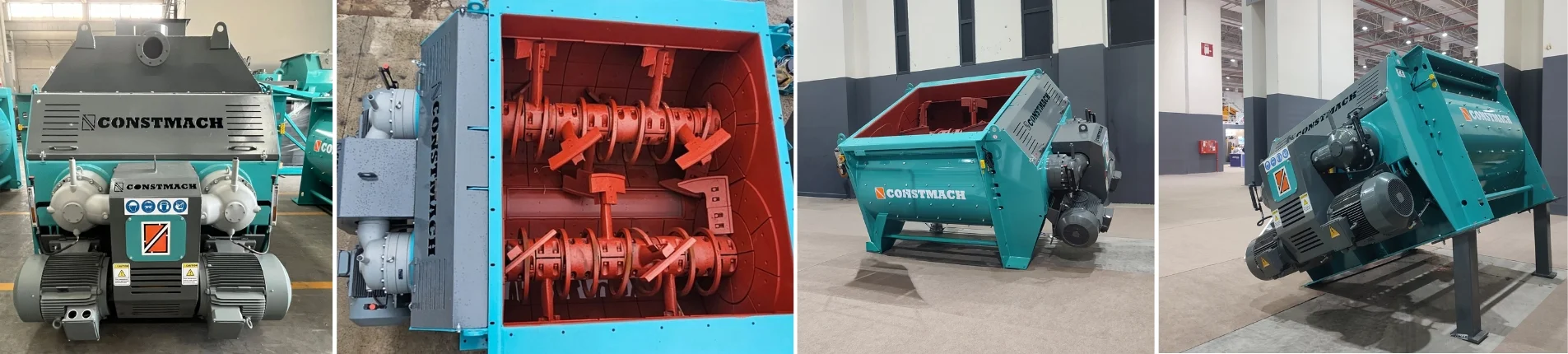

The CTS-4 Twin Shaft Mixer is a central-mix class machine, and choosing it means confirming that a 4 m³ compacted batch and twin 75 kW drives match a plant built for high daily volumes and demanding mixes such as RCC. The points below cover what buyers evaluate beyond the specification sheet.
Where It Is Used
- Large central ready-mix plants supplying major building and infrastructure projects
- Roller-compacted concrete (RCC) plants for dams, large pavements and hardstandings
- Heavy precast factories casting bridge girders, large wall panels and tunnel segments
- Port, airport, metro and energy projects with sustained high concrete demand
- Operations needing central-mix output without moving to the largest available frame
What It Produces
Each cycle delivers 4,000 lt (4 m³) of compacted concrete from a 6,000 lt charge. The mixer handles structural and high-strength ready-mix, dense aggregate-rich RCC, and large stiff precast batches; the powerful counter-rotating action mixes low-water and harsh mixes that softer mixer types struggle with, while still distributing admixtures, pigment and fibre evenly. A 4 m³ batch loads transit mixers in a single or double discharge and keeps multiple precast moulds supplied.
Installation And Power
The two 75 kW motors give 150 kW of mixer drive, so the plant's electrical infrastructure, cabling and any standby generation must be sized for that load plus the rest of the plant. The mixer needs a hydraulic supply for the discharge door and an electrical feed for the automatic lubrication pump. Its mass and forces require a properly engineered, founded plant structure; this is fixed-plant equipment, not a mobile unit.
Maintenance And Wear Parts
- Side body wearing plates: 25 mm, heavier than the smaller models for long life under high aggregate flow
- Main body wearing plates: 25 mm
- Mixing arm wearing plates: 30 mm, the primary high-wear items, inspected frequently
- Four heavily loaded shaft bearings and seals served by the automatic lubrication system; keep the reservoir filled and verify delivery to all points
- Monitor arm and paddle clearance and adjust as wear opens it up, since worn clearance slows mixing and raises power draw
- RCC and aggregate-rich mixes are abrasive; schedule liner inspection on a tighter interval and keep spare liner sets on hand
Comparison Versus Adjacent CTS Models
Against the CTS-3, the CTS-4 adds a full cubic metre of batch (4 m³ versus 3 m³), raises drive power to two 75 kW motors, and steps both body liners up to 25 mm for the heavy, abrasive duty of RCC and aggregate-rich concrete. The smaller CTS-1, CTS-2 and CTS-3 cover compact through high-output plants, while the CTS-5 tops the range at 5 m³ with two 90 kW motors for the very largest central-mix and dam projects. The CTS-4 is the right choice when the plant needs true central-mix volume and the capability to handle stiff, low-water mixes, but the project does not require the maximum CTS-5 frame.