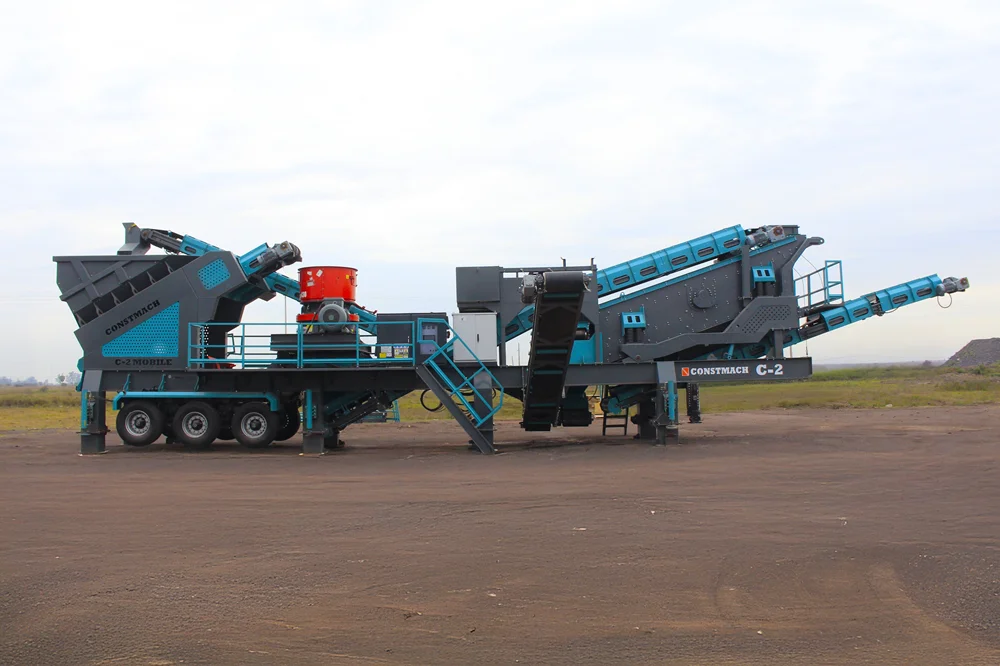






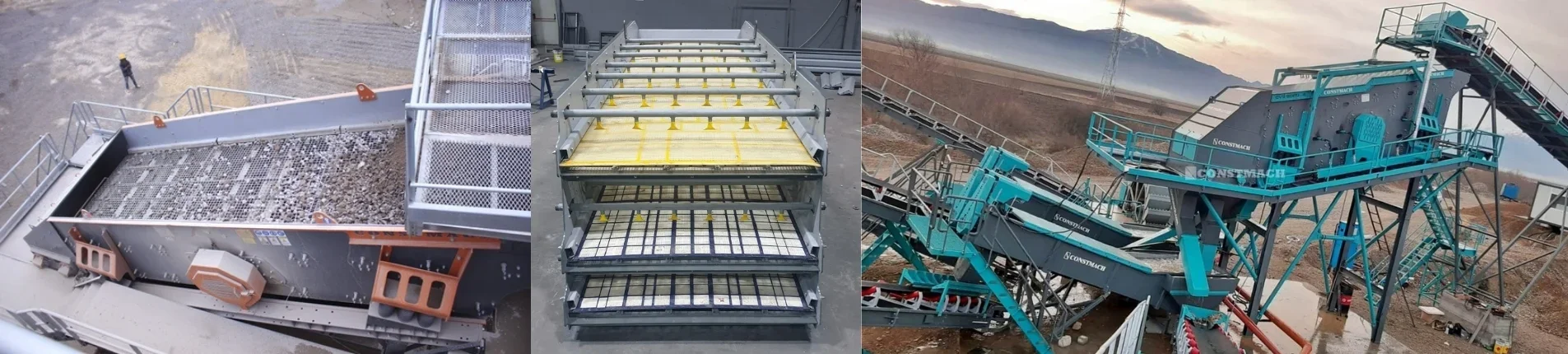

The CONSTMACH CVS-1240 inclined vibrating screen is the size-classification machine of a crushing and screening plant. It takes crusher output and separates it into graded aggregate fractions. Understanding where it fits in the flowsheet, what media it uses and how it is maintained helps operators hold product quality and screen availability.
Where the CVS-1240 Sits in the Plant
The screen is positioned after a crushing stage and is fed by a belt conveyor. Through-products drop to stockpile conveyors, while oversize from the lower deck is typically returned to a crusher in a closed circuit. In a typical line the sequence is feeder, crusher, conveyor, screen, with the screen determining the final product gradation.
What It Handles and Deck Configurations
- The CVS-1240 handles crushed stone, gravel and sand-sized material at 70-95 t/h.
- Two decks produce three fractions, three decks produce four, and four decks produce five fractions in one pass.
- The 1.200 x 4.000 mm box gives 4.8 m² of screening area; capacity depends on mesh size, material moisture and the required cut accuracy.
Deck Media
- Steel woven wire mesh is used for hard, abrasive material and finer cuts.
- Polyurethane panels are used where blinding or pegging is a problem and where longer media life is wanted.
- Media is selected by aperture, open area and the hardness of the feed.
Maintenance
- Inspect and re-tension the screen media regularly; loose mesh tears quickly and reduces efficiency.
- Lubricate the eccentric shaft bearings on schedule and monitor bearing temperature.
- Check the steel-lined feedbox and discharge lips for wear and replace before they fail.
- Verify the support springs and that Huck-bolted joints remain tight under vibration.
Comparison With Alternatives
Compared with a static grizzly or trommel, an inclined vibrating screen offers higher accuracy and more decks in a smaller footprint. Within the CONSTMACH range, the CVS-1240 is the compact unit; for higher throughput or larger top sizes, the CVS-1640, CVS-1650, CVS-1850 and CVS-2470 offer progressively larger screen boxes and deck areas.
Installation and Commissioning
The CVS-1240 is supported on coil springs that isolate its vibration from the supporting structure, and it is installed at a working incline, typically in the region of 15 to 20 degrees, so material flows down the deck under gravity while the stroke stratifies the bed. At 7.400 to 8.000 kg depending on deck count, it sits on a modest steel support tower fed by a conveyor at the top end. During commissioning the eccentric drive is checked for the correct stroke and rotation, the springs are levelled so the box runs square, and the mesh apertures are confirmed against the target product sizes. Feed is introduced gradually so the bed depth and spread across the 1.200 mm width can be observed and the feed conveyor rate trimmed.
Operating Tips for Best Results
- Spread the feed evenly across the full deck width; a feed concentrated on one side reduces efficiency and wears the mesh unevenly.
- Avoid overloading beyond 95 t/h, as too deep a bed prevents fines from reaching the mesh and blurs the cut.
- Choose polyurethane media for damp or near-size material that tends to blind steel mesh.
- Re-tension steel mesh after the first hours of running, when initial stretch occurs.
- Keep the discharge lips and chutes clear so classified fractions do not back up onto the deck.