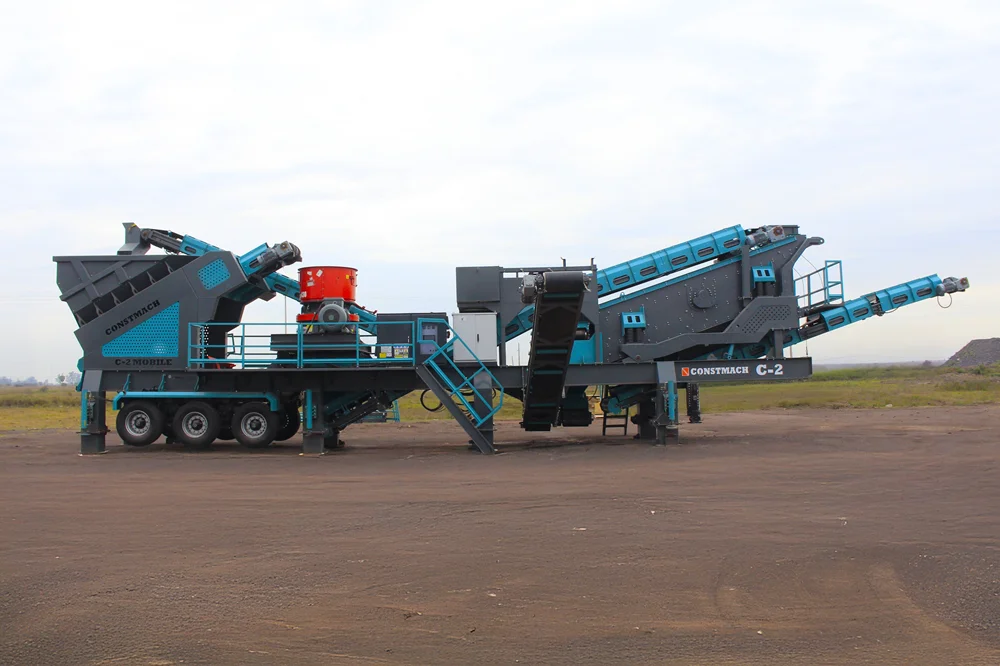






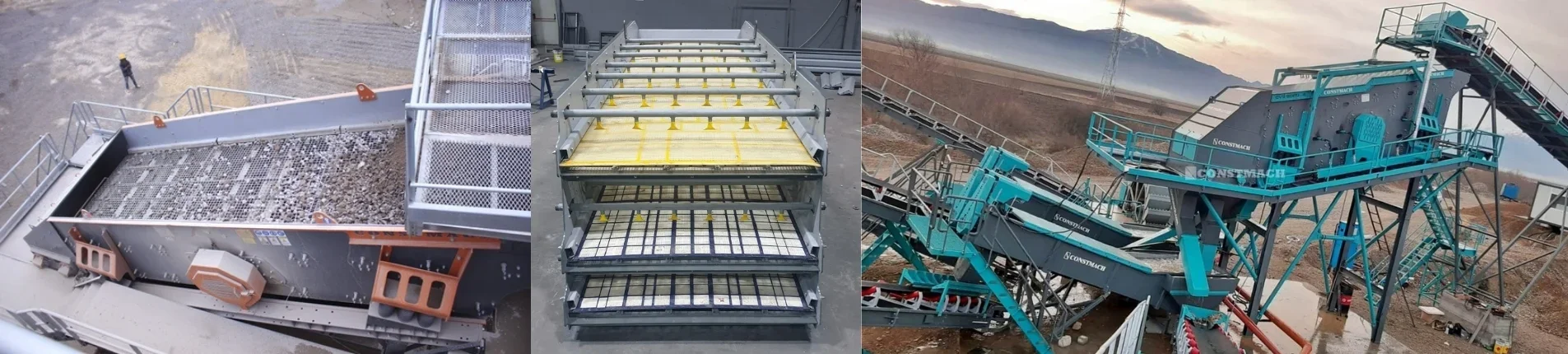

The CONSTMACH CVS-1850 inclined vibrating screen is the size-classification machine in a high-capacity crushing and screening plant. It takes crusher output and separates it into graded aggregate fractions. Understanding its position in the flowsheet, its media options and its maintenance needs helps operators sustain product quality and screen uptime at high tonnage.
Where the CVS-1850 Sits in the Plant
The screen follows a crushing stage and is fed by a belt conveyor. Through-products fall to stockpile conveyors while oversize from the lower deck is normally returned to a crusher in a closed circuit. The line sequence is feeder, crusher, conveyor, screen, with the screen setting the final gradation.
What It Handles and Deck Configurations
- The CVS-1850 handles crushed stone, gravel and sand-sized material at 140-180 t/h.
- Two decks yield three fractions, three decks yield four, and four decks yield five in one pass.
- The 1.800 x 5.000 mm box gives 9 m² of screening area; capacity depends on mesh size, moisture and required cut accuracy.
Deck Media
- Steel woven wire mesh suits hard, abrasive material and finer cuts.
- Polyurethane panels reduce blinding and pegging and offer longer media life.
- Media is chosen by aperture, open area and feed hardness.
Maintenance
- Inspect and re-tension the screen media regularly to prevent tearing and efficiency loss.
- Lubricate the eccentric shaft bearings on schedule and monitor their temperature.
- Check the steel-lined feedbox and discharge lips for wear and replace before failure.
- Verify the support springs and that Huck-bolted joints stay tight under vibration.
Comparison With Alternatives
Compared with a static grizzly or trommel, an inclined vibrating screen gives higher accuracy and more decks in a compact footprint. Within the CONSTMACH range the CVS-1850 has a wider 1.800 mm deck than the CVS-1650, raising deck area to 9 m² and capacity to 140-180 t/h; for the largest duties the CVS-2470 offers a 2.400 x 7.000 mm box and twin-motor drive.
Installation and Commissioning
The CVS-1850 is supported on coil springs that isolate vibration from the structure and is installed at a working incline of roughly 15 to 20 degrees. At 16.000 to 17.500 kg depending on deck count, it sits on a robust steel support tower sized for its mass and fed by a conveyor at the top end. The wide 1.800 mm box requires the feed chute and feedbox to spread material across the full width from the start; an off-centre feed wastes much of the deck. During commissioning the eccentric drive stroke and rotation are verified, the springs levelled so the wide box runs square, and the mesh apertures confirmed before feed is brought on gradually.
Operating Tips for Best Results
- Feed across the full 1.800 mm width; the wide deck is designed to carry high tonnage as a thin, even bed, which keeps the cut sharp.
- Operate within the 140-180 t/h band, using the width rather than bed depth to gain capacity.
- Select polyurethane panels for damp or near-size feed; use steel mesh for hard, dry, abrasive material and finer cuts.
- Re-tension steel mesh after running-in, and inspect the wide deck for any localised wear strip indicating uneven feed.
- Keep discharge lips and chutes clear so the high product volume does not back up onto the deck.