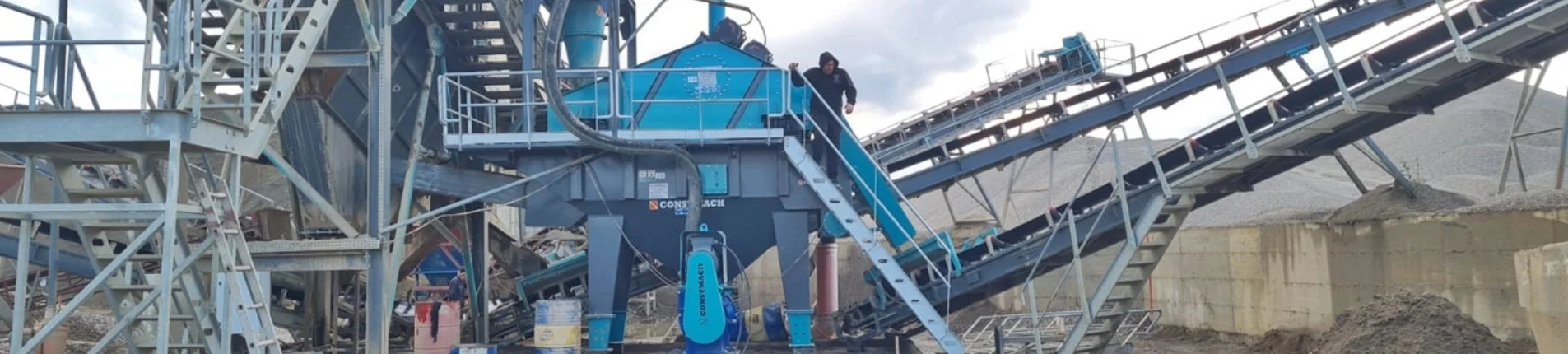
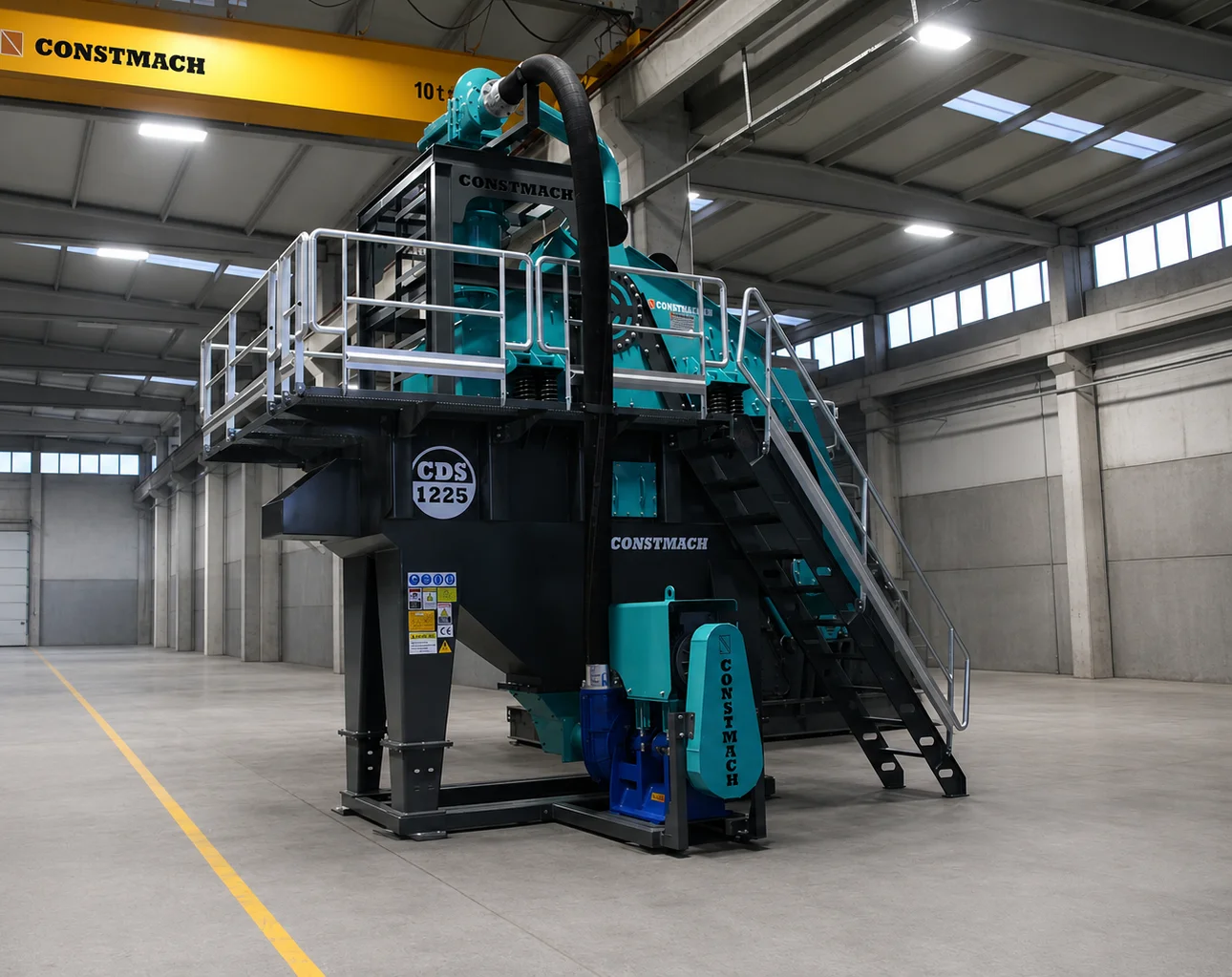
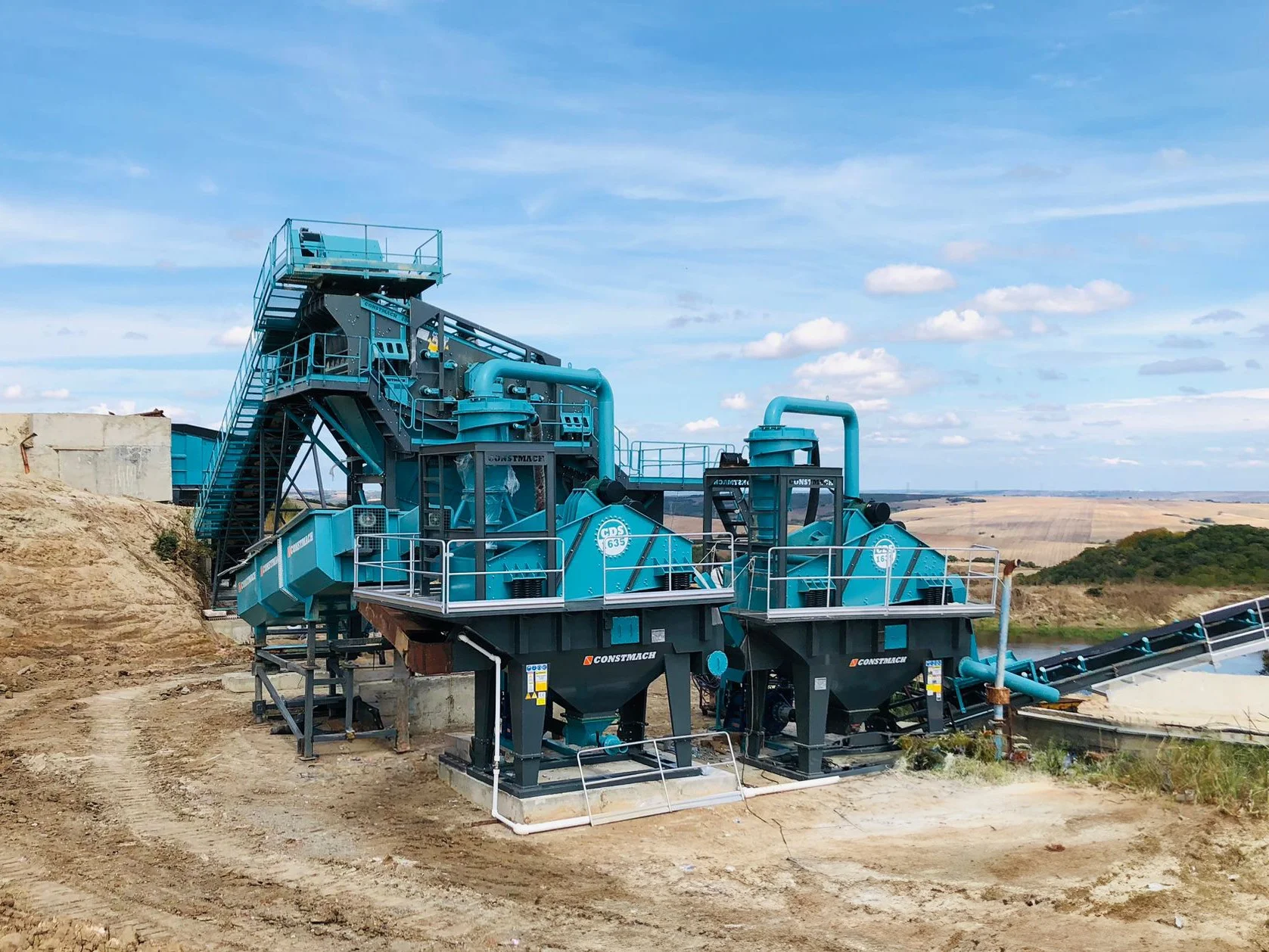
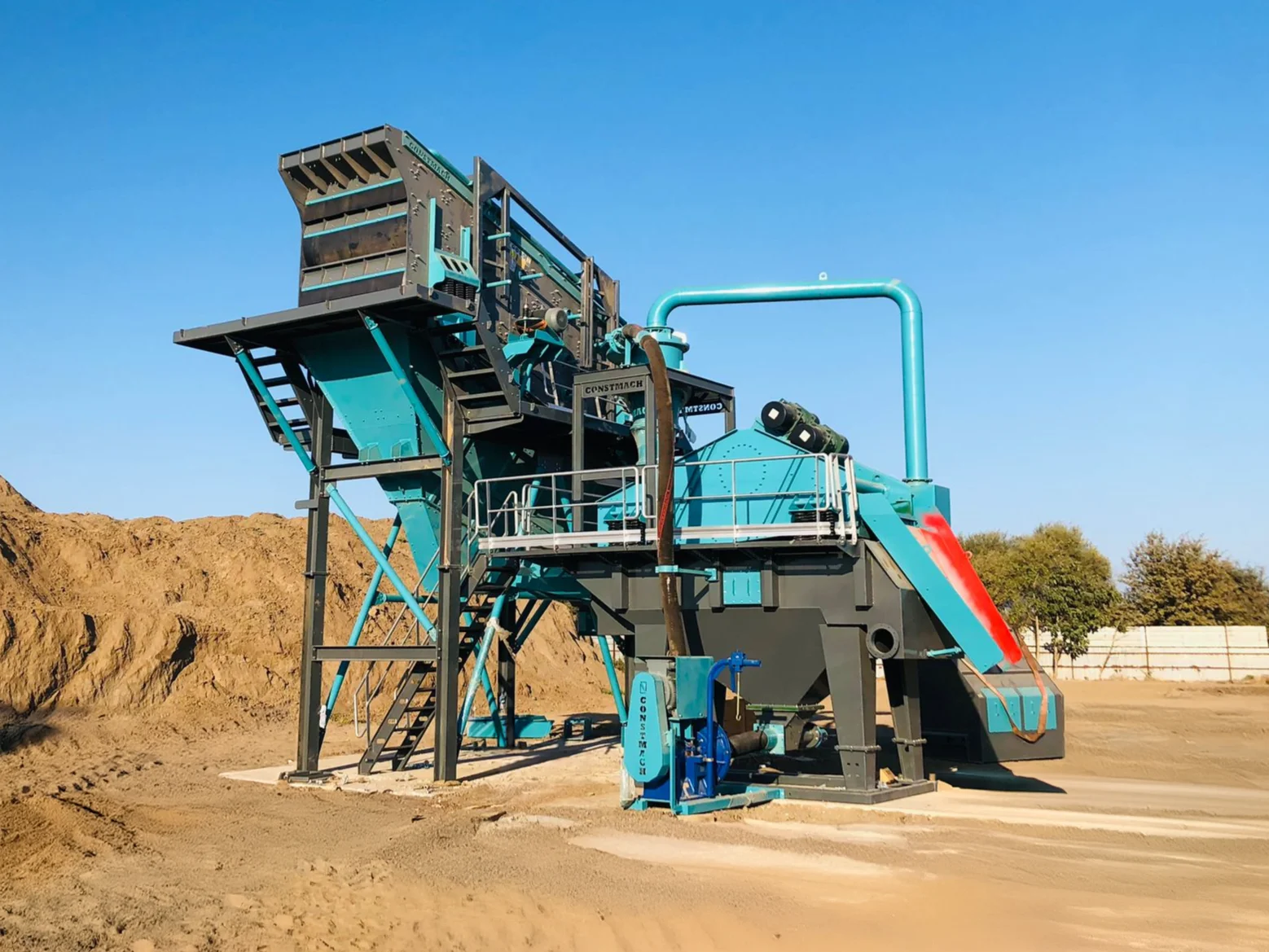
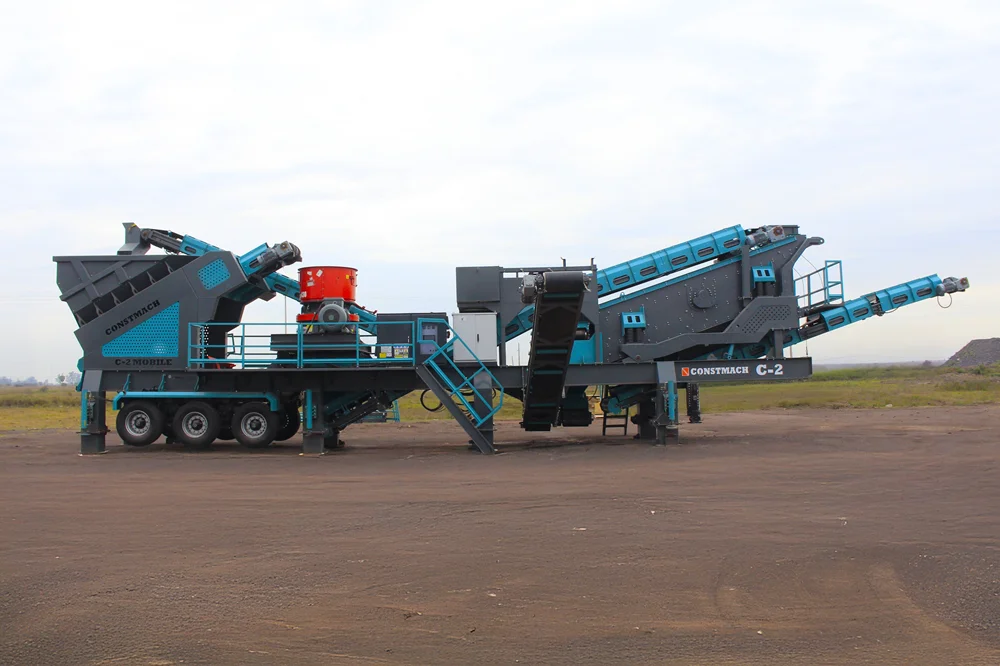
A Constmach dewatering screen with hydrocyclone, the CDS series, is a fine-sand recovery unit that works after the wash, not during it. Sand slurry is pumped up into a hydrocyclone, which thickens it by centrifugal action and drops it onto a high-frequency screen deck. The result is a dry, stackable sand that recovers fines down to about 90 microns, the fraction a screw or bucket-wheel washer normally sends to the pond.
What a dewatering screen with hydrocyclone actually does
The CDS unit has one job: take washed sand slurry and turn it into a low-moisture, conveyable product while rescuing the fine fraction that would otherwise run to waste. It pairs two devices. The hydrocyclone classifies and thickens the slurry, sending coarse and medium particles to its underflow. The dewatering screen then drains the free water from that thickened sand so it leaves the deck dry enough to stack.
This is not a scrubber. It does not break clay bonds or polish grains. By the time the slurry reaches the CDS, the washing is already done. What remains is water management and fines recovery, which is exactly where a screw washer or bucket-wheel washer falls short. A screw or bucket-wheel washer scrubs clay off the grains, but it carries the finest sand over its weir along with the dirt. The CDS picks up that loss.
How the process works, step by step
The sequence is simple and repeatable. A sand slurry from the wash circuit collects in a sump. A slurry pump, 37 kW on the CDS-1225, lifts that slurry up to the hydrocyclone inlet under pressure. Inside the cyclone, the tangential feed creates a spinning vortex. Heavier sand particles migrate to the wall and exit the apex as a thickened underflow stream. The water and the ultra-fine clay slimes leave through the top as overflow.
- Washed sand slurry is collected in a sump below the wash plant.
- The slurry pump feeds it under pressure to the hydrocyclone.
- Centrifugal action thickens the slurry and separates saleable fines from the slimes.
- The cyclone underflow discharges onto the high-frequency dewatering screen deck.
- The screen drains free water; dry sand discharges off the end to a conveyor.
- Drained water returns to the circuit; overflow slimes go to the settling pond.
The high-frequency vibration on the deck is what keeps the water moving forward and out through the panels while the sand bed forms and dewaters. A drainage weir at the discharge end holds a shallow bed so a water table sits above the panels and reports through them rather than running off the end with the sand.
Why pair a hydrocyclone with a dewatering screen
A screen on its own dewaters, but it cannot recover fines that have already left with the wash water. A cyclone on its own recovers fines, but its underflow is still wet. Put them in series and you get both: the cyclone pulls the saleable fines back out of the overflow stream, and the screen takes the moisture out of what the cyclone delivers. Each device covers the other's blind spot.
The key number is roughly 90 microns. A classical screw or bucket-wheel washer flushes particles this fine straight out with the dirt, because the overflow weir cannot hold them back. The hydrocyclone captures them. On a manufactured-sand line that fine fraction is real product and real money, so recovering it changes the economics of the whole plant. Producers who once tipped that material into a pond find it goes onto the stockpile instead, and the moisture they used to ship as dead freight stays behind on the deck.
The Constmach CDS range
Three models cover small to large washed-sand duties. The choice depends on throughput and how much fines recovery you need. Larger units use a bigger cyclone or twin cyclones to handle more slurry without overloading a single cone. The confirmed reference figures are the CDS-1225 deck at 1,200 by 2,500 mm and its 37 kW slurry pump; pump sizing on the larger models is set to the duty of the circuit.
| Model | Screen deck | Hydrocyclone(s) | Capacity | Slurry pump |
|---|
| CDS-1225 | 1,200 x 2,500 mm | Single 20-inch | 60-80 t/h | 37 kW |
| CDS-1635 | Sized to model | Single 26-inch | 100-150 t/h | Sized to duty |
| CDS-2040 | Sized to model | Twin 26-inch | 150-200 t/h | Sized to duty |
The 20-inch and 26-inch figures refer to the cyclone diameter, which sets the cut point and the volume of slurry each cone can process. A larger cyclone passes more slurry but shifts the cut point coarser, so model choice balances tonnage against the fineness you want to recover. Twin cyclones on the CDS-2040 split the feed so the unit can handle a high-tonnage wash plant without pushing a single cyclone past its sensible operating pressure.
Build and wear features
The parts that see abrasive slurry are the wear parts, and they are designed to be swapped. The hydrocyclone is lined to resist the constant scour of sand against its walls and apex. The apex and inlet take the hardest hits and are treated as consumables. The screen panels are modular so a worn section can be replaced without changing the whole deck.
- Wear-resistant cyclone lining and a replaceable apex on the underflow.
- Modular polyurethane screen panels for selective replacement.
- High-frequency vibrating motors or exciters matched to the deck size.
- Drainage weir at the discharge end to hold the dewatering bed.
- Heavy section frame to carry the dynamic load of the vibrating deck.
How the CDS fits into a wash plant
The unit sits at the tail end of the wash circuit. Upstream you have the scrubbing and classifying stage, a log washer, screw washer or bucket-wheel washer that removes clay and silt. The dirty overflow and the washed sand from that stage are collected and pumped to the CDS. Downstream of the CDS you have a dry product conveyor to the stockpile and a return line for the recovered process water.
Because it discharges a stackable product, the CDS removes the need for long drainage bunkers where wet sand sits for days losing moisture by gravity. The sand comes off the deck ready to move, which frees up yard space and shortens the cash cycle between production and sale. It also closes the water loop more tightly, since the screen sends its drained water straight back to the pump sump instead of letting it soak away.
Capacity and sizing
Throughput is driven by two things: the dry tonnes of sand per hour and the volume of slurry the pump must lift. The CDS-1225 handles 60 to 80 t/h, the CDS-1635 covers 100 to 150 t/h, and the CDS-2040 reaches 150 to 200 t/h. Match the unit to the output of your wash plant, then check that the cyclone count suits the slurry volume, not just the dry tonnage.
A few sizing pointers from the field:
- Feed grading: a finer feed needs more cyclone capacity to hold the cut point.
- Solids concentration: very dilute slurry means more water to pump per dry tonne.
- Head: the vertical lift to the cyclone inlet sets the pump duty.
- Headroom: leave margin above peak so the unit is not run flat out continuously.
Two plants with the same dry tonnage can need different models if one runs a much finer or more dilute feed, because the slurry volume, not the dry sand, is what overloads a cyclone. Size on the worst case the plant will actually see, not the nameplate average.
Materials and applications
The CDS is built for washed and manufactured sand. It suits river sand, crushed-rock manufactured sand, and any fine aggregate where moisture and fines loss matter. Typical end products are well-graded sand for concrete and asphalt mixes, plaster and masonry sands, and filter or sports sands where grading and dryness are specified.
Anywhere a producer is currently throwing fines into the pond and shipping wet sand, the CDS pays back by recovering product and cutting moisture. It is a fit for fixed sand-washing plants and for producers upgrading an existing wash line that loses too much fine material. On a manufactured-sand operation it also helps hit grading curves, because the recovered fines fill out the bottom end of the gradation that crushed feed often lacks.
Process role at a glance
- Scrub and classify, screw or bucket-wheel washer, removes clay, silt and oversize.
- Recover fines, hydrocyclone, captures particles down to about 90 microns.
- Dewater, high-frequency screen deck, drains free water and delivers dry sand.
- Convey, stockpile conveyor, moves stackable product to the pile.
Maintenance
Routine work centres on the wear parts and the water path. Check the cyclone apex regularly; as it wears, the cut point drifts and you start losing more fines to overflow or sending too much water to underflow. Inspect screen panels for blinding and tears, and keep the discharge weir set correctly so the bed holds. Watch pump seals and impeller wear, since slurry pumps live a hard life.
- Inspect and rotate or replace the cyclone apex on a set schedule.
- Replace blinded or torn screen panels individually as needed.
- Monitor slurry pump impeller and seal wear; keep a spare on the shelf.
- Keep feed pressure steady; surging pressure upsets the cyclone cut.
- Clear the sump of settled solids so the pump feed stays consistent.
Most of this is quick visual work that fits into a normal shift change. The discipline that matters is doing it on a schedule rather than waiting for the product to go off-spec, because by the time wet or dirty sand shows up at the stockpile you have already lost a batch.
Common mistakes to avoid
The most frequent error is treating the CDS like a washer and expecting it to clean dirty sand. It cannot. If the feed still carries clay, that clay reports to the product. Put the cleaning upstream. The second mistake is undersizing the pump or the cyclone for the slurry volume, which floods the unit and pushes fines out the overflow, the exact loss you bought the machine to stop.
Other avoidable problems: running a worn apex too long, neglecting weir setting so the bed runs dry and water carries sand off the end, and feeding wildly variable slurry concentration. Stable feed in, stable dry sand out. A surging pump or a half-empty sump shows up immediately as a wandering cut point and a wetter product, so the sump level and feed pressure deserve as much attention as the wear parts.
What lower moisture is worth
Moisture is the figure that drives the payback most operators do not put a number on. Sand drained on a gravity bunker often leaves the yard at twelve to fifteen percent moisture by weight. Off a high-frequency dewatering screen the same sand typically discharges in the region of single-digit moisture, depending on grading and feed. The difference is not academic. Every tonne shipped at a higher moisture is partly water you mined, screened and loaded for no return, and on a sold-by-weight basis the buyer is paying for water freight rather than sand.
There is a quality dimension as well. Wet sand bridges in hoppers, blocks gates and skews the water that downstream batching adds to a mix. Drier, more consistent sand meters cleanly and lets the operator hold a tighter water-cement ratio. For a producer feeding a concrete or asphalt customer who controls moisture closely, a stable low-moisture sand is easier to sell and less likely to draw a rejection. The dewatering screen earns its keep on the loading scale and at the customer gate, not only in the fines it saves.
Reading the symptoms when output drifts
An experienced operator reads the discharge before reaching for an instrument. Wet sand spilling off the screen end usually means the bed is too thin or the weir has dropped, so the water is escaping with the product rather than draining through the panels. Sand appearing in the cyclone overflow line points the other way: the apex is worn open or the feed has gone too dilute, and saleable fines are running to the pond. A dry, ratty bed that lets water shoot straight off the deck says the feed has thinned or stopped.
Each of these traces back to one of three inputs: the apex condition, the feed concentration, or the pump and sump behaviour. Hold those steady and the unit holds its output. Let any one of them wander and the product moves off-spec within minutes, which is why the daily checks centre on the apex, the weir and the sump level rather than on the screen itself. The screen is the most visible part of the machine but the least likely to be the cause when something drifts.
Installation and integration notes
The CDS is a compact addition to an existing yard, but a few site points decide whether it runs smoothly. The slurry pump needs a short, steady feed from a sump that does not run dry, so the sump should be sized to buffer the wash circuit and positioned close to the pump. The vertical lift to the cyclone inlet sets the pump head, so keep the cyclone no higher than the duty requires and avoid long horizontal slurry runs that add friction loss. Drained water from the screen wants a clear gravity path back to the sump, and the cyclone overflow needs a line to the settling pond that will not silt up.
Mechanically the deck is a dynamic load, so its support steel or foundation has to be level and stiff enough not to flex under the exciters. Tie the start and stop of the pump and the screen drive together so the deck is never fed without vibrating, and provide isolation on the pump for maintenance. None of this is unusual for a wash plant, but getting the sump, the lift and the return lines right at the planning stage avoids the surging feed and vibration complaints that otherwise surface in the first weeks of running.
How to choose the right CDS
Start with the dry sand tonnage you need to dewater and the grading of your washed product. Pick the model whose capacity band brackets your peak, then confirm the cyclone configuration suits the slurry volume your pump will deliver. A high-tonnage, very fine feed points toward the twin-cyclone CDS-2040; a modest fixed plant is well served by the CDS-1225.
Bring real data: feed grading, target product spec, slurry solids and the lift to the cyclone. Constmach application engineering uses these to confirm the model, cyclone count and pump duty so the unit recovers the fines you are paying to keep and ships sand dry enough to load straight from the pile. Sized correctly, the CDS raises both yield and product dryness on any washed-sand line, and it does so with a short list of wear parts that any plant team can manage.