







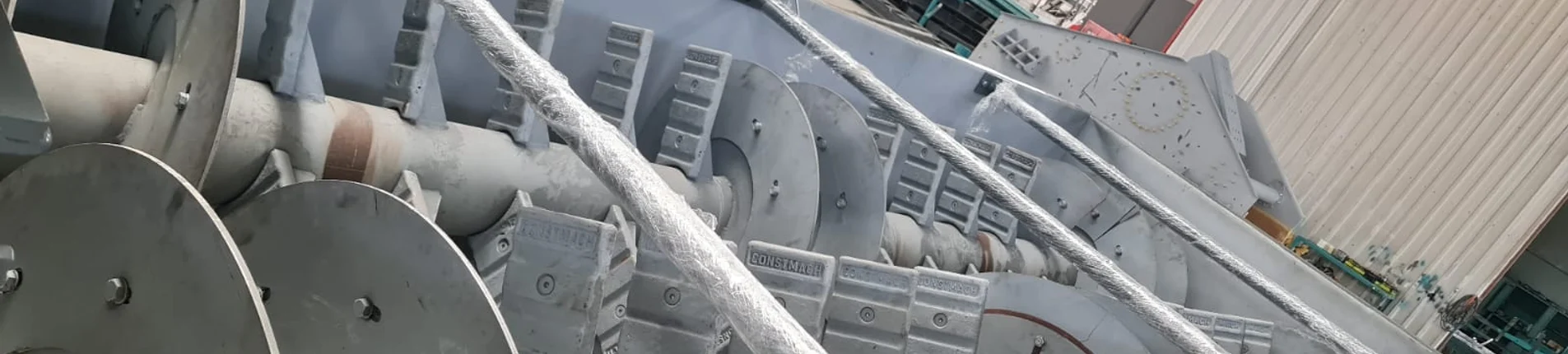

Log Washer

The CONSTMACH Log Washer is a heavy-duty aggregate scrubbing machine designed for the most heavily contaminated feed materials, where standard sand washers cannot break down bonded clay and silt. It belongs to the Gravel Washing Systems product group and is used wherever gravel, crushed stone, or run-of-mine aggregate arrives with a high content of plastic clay, loam, or other sticky impurities that must be removed before the material can be used in concrete, asphalt, road base, or other engineered applications.

The machine is built around two parallel shafts fitted with hardened paddles, arranged in a long inclined trough. The shafts counter-rotate, and the paddles are set on a helical pattern so that material is both lifted and conveyed up the incline while being continuously turned over. This combination produces an intense scrubbing action: aggregate particles are forced against one another and against the paddles, and the resulting abrasion strips clay and silt coatings from the stone. Because the cleaning relies on stone-on-stone attrition rather than only on water pressure, the Log Washer is effective on tightly bonded, plastic contaminants that resist conventional washing.

Water is introduced into the trough to carry away the liberated fines. As the paddles drive the cleaned aggregate up the incline toward the discharge end, the slurry of clay, silt, and wash water overflows at the lower end and is directed to the downstream water-treatment or settling stage. The clean, coarse aggregate exits at the top, ready for screening, further washing, or stockpiling. The angle of installation and the rotational speed of the shafts can be adjusted to suit the type and severity of contamination, allowing operators to balance retention time, throughput, and cleaning intensity.

The CONSTMACH Log Washer accepts feed material up to 50 mm in size and is suited to gravel, crushed stone, and similar aggregates with high clay or loam content. Typical applications include sand and gravel pits, quarries, and mineral processing and recycling operations where dirty feed would otherwise compromise product quality. In mining contexts, the same scrubbing principle is used to liberate valuable minerals locked within clay.

The standard configuration offers a throughput in the range of approximately 200 to 400 tons per hour, making it a high-capacity unit positioned at the front of a washing circuit. It is powered by two electric motors and runs at a controlled shaft speed in the order of 15 to 25 rpm, low enough to maximise scrubbing contact time while protecting the wear components. The unit is engineered for continuous operation under abrasive conditions, with a robust steel main body and wear-resistant paddle facings.

Key components reflect the demanding duty: a welded steel trough forms the main body, the shafts are produced from chromium-nickel-molybdenum alloy steel, the paddles and helices are protected with abrasion-resistant facing, and the drive line runs on heavy-duty spherical roller bearings in cast steel housings. Replaceable wear parts and a low operating speed are intended to extend service life and reduce downtime in continuous washing plants.

Within a complete washing system, the Log Washer typically operates as the primary scrubbing stage, ahead of vibrating screens, sand washers, and water-clarification equipment. By removing the bulk of the clay and silt at the inlet, it protects downstream equipment, improves the efficiency of subsequent washing and grading, and helps ensure that the finished aggregate meets cleanliness requirements for construction use.

Log Washer Technical Specifications

Size2.000 x 7.000 mm (Double Row)
Electric Motor2 x 37 kW, GAMAK Brand, IE3 Efficiency class, 1500 rpm
Feeding Size0 - 50 mm
Main Body MaterialS235JR A1 Quality, 8 mm Sheet as Twisted Type
Speed15 - 25 rpm
ScrewDouble Row Carrier Spiral Spoons, S235JR, 8 mm Sheet and the Arms Against Wear Will be Covered With Casting, Helices are Hardox Coated.
ShaftCr-Ni-Mo Alloy Steel
HousingGS52 Steel Casting
BearingSKF or FAG, Heavy Duty type spherical roller bearings
Capacity200 - 400 tph
Weight24.000 kg

Log Washer General Layout

FAQ

The CONSTMACH Log Washer is a twin-shaft scrubbing machine used to clean heavily contaminated gravel and crushed stone by mechanical abrasion. The questions below cover what it produces, the materials it handles, how the scrubbing process works, where it is applied, how wash water is managed, and what maintenance the wear components require.

What does the Log Washer do?

It removes bonded clay, silt, and loam from coarse aggregate through intense stone-on-stone and stone-on-paddle abrasion. The output is clean, coarse aggregate suitable for further screening, washing, or direct use, while the liberated fines are carried away in the wash water.

What materials and feed sizes can it handle?

The machine is designed for gravel, crushed stone, and run-of-mine aggregate with a high content of plastic clay or loam. The standard unit accepts feed material up to 50 mm.

How does the twin-shaft scrubbing process work?

  • Two counter-rotating shafts carry hardened paddles arranged in a helical pattern.
  • The paddles lift, turn, and convey the material up an inclined trough.
  • Abrasion between particles strips clay and silt from the stone.
  • Wash water carries the liberated fines to overflow, while clean aggregate discharges at the top.

Where is the Log Washer used?

It is applied in sand and gravel pits, quarries, aggregate washing plants, recycling operations, and mineral processing, typically as the primary scrubbing stage for difficult, clay-rich feed.

How is wash water managed?

Water introduced into the trough flushes the separated fines into an overflow that is directed to settling tanks, clarifiers, or filter presses downstream. This allows solids to be removed and, in many installations, water to be recirculated back to the plant.

What maintenance does it require?

Maintenance focuses on the wear components: the paddles and helical facings, the alloy-steel shafts, and the heavy-duty bearings. Operating at a low shaft speed and using replaceable, abrasion-resistant wear parts is intended to extend service intervals and simplify part replacement.

Frequently Asked Questions

whatsapp gorsel 2024 01 10 saat 15 28 30 bf9fc1cb 9474
Quick Contact

Leave a request, and our expert team will as soon as possible get back to you

Fill out the form for detailed information about concrete plants, crushing-screening plants, or our other products — or contact us directly.

By leaving a request, you consent to the processing of your personal data.

or directly

What's new on Constmach

Our expert team is ready to provide a solution tailored to your project. We're just a phone call away — call us now.