







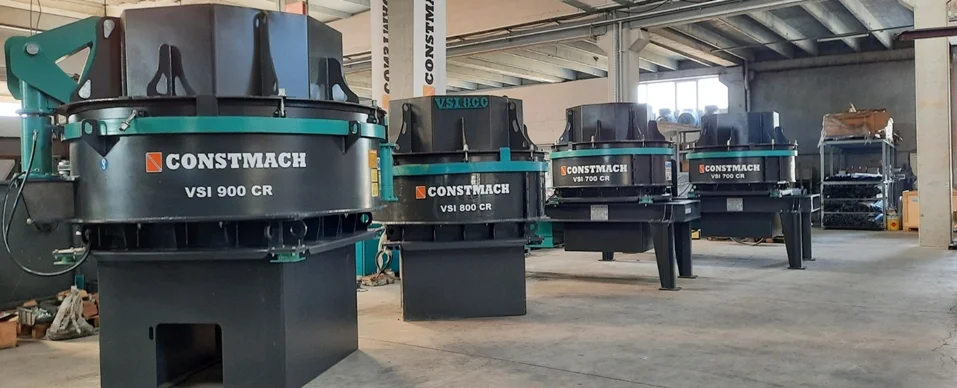

VSI-700-CR | Vertical Shaft Impact Crusher

VSI-700-CR Vertical Shaft Impact Crusher is the compact, single-motor model in CONSTMACH's VSI range, used as a final-stage crusher to produce manufactured sand and to give a cubical shape to the fine fractions coming from secondary crushing. It pairs a 700 mm rotor with a 110 kW drive and an operating weight of 6,500 kg, making it the lightest and most economical sand-making machine in the family, well suited to smaller plants and supplementary sand production.

Vertical shaft impact crushers are widely known as sand-making machines because their role in a crushing and screening line is to convert the fine product of the secondary stage into specification sand and well-shaped fine aggregate. The VSI-700-CR is dimensioned for this duty at modest tonnage with low installed power, so it can be added to an existing plant to make up a sand shortfall, or form the sand circuit of a compact new installation, without a heavy demand on structure or electrical supply.

The CR designation marks a closed-rotor, rock-on-anvil configuration. Material entering the centre of the high-speed rotor is accelerated outward and thrown against fixed anvils arranged around the crushing chamber. The impact against the steel anvils fractures the stone and rounds off its edges, producing a cubical particle and a high proportion of fine material. This anvil arrangement is the preferred choice for harder rock, where rock-on-anvil impact gives a stronger reduction and a more consistent product than an autogenous rock bed.

The VSI-700-CR accepts a maximum feed size of 35 mm, taking the product of a secondary crusher, with the rotor running at a tip speed of 60-70 m/s. The high impact velocity is what generates manufactured sand and shapes the fine aggregate, so the rotor speed is the main control over how much fines the machine produces. Hard stones such as basalt and granite are typical feed, since the closed-rotor configuration is matched to abrasive, high-strength material.

Rated capacity is 60 to 100 tonnes per hour, set by feed gradation, material properties and rotor speed. A variable-speed rotor allows the operator to adapt to changes in material type and product specification, raising tip speed for more fines or lowering it to protect shape and reduce wear. The high reduction ratio achieved through impact lets the VSI-700-CR turn a coarse secondary product into specification sand in a single pass.

The machine is built around heavy-duty roller bearings and a large symmetrical feed box, with four interchangeable crushing chambers that can be configured for different feed sizes and tonnage requirements. An automatic greasing system maintains lubrication during continuous running, supporting reliable operation at the high speeds inherent to VSI crushing and reducing the demand for manual attention.

The VSI-700-CR ships in a modular structure that fits within closed truck trailers and 40 ft open-top containers, keeping transport cost low. In a complete CONSTMACH plant it sits after the secondary crusher in the sand circuit, feeding screens and, where required, sand-washing equipment. Operators needing greater capacity move up to the twin-motor VSI-900-CR, or to the open-rotor VSI-1000-OR for rock-on-rock autogenous crushing of the hardest feed.

VSI-700-CR Technical Specifications

Max Feeding Size (mm)35 mm
Weight (kg)6.500 kg
Motor Power (kW)110 kW
Rotor Diameter (mm)Ø700 mm
Rotor Speed (m/s)60-70 m/s
Production capacity (t/h)60 – 100 t/h

VSI-700-CRVideo

VSI-700-CR General Layout

FAQ

The VSI-700-CR Vertical Shaft Impact Crusher, also known as a sand-making machine, is a final-stage crusher for manufactured sand and fine cubical aggregate. The following covers feed materials, output products, applications, wear-part service, the rock-on-anvil principle and comparisons with alternatives.

What materials can the VSI-700-CR process?

The VSI-700-CR is built for the fine fractions coming from secondary crushers, including hard, abrasive stone. Typical feed includes:

  • Basalt, granite and other hard igneous rock
  • Hard limestone and gravel from secondary crushing
  • Material requiring conversion into manufactured sand

Maximum feed size is 35 mm. The closed-rotor, rock-on-anvil configuration is specifically matched to harder rock, where impact against the anvils gives a stronger, more consistent reduction.

What products does it make?

The VSI-700-CR produces manufactured sand and cubical fine aggregate. Output is used as a sand substitute or supplement in concrete and asphalt, and to upgrade the shape of fine aggregate from upstream crushers. The high-velocity impact creates a high fines content and a cubical grain shape that improves the workability of bound mixes.

Which industries and applications use it?

  • Manufactured (crushed) sand production for concrete
  • Fine aggregate shaping for asphalt and concrete
  • Quarrying and aggregate plants supplementing natural sand
  • Hard-rock processing where natural sand is scarce

What is the difference between rock-on-anvil (CR) and rock-on-rock (OR)?

In the rock-on-anvil (closed rotor, CR) configuration of the VSI-700-CR, material is thrown by the rotor against fixed steel anvils. This gives a stronger reduction and a more consistent product and is preferred for harder rock. In a rock-on-rock (open rotor, OR) configuration, material is thrown against a bed of the same stone, which lowers wear-part consumption but generally yields a slightly different product mix; it is favoured for very abrasive feed where wear cost dominates.

How are wear parts replaced and how long do they last?

The main wear parts are the rotor wear tips, the anvils and the chamber liners. In the rock-on-anvil configuration the anvils take the direct impact and wear faster on abrasive feed, so they are designed to be interchangeable and replaced on a routine schedule. Service life depends on rock abrasiveness, rotor speed and tonnage. The four interchangeable crushing chambers allow the wear arrangement to be matched to the duty.

How does a VSI compare with a tertiary impact crusher?

A tertiary impact crusher uses a horizontal rotor with blow bars and breaker plates and gives strong reduction with cubical shaping for non-abrasive stone. The VSI-700-CR accelerates material against anvils and is the better choice for manufactured sand from harder, abrasive rock, with rotor speed giving precise control over fines. For abrasive feed and a sand product, the VSI is normally preferred, and the two machine types are often combined so the tertiary impactor shapes the coarse fractions while the VSI generates the sand.

How does the VSI-700-CR fit into a complete plant?

The VSI-700-CR is installed after the secondary crusher in the sand circuit, fed from a screen that delivers the correct size fraction. Its output is screened again and, where a washed product is required, passed to sand-washing equipment. The variable-speed rotor lets the operator match the fines yield to demand, and the four interchangeable crushing chambers allow the machine to be reconfigured as feed or product targets change. The unit is supplied within complete CONSTMACH plants or as an addition to an existing line, with wear parts available from the manufacturer.

Frequently Asked Questions

whatsapp gorsel 2024 01 10 saat 15 28 30 bf9fc1cb 9474
Quick Contact

Leave a request, and our expert team will as soon as possible get back to you

Fill out the form for detailed information about concrete plants, crushing-screening plants, or our other products — or contact us directly.

By leaving a request, you consent to the processing of your personal data.

or directly

What's new on Constmach

Our expert team is ready to provide a solution tailored to your project. We're just a phone call away — call us now.