





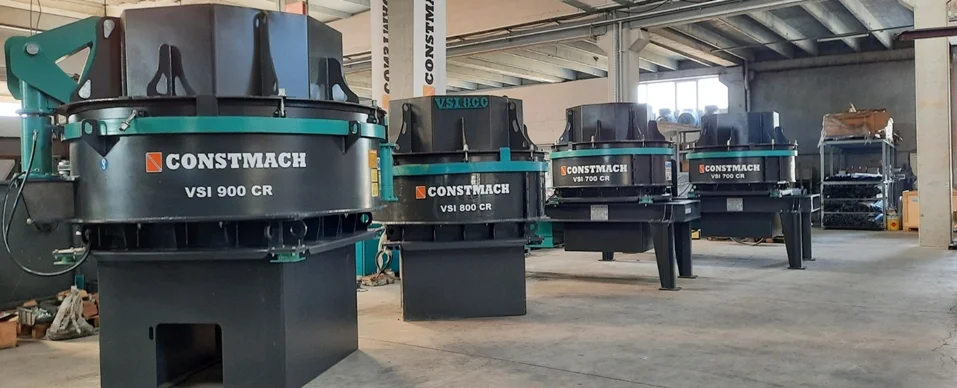

The VSI-900-CR Vertical Shaft Impact Crusher, also known as a sand-making machine, is a high-capacity final-stage crusher for manufactured sand and fine cubical aggregate. The following covers feed materials, output products, applications, wear-part service, the rock-on-anvil principle and comparisons with alternatives.
What materials can the VSI-900-CR process?
The VSI-900-CR is built for the fine fractions from secondary crushers, including hard, abrasive stone, at volume. Typical feed includes:
- Basalt, granite and other hard igneous rock
- Hard limestone and gravel from secondary crushing
- Material requiring conversion into manufactured sand
Maximum feed size is 45 mm. The closed-rotor, rock-on-anvil configuration is matched to harder rock, where impact against the anvils gives a stronger, more consistent reduction.
What products does it make?
The VSI-900-CR produces manufactured sand and cubical fine aggregate at high tonnage. Output serves as a sand substitute or supplement in concrete and asphalt and improves the shape of fine aggregate from upstream crushers. The high-velocity impact yields high fines content and a cubical grain shape that benefits the workability of bound mixes.
Which industries and applications use it?
- High-volume manufactured (crushed) sand production
- Fine aggregate shaping for asphalt and concrete
- Large quarries and aggregate plants supplementing natural sand
- Hard-rock processing where natural sand is scarce
What is the difference between rock-on-anvil (CR) and rock-on-rock (OR)?
In the rock-on-anvil (closed rotor, CR) configuration of the VSI-900-CR, material is thrown by the rotor against fixed steel anvils, giving a stronger reduction and a more consistent product, which is preferred for harder rock. In a rock-on-rock (open rotor, OR) configuration, material is thrown against a bed of the same stone, lowering wear-part consumption but generally yielding a different product mix; it is favoured for very abrasive feed where wear cost dominates.
How are wear parts replaced and how long do they last?
The main wear parts are the rotor wear tips, the anvils and the chamber liners. In the rock-on-anvil configuration the anvils take the direct impact and wear faster on abrasive feed, so they are interchangeable and replaced on a routine schedule. Service life depends on rock abrasiveness, rotor speed and tonnage, and at the VSI-900-CR's output should be tracked against volume. The four interchangeable chambers let the wear arrangement be matched to the duty.
How does a VSI compare with a tertiary impact crusher?
A tertiary impact crusher uses a horizontal rotor with blow bars and breaker plates, giving strong reduction with cubical shaping for non-abrasive stone. The VSI-900-CR accelerates material against anvils and is the better choice for manufactured sand from harder, abrasive rock at volume, with rotor speed giving precise control over fines. For abrasive feed and a sand product, the VSI is normally preferred, and the two types are often combined so a tertiary impactor shapes the coarse fractions while the VSI generates the sand.
How does the VSI-900-CR fit into a complete plant?
The VSI-900-CR is installed after the secondary crusher in the sand circuit, fed from a screen that delivers the correct size fraction, with its output screened again and, where a washed product is needed, passed to sand-washing equipment. The variable-speed rotor lets the operator match fines yield to demand, and the four interchangeable crushing chambers allow reconfiguration as feed or product targets change. It is supplied within complete CONSTMACH plants or as an addition to an existing high-capacity line, with wear parts available from the manufacturer.