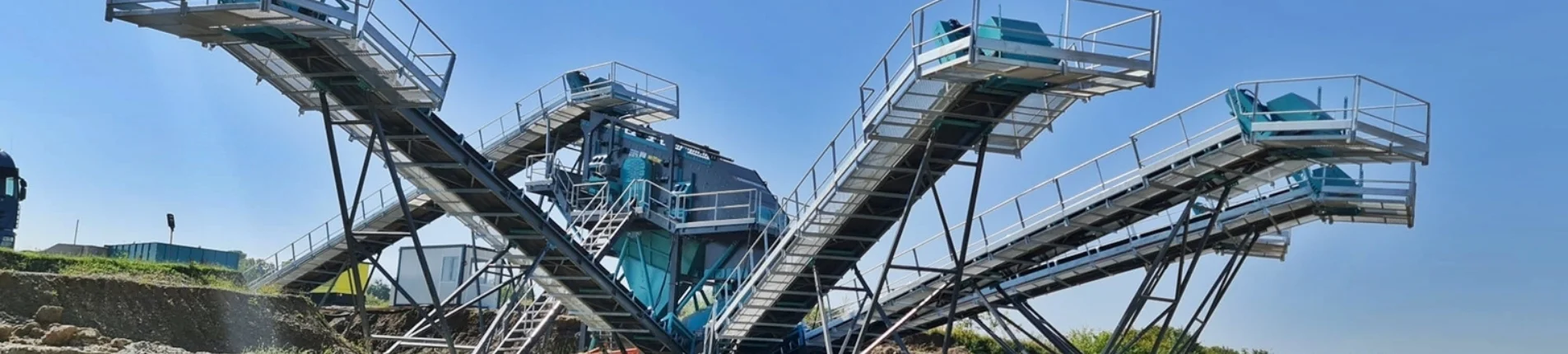
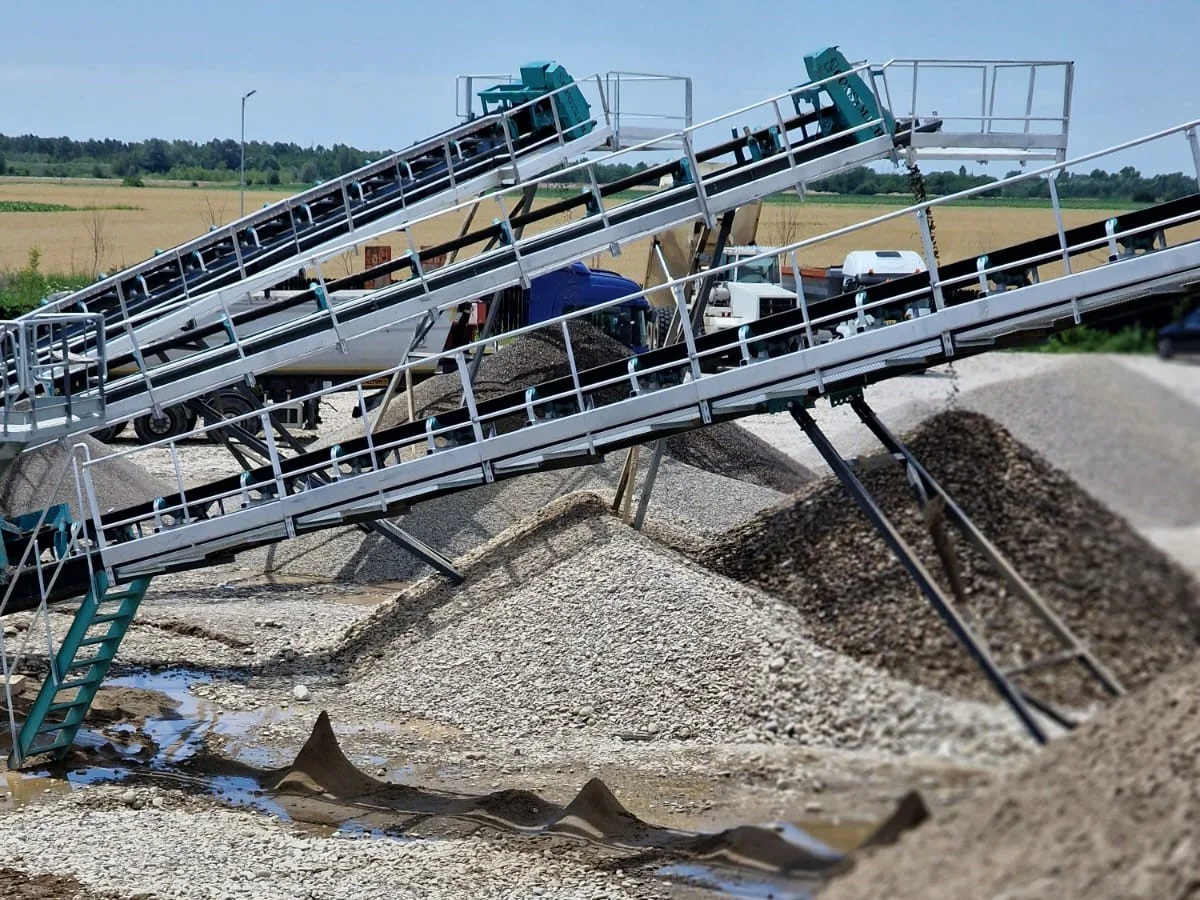
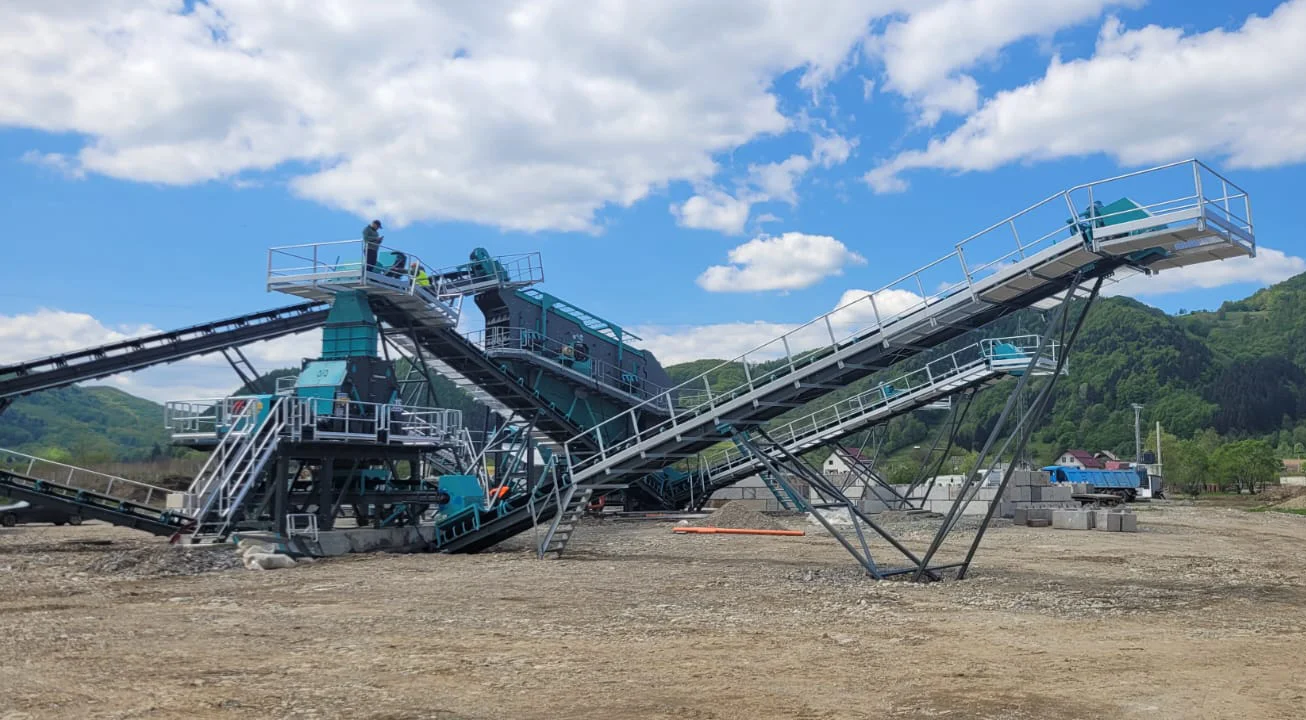
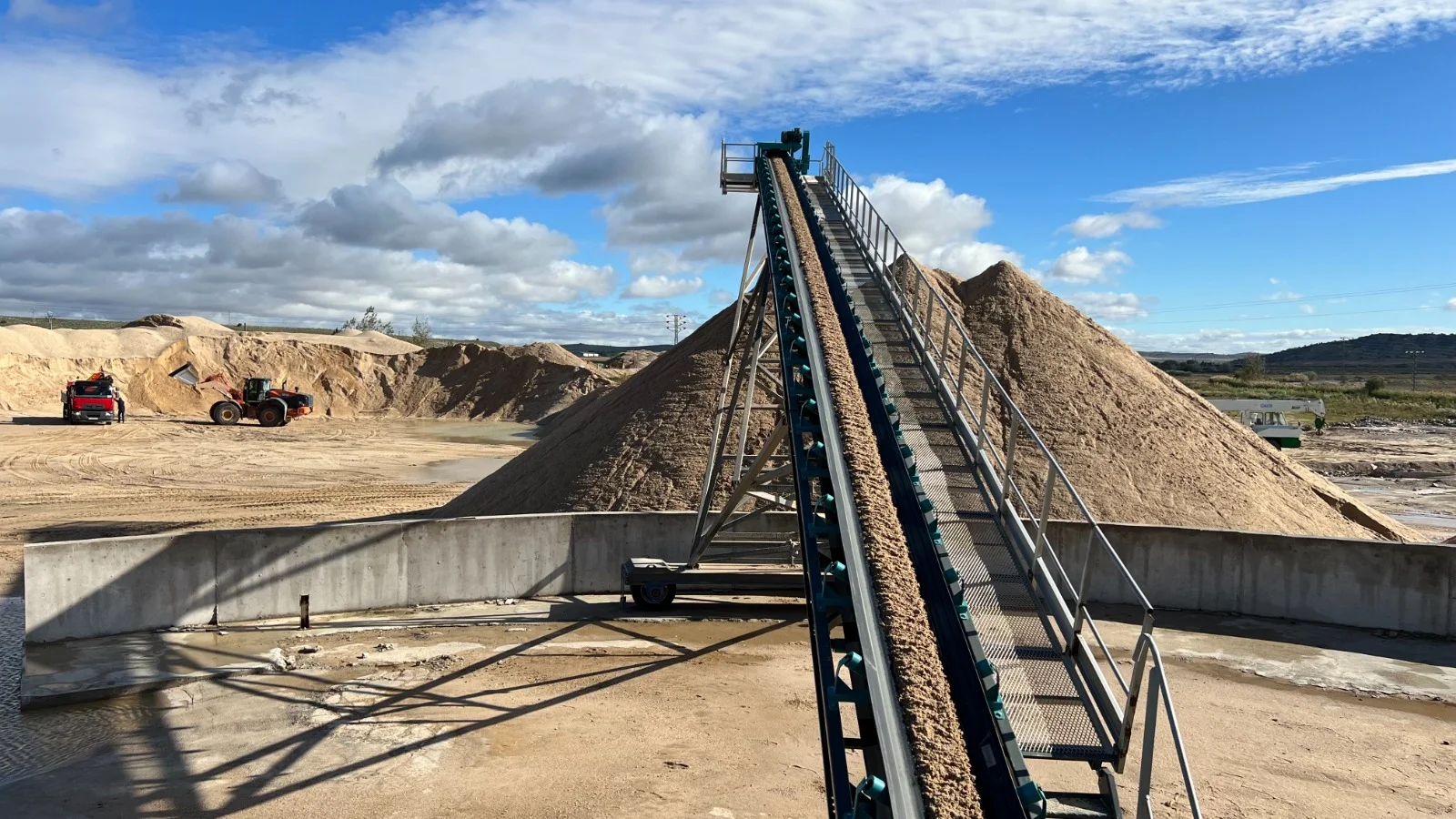
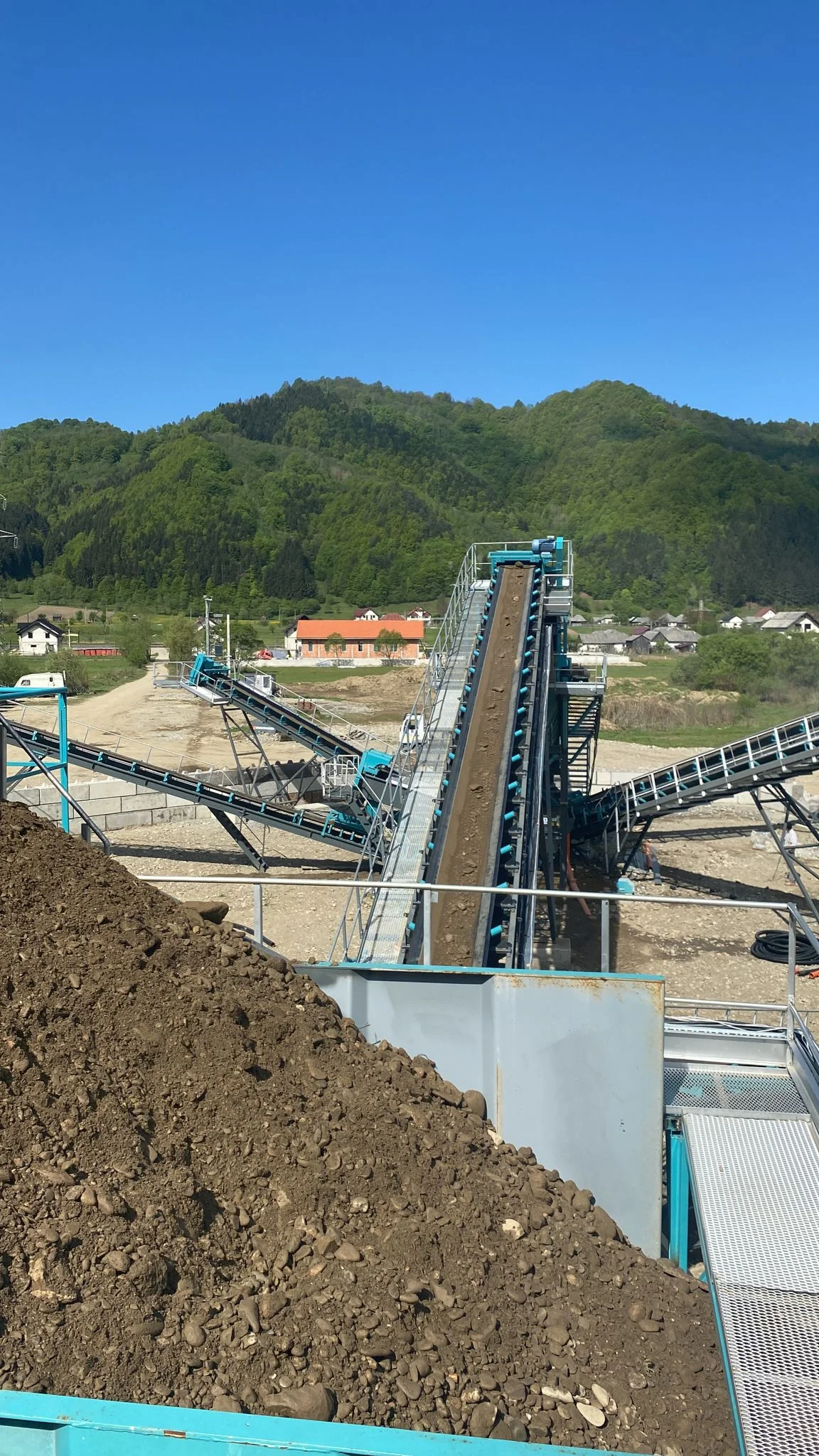
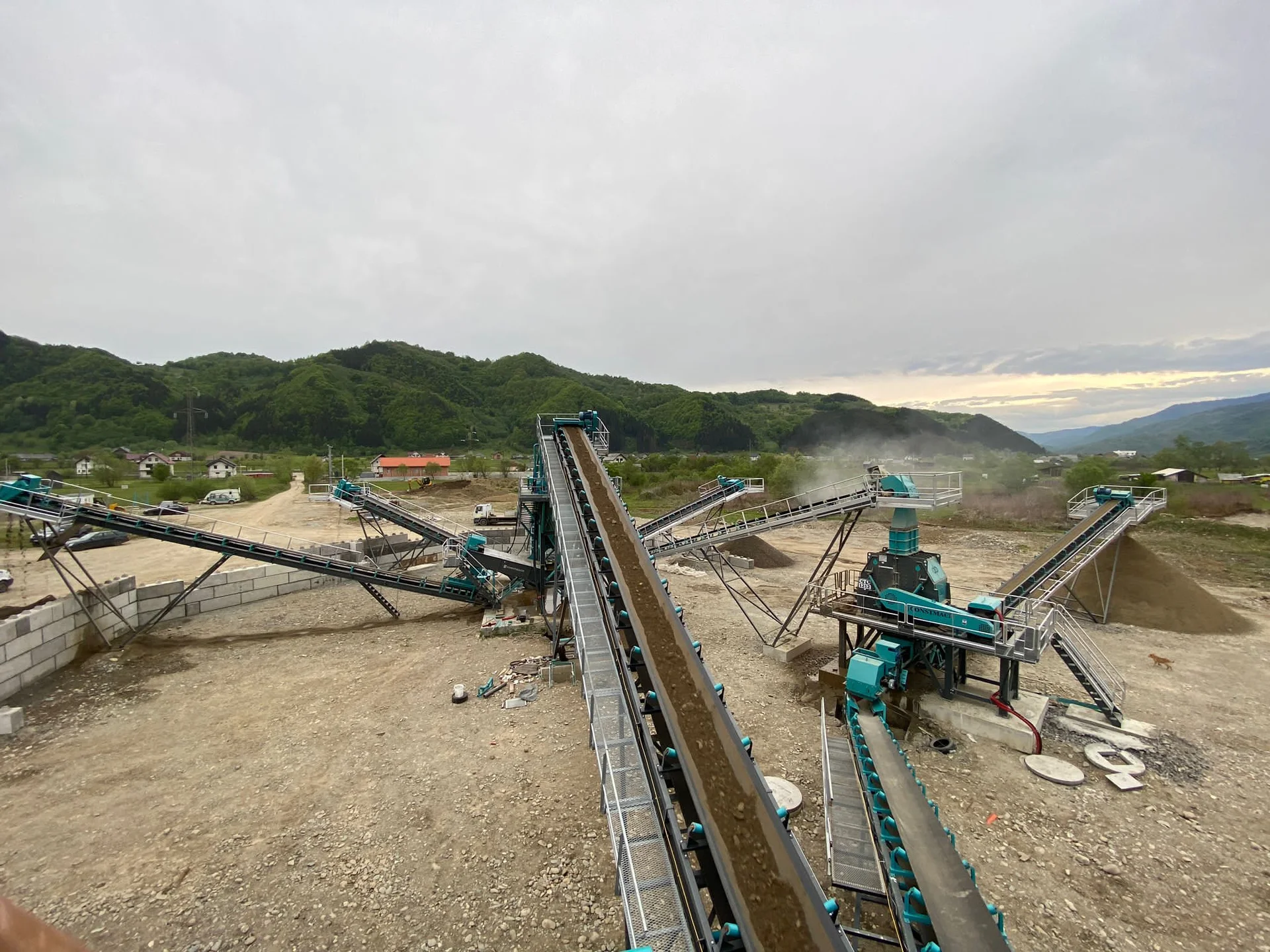
A belt conveyor is a continuous transport machine that carries crushed and screened bulk material from one stage of a plant to the next, and finally out to stockpile. Constmach builds the CBC range in five belt widths from 500 mm up to 1,200 mm, each fitted as standard with a 4-ply rubber belt and selected per application as a smooth or chevron-ribbed profile. The conveyor is the machine that ties a line together: every crusher and screen needs material brought to it and carried away from it, and that is the job the belt does.
What a belt conveyor does in a crushing plant
A belt conveyor moves material; it does not meter it and it does not separate it. That distinction matters on site. A vibrating feeder controls the rate at which material enters the crusher. A vibrating screen splits the flow into fractions by size. The belt conveyor simply receives the discharge from one of those machines and delivers it, continuously and at a steady rate, to wherever it needs to go next. In a typical line a belt picks up the primary jaw crusher product, runs it to the screen, and then a set of belts under the screen decks carries each finished fraction away to its own stockpile.
Because it sits between every other machine, the conveyor is what turns a collection of crushers and screens into a working plant. Take the belts away and you have islands of equipment with no flow between them. That is why belt conveyors appear in every crushing and screening installation Constmach supplies, from a single mobile unit to a large multi-stage stationary plant. The belt is also the one machine that touches material more or less constantly through the whole process, so its reliability sets the pace for everything around it. A crusher can be fed and a screen can be loaded, but if the belt between them stops, the line stops with it.
How a belt conveyor works
The principle is straightforward. An endless rubber belt loops around two pulleys, one at each end of the steel frame. The head pulley is driven; the tail pulley is free. Between them the belt is supported on idler rollers. On the carry side the rollers are arranged in a trough to cradle the material and stop it spilling over the edges. On the return side, beneath the frame, flat rollers support the empty belt on its way back.
The drive motor turns the head pulley through a gearbox, the belt moves, and material loaded at the tail end is carried up the run and thrown off at the head. A take-up unit keeps the belt under correct tension so it grips the drive pulley without slipping. Scrapers at the discharge clean carry-back off the belt surface before it travels round and back along the return side. Each of these parts is sized to the duty the conveyor has to handle, which is why two belts of the same width can carry quite different drives and roller spacings depending on where they sit in the plant.
The belt itself
The belt is the working surface and the largest single wear item. Constmach supplies a 4-ply belt as standard quality, meaning four fabric (tarpaulin) plies bonded within the rubber to carry the tension and resist the impact of falling rock. The profile is chosen to suit the run. A smooth belt is used on horizontal and gently inclined sections. A ribbed, or chevron, profile is specified for steeper inclined runs, where the raised pattern keeps material from rolling back down the belt. The plies do the structural work: they take the pull from the drive and spread the shock of a falling lump so the rubber cover is not the only thing absorbing the impact. A heavier-loaded or longer belt asks more of those plies, which is one reason belt selection follows the duty rather than the model number alone.
Why this type of machine
Continuous belt transport is the most economical way to move large tonnages of aggregate over the short to medium distances inside a plant. It runs steadily, draws modest power for the work it does, and needs little attention between routine checks. Compared with intermittent handling, a belt gives a constant, predictable flow into the next machine, which is exactly what a crusher or screen wants if it is to run at a stable rate. The conveyor also lifts material; an inclined belt raises product to the height it needs for a stockpile or to feed the inlet of a downstream machine, with no extra handling step. Few alternatives match it on cost per tonne moved. Trucks and loaders can shift material, but they need an operator, fuel and space to manoeuvre, and they deliver in batches rather than a steady stream. A belt, once set up, simply runs.
The Constmach CBC range
Constmach designates its belt conveyors CBC and classes them by belt width. Width is the first sizing decision because, together with belt speed, it sets how much material the conveyor can carry and how large a lump it can handle without the rock fouling the skirts or the frame. The five widths cover the full span from a small single-fraction line to heavy primary transport.
| Model | Belt width (mm) | Typical role | Drive |
|---|
| CBC-500 | 500 | Narrowest belt; low-volume runs and single fraction or fines | Electric motor and gearbox |
| CBC-650 | 650 | General intermediate transport between machines | Electric motor and gearbox |
| CBC-800 | 800 | Higher volumes within the line | Electric motor and gearbox |
| CBC-1.000 | 1,000 | High-volume transport | Electric motor and gearbox |
| CBC-1.200 | 1,200 | Heaviest transport, including primary product | Electric motor and gearbox |
The narrow CBC-500 suits a low-volume duty, such as carrying a single finished fraction or fines away from under a screen deck. As the width grows, so does the carrying capacity: the CBC-650 covers general intermediate transport between machines, the CBC-800 handles higher volumes, the CBC-1.000 is a high-volume belt, and the CBC-1.200 is the choice for the heaviest transport, typically primary crusher product where both tonnage and lump size are large. Constmach selects the width, belt speed and length to match each conveyor to its place in your line rather than offering one size for every position. The step between widths is deliberate, so there is a belt that fits each role without leaving a large gap in capacity between one model and the next.
Build quality and main components
A belt conveyor is a simple machine that earns its keep through the quality of a few key parts. Constmach builds the steel frame to carry the belt over its full span and to take the load of the material without sagging between supports. The components that do the work are:
- Head and tail pulleys — the driven head pulley at the discharge and the free tail pulley at the loading end, both sized to the belt width and tension.
- Idler rollers — troughed sets on the carry side to shape the material into the belt, flat rollers on the return side to support the empty belt.
- Drive motor and gearbox — sized to the belt width, speed, incline and tonnage so the conveyor starts under load and runs without slip.
- Scrapers — fitted at the discharge to clean carry-back off the belt and keep the return side and tail pulley clear of build-up.
- Take-up — maintains belt tension as the belt beds in and the temperature changes, so the drive keeps its grip.
The belt and the idler rollers are the parts that wear in normal service, which is why both are treated as standard maintenance items rather than fixed components. The pulleys, frame and drive last far longer and are usually only touched at major overhauls. Keeping that distinction in mind helps when stocking spares: a sensible store holds belting and a set of rollers, not a spare gearbox for every belt.
How the conveyor fits in the crushing line
Picture the flow through a stationary line. Material is tipped into a hopper and a vibrating feeder meters it forward. A belt conveyor then carries it to the primary jaw crusher. The crusher discharge drops onto a second belt that runs up to a vibrating screen. The screen splits the flow, and a belt under each deck carries the separated fractions away. Oversize that needs further reduction is returned by belt to a secondary crusher, such as a secondary impact crusher or a vertical shaft impact crusher, and the finished sizes go by belt to their own stockpiles.
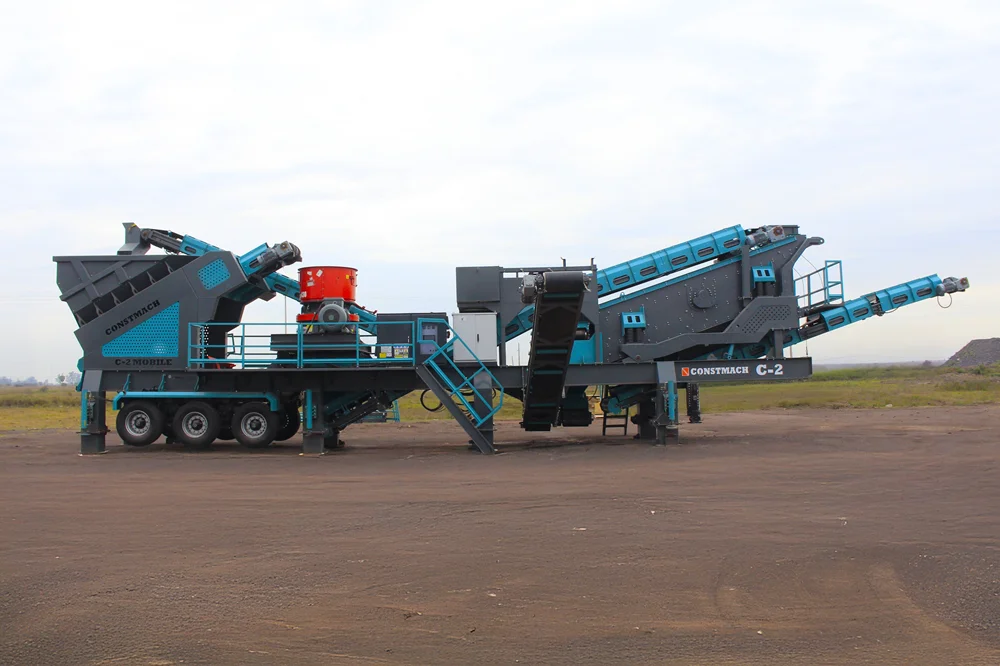
Every one of those links is a belt conveyor. The number, length and incline of the belts depend on the plant layout, the number of crushing stages and how the stockpiles are arranged on the ground. On a mobile plant the same logic applies in a compact form, with shorter belts arranged to fold for transport. The belts also set the geometry of the plant. Where a belt has to deliver into the next machine fixes the discharge height, and the height fixes the length and incline of the belt feeding it. Plan the belts well and the machines line up; plan them poorly and you end up rehandling material or building the plant taller than it needs to be.
Capacity and sizing
Two things govern how much a belt can move: how wide it is and how fast it runs. A wider belt carries a thicker, broader stream of material; a faster belt moves more of that stream past a point each minute. Constmach sets both to the throughput the position demands, then checks the result against the largest lump the belt will carry. Lump size matters because a big rock needs clearance at the skirts and a belt wide enough to centre the load. Putting primary product on too narrow a belt causes spillage and edge damage.
Incline is the third factor. The steeper the run, the more the drive has to work and the more likely material is to roll back, which is where the chevron belt earns its place. When you specify a conveyor, the honest inputs are the tonnes per hour at that point, the top lump size, the horizontal distance and the lift. From those Constmach picks the width from the CBC range, the belt speed, the profile and the drive rating.
A worked sizing example
Take a belt that has to carry the finished 0-5 mm sand from under a screen deck to a stockpile fifteen metres away, lifting it about four metres on the way. The tonnage is modest, the material is fine with no large lump, and the run is short with a gentle climb. A CBC-500 or CBC-650 fits this duty: a narrow belt carries the fine stream comfortably, the smooth profile copes with the gentle incline, and a small drive moves it. Now take the primary jaw crusher product on the same plant, perhaps a wide spread of sizes up to 150 mm at a much higher tonnage, running thirty metres and climbing six. Here the CBC-1.200 is the sensible choice: the wide belt centres the large lumps, carries the high tonnage without running deep, and the heavier drive handles the longer, steeper, fully loaded run. The same plant therefore uses two very different belts, and trying to use one width for both would either choke the primary or waste capacity under the screen. That is the logic behind sizing each belt to its own position.
Materials and applications
Belt conveyors handle the full range of crushed stone and aggregate found in quarrying and recycling. That includes hard rock such as granite and basalt, softer limestone, river gravel, and the various finished fractions a screen produces, from coarse base stone down to sand and fines. The aggregate they deliver feeds the usual end uses, including aggregate for concrete and asphalt, road base and railway ballast.
Selection follows the material. Sharp, abrasive hard rock argues for a good belt quality and well-protected idlers at impact points. Fines and damp material need attention to the discharge and scrapers to control carry-back. The chevron profile comes into its own where a finished fraction has to be lifted up a steep belt to a high stockpile. In recycling work, where the feed can include reinforcing steel, timber and other debris, the loading point and the scrapers deserve extra thought, because tramp material is harder on a belt than clean crushed stone.
Wear economics
The running cost of a belt conveyor is dominated by two items: the belt and the idler rollers. Everything else lasts for years. The way to keep that cost predictable is to treat both as consumables and to look after the things that shorten their life. A belt that tracks true and is loaded in the centre can run for years; the same belt run off-centre frays its edges and fails in a fraction of the time, turning a planned replacement into an unplanned stoppage. The economics favour prevention every time. A few minutes spent adjusting tracking or swapping a seized roller is cheap against the cost of a new belt and the production lost while it is fitted. Material matters too: abrasive hard rock and high impact points wear a belt faster than soft limestone or rounded gravel, so a plant on granite should budget shorter belt life than one on limestone and stock spares accordingly. Buying the right belt width at the start is part of the same calculation, because an under-width belt loaded with oversize wears its edges and needs replacing far sooner than the correct belt would have, wiping out the saving that drove the choice.
Maintenance and wear parts
Day-to-day care is light but it should not be skipped. The belt is the main wear part and its life depends on tracking. A belt that runs off-centre wears its edges, frays and tears far sooner than one that runs true, so checking tracking and adjusting the take-up is the single most useful routine task. Idler rollers are the other wear item; a seized roller drags, flat-spots and chews the belt above it, so rollers that no longer spin freely are replaced before they cause belt damage.
Scrapers need their blades inspected and adjusted as they wear, because carry-back left on the belt builds up on the return idlers and the tail pulley and pulls the belt out of line. Constmach supplies belting, idler rollers, pulleys, scraper blades and drive components as spare parts, so a worn item can be changed without taking the whole conveyor out of service for long.
Operating tips
A few habits keep a belt running well. Load it in the centre and in the direction of travel, so material lands where the trough can hold it rather than to one side. Walk the line during a shift and listen: a roller that has stopped turning often announces itself with a squeal or a hot bearing before it cuts the belt. Keep the area under the return run clear, because spillage that piles up there will eventually foul the belt and the return idlers. Start the belt empty where the layout allows, since starting under a full load asks the most of the drive and the belt joint. Tension the take-up enough to stop slip but no more, as over-tensioning wears the belt and the pulley bearings for no gain. None of this is difficult, and a conveyor that is loaded well and watched during the shift gives very little trouble between routine maintenance stops.
Common mistakes to avoid
- Undersizing the belt width. Choosing a narrow belt to save cost, then loading it with large primary lumps, leads to spillage, edge wear and short belt life.
- Ignoring tracking. Letting a belt run off-centre is the fastest way to ruin it. A few minutes adjusting tracking saves a belt change.
- Using a smooth belt on a steep run. Material rolls back, capacity drops and the belt slips. A chevron profile is the correct choice for steep inclines.
- Neglecting scrapers. Worn or missing scrapers let carry-back build up, foul the return idlers and push the belt off line.
- Loading off-centre. Material that lands to one side of the belt drags it sideways and accelerates edge wear; the loading point should centre the load.
How to choose the right conveyor
Start from the position in the plant, not from a model number. Establish the tonnes per hour the belt has to move at that point, the largest lump it will see, the horizontal length of the run and the height it has to lift. Those four figures point to a belt width in the CBC range and a belt speed. Then settle the profile: smooth for level and gentle runs, chevron for steep inclines. A narrow CBC-500 is right for a low-volume single fraction; a CBC-1.200 is what heavy primary transport calls for.
Specify each conveyor for its own duty rather than fitting one width everywhere. A plant usually runs a mix of widths, with the heaviest belts on the primary line and narrower belts under the screen decks. Matched correctly, a belt conveyor is among the most reliable machines on site, carrying material year after year on routine attention to tracking, rollers and scrapers.