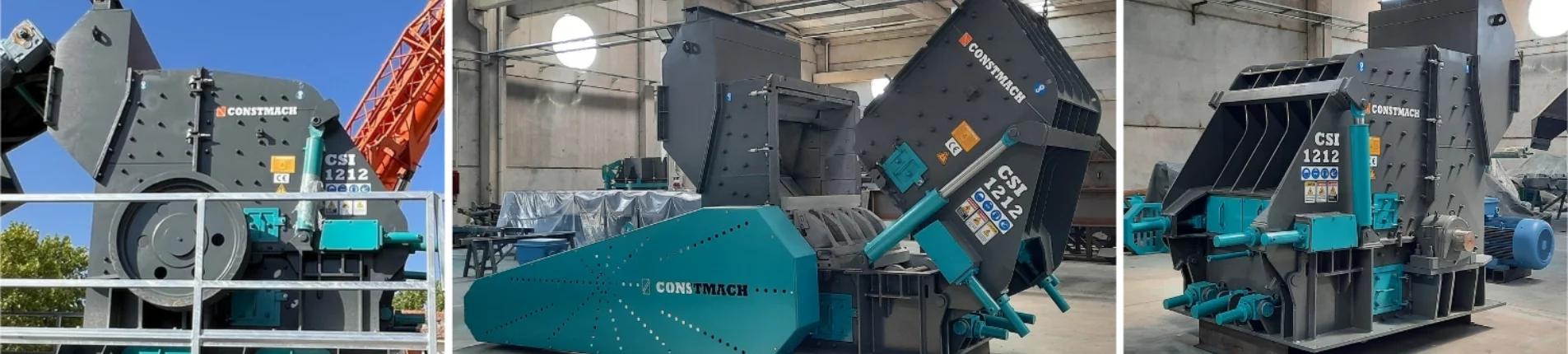
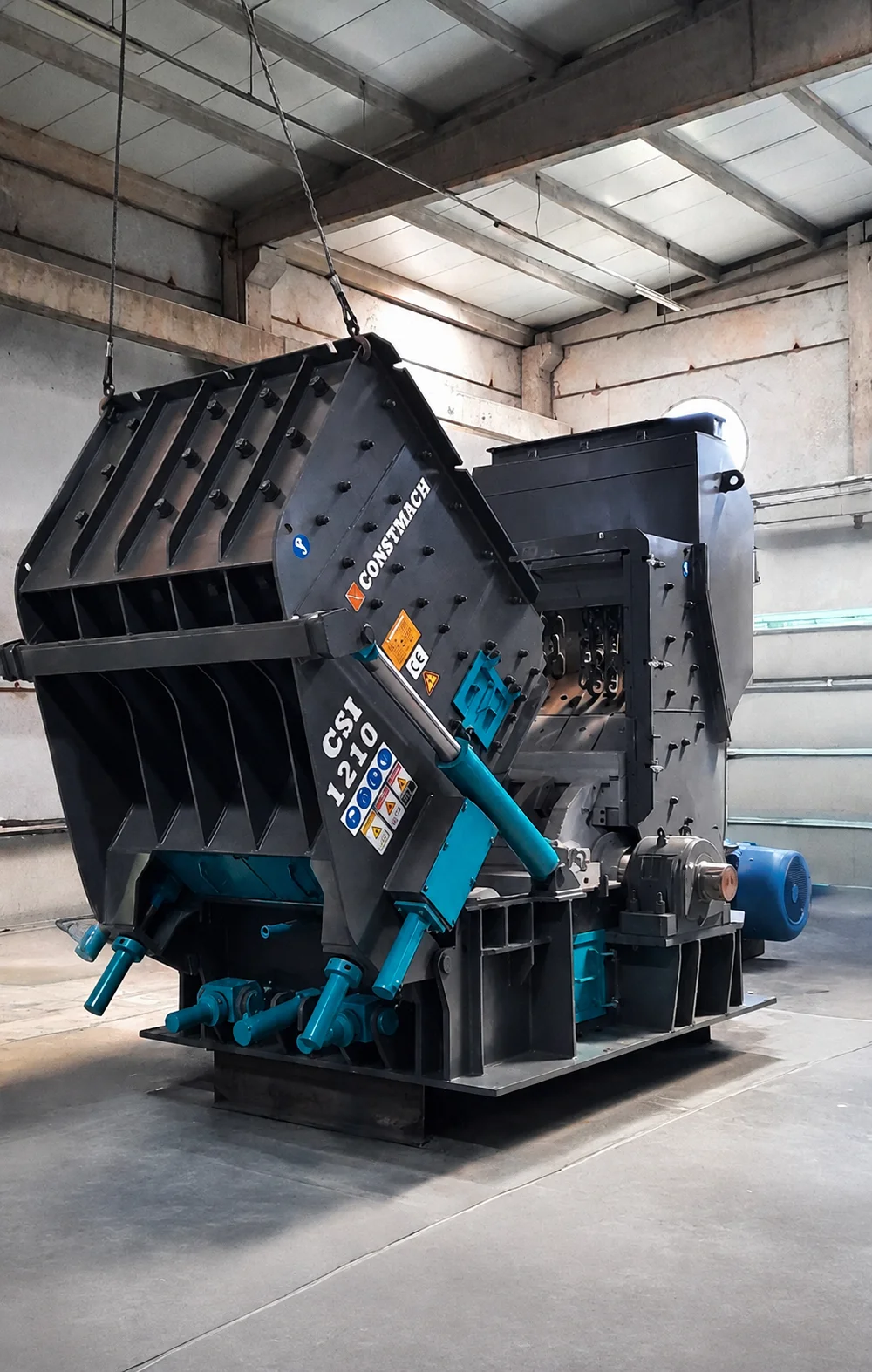
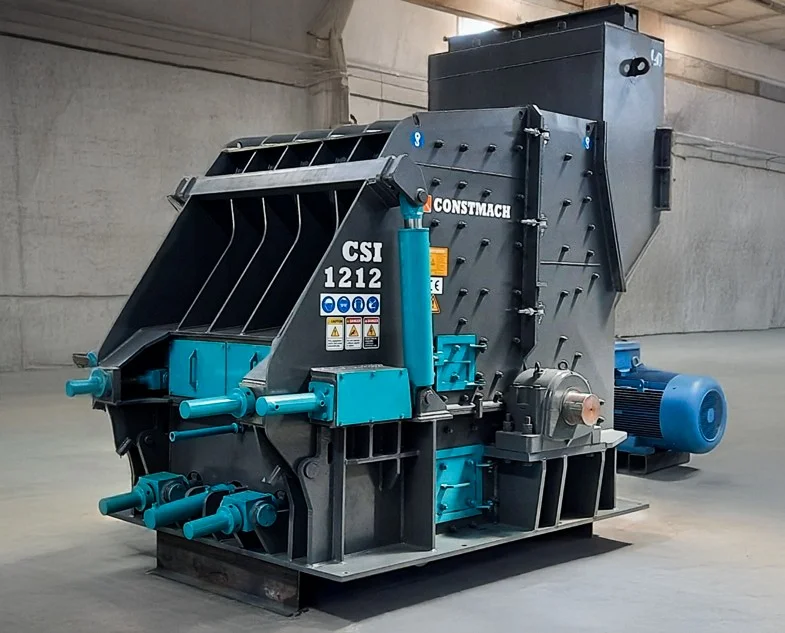
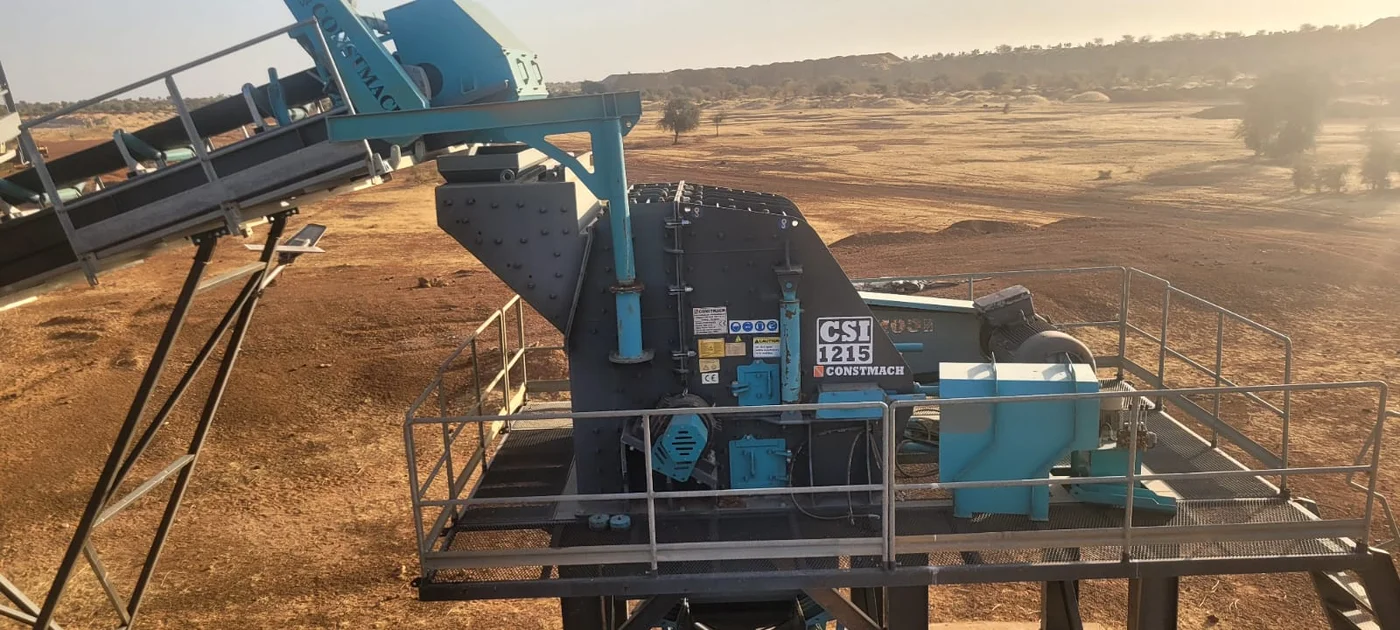
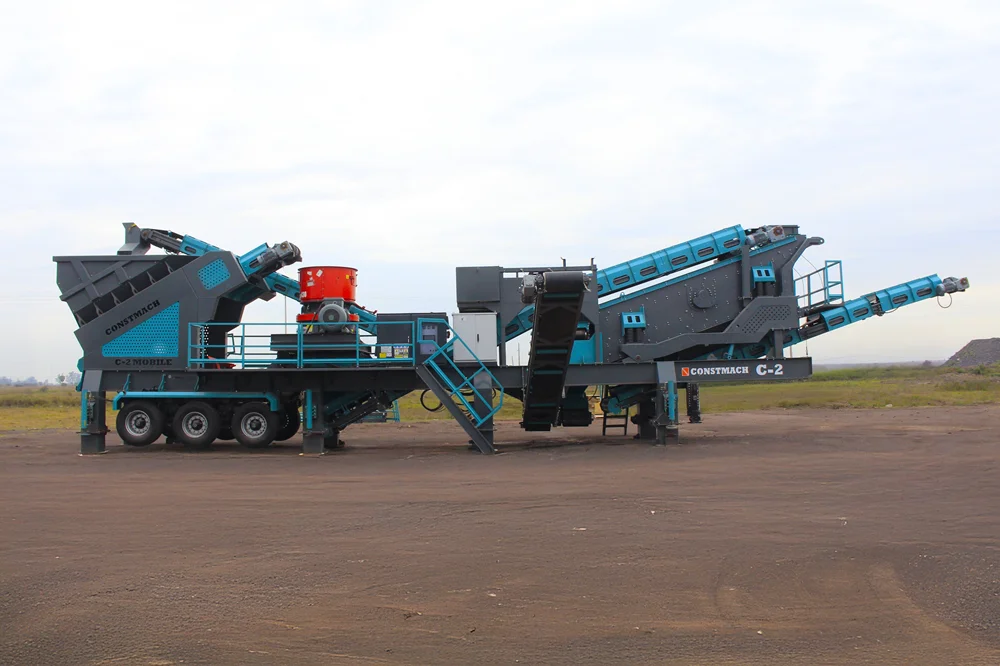
A secondary impact crusher is a second-stage machine that takes the product of the primary crusher and breaks it down further while sharpening particle shape. Constmach builds the CSI range in three sizes from 60 to 250 t/h, all using manganese blow bars on a rotor that throw rock against fixed breaker plates to make cubical aggregate for concrete and asphalt.
What a secondary impact crusher is
The secondary impact crusher sits in the middle of a crushing line. It receives the pre-reduced feed from a jaw crusher or primary impact crusher and reduces it again to a closer, more saleable gradation. The job is not just size reduction. It is shape. A well-set secondary impact crusher converts flaky or slabby pieces into cubical grains, which is exactly what concrete mix designs and asphalt specifications reward.
Constmach's CSI machines are purpose-built for this position. They are not scaled-down primaries and they are not asked to swallow run-of-quarry boulders. They handle a controlled feed and concentrate on producing a consistent, well-graded product. That focus is what lets them run efficiently at the tonnages they are rated for. A primary crusher is judged on how much it can swallow and how reliably it breaks the biggest lumps in the quarry. A secondary machine is judged on something subtler: the percentage of finished product that lands inside spec, the cubicity of that product, and the cost of the wear parts consumed per tonne. Those are different problems, and the CSI is shaped around the second one.
How the impact principle works
Inside the chamber a heavy rotor spins at high speed. Manganese blow bars bolted to that rotor strike the incoming rock and hurl it across the chamber against the breaker plates. The rock fractures along its natural cleavage lines. It then rebounds, gets struck again, and the cycle repeats until the fragments are small enough to pass through the gap between the rotor and the lower breaker plate.
Because the rock breaks along internal flaws rather than being squeezed, the resulting pieces tend to be cubical rather than elongated. The output size is controlled by the gap setting between the breaker plates and the rotor, by rotor speed, and by the feed rate. Tighten the gap and you get a finer, more reduced product; open it and you pass coarser material at higher throughput.
It helps to picture the energy path. The motor spins the rotor up to working speed and the rotor stores that energy as rotational inertia. Each blow bar delivers a fraction of it to every stone it meets, accelerating the stone to a velocity high enough that the impact against the breaker plate exceeds the rock's tensile strength. Stone is far weaker in tension than in compression, so impact crushing exploits the rock's own weakness instead of fighting its strength. That is why an impact crusher reaches a high reduction ratio in one pass, and why it produces shape that a compression machine struggles to match on the same feed. The price of that efficiency is metal: every joule that breaks rock also abrades the bar that delivered it, which is the reason wear-part choice and material matching dominate the running cost.
Why choose an impact crusher in the secondary stage
There are two common ways to crush in the secondary position: compression, using a cone crusher, or impact, using a machine like the CSI. Impact crushing has a clear advantage where shape and high reduction ratio matter and where the rock is not strongly abrasive.
An impact crusher gives a higher reduction ratio in a single pass, so you often need fewer machines to reach final product. It produces a better cubical shape than a cone in many limestone-type materials. And the chamber is open and simple, which makes it easy to inspect and service. The trade-off is wear: impact crushing is harder on wear parts when the feed is abrasive, which is why the secondary impact crusher is matched to medium-hard, lower-abrasion rock.
The choice also shapes the rest of the plant. A higher reduction ratio per pass can collapse what might have been a three-stage compression flowsheet into two stages, which removes a crusher, a screen deck, a stretch of conveyor and the civil works that carry all of it. Fewer machines mean fewer transfer points, fewer motors to power and fewer items on the maintenance roster. For a limestone producer selling shaped aggregate, that simplicity often outweighs the extra wear metal an impact chamber consumes, because the wear is cheap when the rock is soft and the shape commands a better price at the weighbridge.
The Constmach CSI range
The CSI family covers three rotor sizes. The right model depends on your required throughput, your feed size from the primary, and the gradation you need to deliver. The table below summarises the range.
| Model | Rotor (mm) | Capacity (t/h) | Drive |
|---|
| CSI-1210 | 1,100 x 1,100 | 60 - 100 | 160 kW |
| CSI-1212 | 1,100 x 1,250 | 120 - 150 | 200 kW |
| CSI-1215 | 1,100 x 1,500 | 200 - 250 | 250 kW |
All three share the same working principle and the same wear-part concept, so operators who move up from a CSI-1210 to a CSI-1215 are not relearning the machine. They are simply working with a wider rotor and more installed power to push more tonnes through the same chamber geometry. Notice how the rotor width grows from 1,100 mm to 1,250 mm to 1,500 mm while the rotor diameter stays at 1,100 mm across the range. That is a deliberate design choice. Holding the diameter fixed keeps the impact velocity and the breaking action consistent from the smallest model to the largest, so the product shape and the reduction behaviour you tune on a CSI-1210 carry over when you scale up. The extra capacity comes from a wider chamber and more installed power, not from a hotter, harder-running rotor.
Build quality and wear parts
The parts that actually touch rock are the manganese blow bars on the rotor and the breaker plates that line the chamber. Both are replaceable. Manganese is chosen because it work-hardens under impact: the surface toughens in service, which extends life in the kind of medium-hard rock the CSI is built for.
The rotor itself is the heart of the machine. It is a heavy, balanced assembly designed to carry the blow bars and store the rotational energy that does the breaking. Around it, the housing and breaker plates take the secondary impacts. Treating these as a consumable system rather than a fixed part of the machine is the correct way to think about an impact crusher: you plan for blow-bar and plate changes the same way you plan for any other scheduled maintenance.
A word on the metallurgy, because it drives the economics. Austenitic manganese steel arrives relatively soft and only reaches its full surface hardness once it has been pounded in service. The repeated impact of rock against the working face transforms the outer layer into a hard skin while the core stays tough and resists cracking. That combination is why manganese outlasts a simple hard alloy on a feed that is impacting rather than grinding. The corollary is that manganese is the right answer for the medium-hard limestone the CSI targets, and the wrong answer if you starve it of impact or feed it something so abrasive that it abrades faster than it can work-harden. Matching the wear metal to the duty is not an afterthought; it is part of specifying the machine.
Automatic lubrication
Automatic lubrication is standard on the CSI range. Greasing the main bearings on a fixed schedule, without relying on an operator to remember it, is one of the simplest ways to protect the most expensive components in the machine. It removes a common cause of premature bearing failure and keeps the rotor running true. The rotor bearings on an impact crusher carry both the static weight of a heavy assembly and the dynamic load of every impact transmitted up the shaft, so they live a hard life. An automatic system delivers a measured shot of grease at set intervals regardless of how busy the shift is, which keeps a fresh film between the rolling elements and flushes contamination out of the bearing. Replacing a set of main bearings means pulling the rotor, so anything that pushes that event further into the future pays for itself many times over.
Where it fits in the crushing line
A typical aggregate flow runs primary crushing, then secondary crushing, then screening, with an optional tertiary stage for the finest fractions. The CSI sits in the second box of that diagram, after the primary and before screening or a tertiary crusher.
Material reaches the secondary impact crusher already reduced by the primary, usually carried on a belt conveyor and fed at a controlled rate by a vibrating feeder. The crushed product then goes to a vibrating screen, where it is split into saleable sizes. Oversize can be returned to the crusher in a closed circuit until it meets specification. Designing this circuit correctly is as important as choosing the crusher: feed, crush and screen have to be balanced so no single machine becomes a bottleneck.
Think of the three machines as a chain whose strength is set by its weakest link. A vibrating feeder ahead of the crusher does two jobs: it meters material so the chamber sees a steady load instead of surges, and it can carry a grizzly section that scalps fines around the crusher so the chamber works only on the rock that actually needs reducing. Behind the crusher, the screen has to be sized for the full crushed tonnage, not just the finished fraction, because everything the crusher produces lands on the top deck before it is split. In a closed circuit the screen also returns oversize, so the conveyors and the chute work carry the crusher's output plus that recirculating load. Size the feeder, the screen and the return conveyor to the real combined flow and the plant runs smoothly; size any one of them to the finished tonnage alone and it becomes the bottleneck that caps the whole line.
Capacity and sizing
The capacity figures in the table are ranges for a reason. Actual throughput depends on the feed size, the closed-side setting you run, the hardness and moisture of the rock, and how evenly the machine is fed. A CSI-1212 rated at 120 to 150 t/h will sit near the top of that band on clean, dry limestone with a steady feed, and lower on damp or harder material crushed to a fine product.
Size the crusher to the plant, not the other way round. Start from the tonnes per hour of finished product you need to sell, add the recirculating load from any closed circuit, and pick the model whose rated band comfortably contains that number. Buying right at the edge of a machine's capacity leaves no margin for harder seams or for the day you want to push output.
A worked sizing example
Take a producer who needs 180 t/h of finished 0-20 mm aggregate from a limestone quarry. The primary, a jaw crusher, delivers a product topping out around 150 mm, which suits a secondary impact chamber. Suppose the screen analysis shows that roughly one tonne in five comes off the crusher oversize and has to be recirculated. The crusher therefore has to handle the 180 t/h of saleable product plus that recirculating fraction, which pushes the real load through the chamber to about 225 t/h. A CSI-1212, capped at 150 t/h, would be run beyond its band and would wear and stall; the CSI-1215, rated 200 to 250 t/h, contains the 225 t/h figure with a little headroom for a harder seam or a wet morning. That is the model to specify. Run the same arithmetic for a 90 t/h finished requirement with a smaller recirculating load and the answer lands on the CSI-1210. The method matters more than the numbers: always size against the combined crusher load, never against finished tonnes alone, and always leave a margin you can spend on bad days.
Materials and applications
The CSI range is suited to medium-hard, lower-abrasion rock. Limestone is the classic example, and it is where impact crushing shows its best shape and lowest wear cost. Similar sedimentary stones and many recycled materials fall into the same category.
The end product is well-graded, cubical aggregate. That shape matters because cubical particles pack and interlock better than flaky ones. In concrete it improves workability and strength; in asphalt it improves stability and resistance to rutting. If your business is selling aggregate for concrete and asphalt from a limestone-type deposit, a secondary impact crusher is usually the most direct route to a premium-shape product.
What the CSI is not built for is highly abrasive, very hard rock such as granite or quartzite in the secondary position. Those materials wear blow bars quickly and are better suited to compression crushing. Matching the machine to the rock is the single biggest factor in your long-term running cost.
It is worth being precise about why shape pays. A flaky or elongated particle has a long axis that creates voids when particles are packed together, and those voids have to be filled with cement paste in concrete or with bitumen in asphalt, both of which cost money. A cubical particle of the same nominal size packs tighter, demands less binder for the same strength, and resists the forces that try to slide particles past one another. In an asphalt wearing course that translates into better resistance to rutting under traffic; in concrete it shows up as a more workable mix at a lower water-to-cement ratio. The producer who can deliver consistently cubical aggregate from a clean limestone face has a product that mix designers actively prefer, and that preference is worth real money over the life of a quarry.
Wear economics
The headline price of a crusher is paid once; the wear bill is paid every shift for the life of the machine, so it usually dominates the true cost of ownership. The right way to track it is cost per tonne of finished product, not the price of a blow-bar set in isolation. A cheaper bar that wears twice as fast is not cheaper. On the medium-hard, lower-abrasion limestone the CSI is built for, manganese wear parts give a long, predictable life and a wear cost low enough that the shape premium on the product comfortably covers it. Push the same machine onto abrasive granite and the wear curve steepens sharply, the cost per tonne climbs, and the economics that made impact crushing attractive quietly invert. This is why the material decision drives everything downstream. Two practical habits keep wear cost under control: run the bars to a planned end-of-life rather than to failure, and rotate or change them in matched sets so the rotor stays balanced and one worn bar does not start hammering the chamber out of true. Logging the tonnes between changes turns wear from a surprise into a line in the budget you can forecast a quarter ahead.
Maintenance and wear-part management
Day-to-day maintenance on an impact crusher is mostly about wear parts and lubrication. Blow bars wear from the leading edge and should be rotated or replaced before they thin to the point of risking the rotor. Breaker plates wear on their impact faces and are replaced when the gap they present can no longer be adjusted back into range.
- Inspect blow bars and breaker plates on a regular cycle and log the wear so you can predict the next change.
- Keep the automatic lubrication system topped up and confirm it is actually delivering grease to the bearings.
- Watch the gap setting; as plates wear, reset the gap to hold your target product size.
- Keep the rotor balanced. Replace blow bars in matched sets so the rotor stays true and vibration stays low.
- Feed the chamber evenly and centrally. Slugging material in on one side accelerates uneven wear.
Operating tips for steady output
A few habits separate a chamber that runs sweetly from one that fights its operator all shift. Feed it choke-fed but not choked: a steady curtain of rock across the full width of the rotor gives even wear and consistent product, while dumping slugs of material starves the chamber one moment and floods it the next. Keep the feed centred so both ends of the blow bars do equal work; a feed biased to one side wears that end of the rotor and the matching breaker plate faster and throws the rotor out of balance. Watch the motor load as a proxy for what the chamber is doing, because a rising draw with falling throughput is the classic sign of a chamber starting to pack with damp or sticky material. Reset the gap as the plates wear rather than chasing the drifting product size with the feed rate, because feed rate fixes throughput, not gradation. And listen to the machine: a change in the note of the rotor, a new vibration, or an unfamiliar knock is information, and catching it at the inspection hatch is far cheaper than catching it after a bar has let go. None of this is exotic. It is the routine discipline that keeps an impact crusher producing in-spec aggregate at its rated tonnage day after day.
Common mistakes to avoid
The most expensive mistake is feeding the wrong rock. Running abrasive material through a machine designed for limestone-type stone burns through blow bars and turns a good investment into a constant wear-part bill.
The second is overfeeding. An impact crusher works best with a steady, regulated feed from a vibrating feeder. Choking the chamber drops throughput and increases wear without improving the product. The third is neglecting the gap setting: as the breaker plates wear, the product drifts coarser, and operators sometimes chase the problem by changing feed rate instead of simply resetting the gap. The fourth is letting blow bars run too long to save money, then having to replace the rotor instead.
How to choose the right model
Work through it in order. First confirm the rock is suited to impact crushing in the secondary stage: medium-hard, lower-abrasion, limestone-type. Then fix your target throughput in finished tonnes per hour and add any recirculating load. Match that figure to the CSI-1210, CSI-1212 or CSI-1215 band with a little headroom. Finally, check the feed: the primary's product size has to fit the secondary's inlet, and the drive power has to suit your grid supply.
If the rock fits and the numbers line up, the secondary impact crusher is one of the most cost-effective ways to turn primary product into premium cubical aggregate. Choosing the model is mostly arithmetic once the material is confirmed; the harder engineering judgement is in the circuit around it, and that is where matching feed, crusher and screen pays off for the life of the plant.