







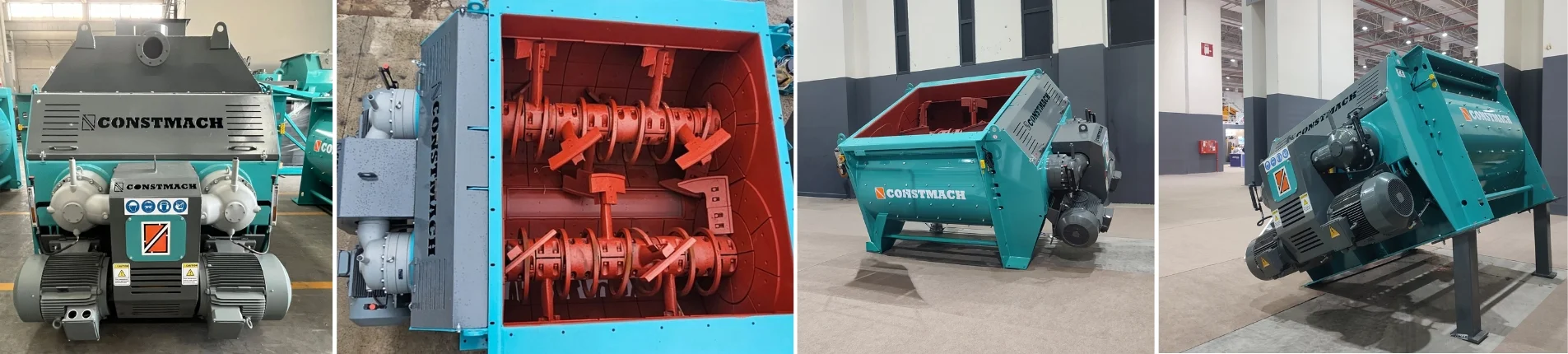

CTS - 1 | Twin Shaft Concrete Mixer

CTS-1 Twin Shaft Mixer is the entry model of the CONSTMACH CTS twin-shaft range, sized for compact and mobile concrete batching plants where one cubic metre of compacted concrete per batch matches the plant's output. It accepts a charging volume of 1,500 lt, yields 1,250 lt of fresh concrete and delivers 1,000 lt of compacted concrete in each cycle, making it a natural fit for stationary plants in the 30 to 60 m³/h class and for relocatable units where weight and footprint matter.

The mixer is driven by a single 37 kW motor, the lowest power rating in the family and the reason the CTS-1 draws modest electrical demand and pairs comfortably with smaller plant switchgear. Two horizontal shafts turn in opposite directions inside the trough, each carrying mixing arms and paddles. The counter-rotating action throws material from each side of the mixer toward the centre, where the streams collide and intermix; water injected through jets is absorbed quickly so the cement slurry coats every aggregate particle uniformly. This compulsory mixing produces a homogeneous batch in a short cycle, which is the core advantage of twin-shaft technology over pan or drum mixers.

Wear protection is matched to the duty of an entry-level unit. The side body is lined with 15 mm Hardox plates, the main body with 15 mm wearing plates, and the mixing arms carry 25 mm wearing plates at the points of highest abrasion. These liners take the brunt of aggregate scour and are designed to be replaced individually as they wear, so the trough itself stays serviceable over a long working life. For a plant producing lower daily volumes, this liner package gives a sensible balance between purchase cost and replacement interval.

The CTS-1 is supplied with an automatic lubrication system that meters grease to the shaft bearings and seals on a set schedule, removing a frequent manual task and protecting the most load-sensitive components from dry running. A hydraulic discharge door under the trough opens under power to empty the batch cleanly and can be held at intermediate positions for controlled discharge into a transit mixer, skip or precast distribution system.

Operator safety is built in through a maintenance door safety switch, which cuts the mixer drive whenever the inspection door is opened, so the shafts cannot turn while a person is reaching inside for cleaning or liner inspection. This interlock is standard across the CTS range and is an important consideration where the plant is operated by general site crews rather than dedicated technicians.

In service, the CTS-1 suits ready-mix supply for small projects, lower-volume precast and block production, and mobile plants that follow the work. Because its single-motor drive, compact trough and 1 m³ batch are easy to integrate, it is often the starting point for contractors building their first batching plant, while larger projects step up to the higher-volume CTS models. Combined with CONSTMACH aggregate weighing and cement dosing equipment, the CTS-1 forms the mixing heart of a complete entry-level concrete production line.

CTS - 1 Technical Specifications

Charging Volume1.500 lt
Fresh Concrete Volume1.250 lt
Compacted Concrete Volume1.000 lt
Motor Power37 kW
Side Body Wearing Plates15 mm Hardox
Main Body Wearing Plates15 mm
Mixing Arm Wearing Plates25 mm
Automatic Lubrication SystemAVAILABLE
Hydralulic Discharge DoorAVAILABLE
Maintanence Door Safety SwitchAVAILABLE

CTS - 1Video

FAQ

The CTS-1 Twin Shaft Mixer is the smallest member of the CTS family, and selecting it correctly means matching its 1 m³ compacted batch and 37 kW drive to the right kind of plant and product. The notes below cover the questions a buyer asks beyond the specification table.

Where It Is Used

  • Compact stationary concrete batching plants in the 30 to 60 m³/h range
  • Mobile and relocatable plants where low weight and a small footprint are priorities
  • Small ready-mix operations supplying local construction sites
  • Lower-volume precast and concrete block production
  • Contractors setting up their first in-house batching plant

What It Produces

Each cycle yields 1,000 lt (1 m³) of compacted concrete from a 1,500 lt charge. The twin-shaft action handles standard ready-mix, structural concrete, and stiffer precast and block mixes with low slump, because the counter-rotating arms keep dry, low-water mixes moving rather than balling up as a drum mixer can. For coloured or fibre-reinforced batches, the intensive mixing distributes pigment and fibre evenly.

Installation And Power

The single 37 kW motor keeps the electrical connection small, which simplifies integration into modest plant switchgear and reduces the generator size on off-grid sites. The mixer requires a compressed-air or hydraulic supply for the discharge door and an electrical feed for the automatic lubrication pump. Because the unit is light relative to larger CTS models, it suits mobile chassis-mounted plants.

Maintenance And Wear Parts

  • Side body wearing plates: 15 mm Hardox, replaceable as a set when worn
  • Main body wearing plates: 15 mm
  • Mixing arm wearing plates: 25 mm, the highest-wear items, inspected most often
  • Mixing arm tips and paddles should be checked for clearance to the liners and adjusted as they wear
  • The automatic lubrication system reservoir must be kept filled; verify grease delivery to all bearing points
  • Wash the trough at the end of each shift to prevent concrete build-up on shafts and liners

Operating Considerations

Because the CTS-1 serves smaller plants, it is often the most accessible part of the line for the operator, which makes daily discipline important. The trough should be charged with aggregate and binder in the correct sequence so the arms are never asked to start against a packed, dry load, and the water jets should be confirmed clear before each shift so cement slurry forms evenly. Mixing time should be set from trial batches rather than guessed; with a 1 m³ batch, even a few seconds of unnecessary mixing per cycle adds up across a production day and wears the liners and arms faster than required. End-of-shift washout matters as much on the entry model as on the large machines, since hardened concrete on the shafts and paddles is the most common cause of premature wear and increased power draw.

Comparison Versus Other Mixer Types And Larger CTS Models

Against a pan or planetary mixer of similar batch size, the CTS-1 mixes faster and tolerates larger aggregate, and against a drum mixer it produces a more homogeneous batch and handles low-slump mixes better. Within the CTS family, the CTS-1 is the only single-motor model; the CTS-2 doubles the batch to 2 m³ with twin 37 kW drives, and the larger CTS-3, CTS-4 and CTS-5 step up to 3, 4 and 5 m³ for higher-throughput and central-mix plants. A buyer should choose the CTS-1 when planned output and product range stay within roughly 1 m³ per batch, and step up to a larger model if daily volume is expected to grow, since over-running a small mixer to chase output shortens liner life and offers no cost saving over the correctly sized machine.

Frequently Asked Questions

whatsapp gorsel 2024 01 10 saat 15 28 30 bf9fc1cb 9474
Quick Contact

Leave a request, and our expert team will as soon as possible get back to you

Fill out the form for detailed information about concrete plants, crushing-screening plants, or our other products — or contact us directly.

By leaving a request, you consent to the processing of your personal data.

or directly

What's new on Constmach

Our expert team is ready to provide a solution tailored to your project. We're just a phone call away — call us now.