







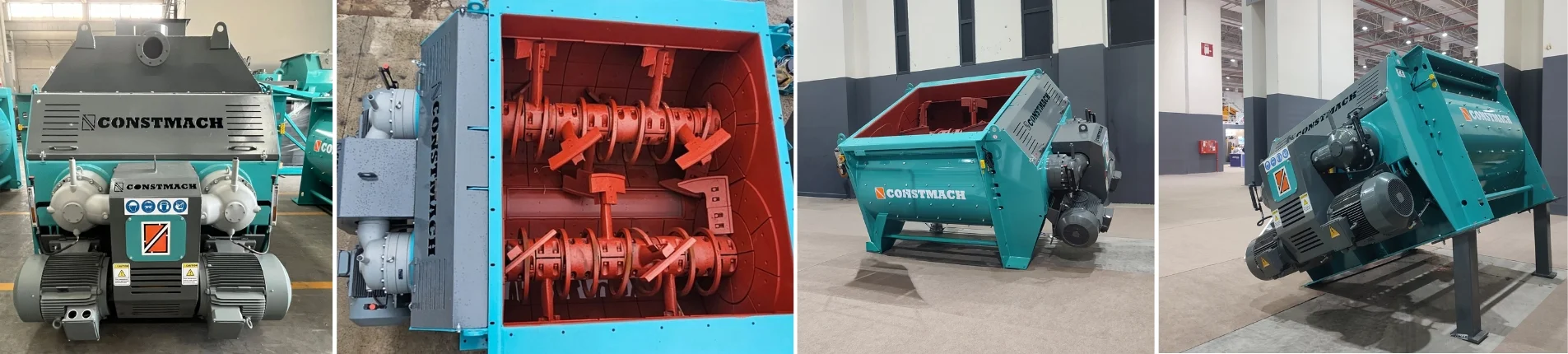

CTS - 5 | Twin Shaft Concrete Mixer

CTS-5 Twin Shaft Mixer is the flagship of the CONSTMACH CTS range, the largest-capacity model built for plants whose daily output reaches the highest production tiers. It accepts a charging volume of 7,500 lt, produces 6,250 lt of fresh concrete and discharges 5,000 lt of compacted concrete in each batch. At five cubic metres per cycle the CTS-5 is dimensioned for major central-mix ready-mix plants, large dam and roller-compacted concrete (RCC) placements, and the highest-volume precast factories, where the mixer must sustain throughput that smaller frames cannot reach.

The machine is driven by two 90 kW motors, the most powerful pairing in the family, for a combined 180 kW. This torque is what allows the CTS-5 to turn over a full 7,500 lt charge of stiff, aggregate-rich RCC or high-strength structural concrete and to restart under load through continuous, around-the-clock casting. The two horizontal shafts counter-rotate, throwing material from each side toward the centre where the streams collide and intermix; jetted water is absorbed rapidly so the cement slurry coats every aggregate particle uniformly, producing a homogeneous 5 m³ batch in the short cycle that keeps a large central plant at its rated output.

Wear protection is the heaviest in the range. The side body uses 25 mm wearing plates, the main body steps up to 30 mm wearing plates, and the mixing arms carry 30 mm wearing plates at the highest-abrasion points. The 30 mm main-body liner, the thickest specified across the CTS models, is matched to the enormous mass of aggregate that passes through the trough every cycle on a 5 m³ machine and to the abrasive duty of dam-scale RCC; heavier liners translate directly into fewer changeouts and more productive hours on a plant that cannot easily stop. All liners remain individually replaceable so the trough body stays in service over a long working life.

An automatic lubrication system meters grease to the four heavily loaded shaft bearings and seals on a fixed schedule. On a 180 kW machine in continuous service, dependable bearing lubrication is the single most important factor in avoiding unplanned downtime, and automating it eliminates the risk of a missed greasing during extended shifts. A hydraulic discharge door empties the 5 m³ batch rapidly and cleanly so the trough is immediately ready to recharge; at this scale, even a small delay in discharge multiplied across a full shift represents a meaningful loss of output, so fast door action is integral to the design.

A maintenance door safety switch interlocks the inspection door with both drives, stopping both shafts whenever the door is opened. On the most powerful machine in the range, a positive interlock that guarantees neither shaft can rotate during cleaning or liner inspection is fundamental to crew safety.

In service, the CTS-5 is the mixing centre of the largest central ready-mix plants supplying flagship infrastructure, of RCC plants placing concrete for dams and major pavements, and of high-volume precast factories casting bridge girders, large segments and heavy panels. Its 5 m³ batch and twin 90 kW drives top the CTS family above the CTS-4, making it the selection for projects that demand the maximum sustainable output. Integrated with CONSTMACH heavy-duty weighing, dosing and conveying systems, the CTS-5 anchors a high-capacity central concrete production plant.

CTS - 5 Technical Specifications

Charging Volume7.500 lt
Fresh Concrete Volume6.250 lt
Compacted Concrete Volume5.000 lt
Motor Power2 x 90 kW
Side Body Wearing Plates25 mm
Main Body Wearing Plates30 mm
Mixing Arm Wearing Plates30 mm
Automatic Lubrication SystemAVAILABLE
Hydralulic Discharge DoorAVAILABLE
Maintanence Door Safety SwitchAVAILABLE

CTS - 5Video

FAQ

The CTS-5 Twin Shaft Mixer is the largest model in the CTS range, and choosing it means confirming that a 5 m³ compacted batch and twin 90 kW drives are matched to a plant built for the highest production volumes and the most demanding mixes. The notes below address what buyers weigh beyond the specification table.

Where It Is Used

  • Major central ready-mix plants supplying flagship building and infrastructure projects
  • Roller-compacted concrete (RCC) plants for dams, large airfields and heavy pavements
  • Highest-volume precast factories casting bridge girders, large segments and heavy panels
  • Large dam, port, airport and energy projects requiring sustained maximum output
  • Operations that need the largest batch the CTS range offers

What It Produces

Each cycle delivers 5,000 lt (5 m³) of compacted concrete from a 7,500 lt charge. The mixer handles structural and high-strength ready-mix, dense aggregate-rich RCC and large stiff precast batches, and its powerful counter-rotating action mixes very low-water and harsh mixes thoroughly while still distributing admixtures, pigment and fibre evenly. A 5 m³ batch can fill a transit mixer in a single discharge and keep multiple high-rate precast lines supplied at once.

Installation And Power

The two 90 kW motors give 180 kW of mixer drive, so the plant's electrical infrastructure, cabling, transformer and any standby generation must be engineered for this load alongside the rest of the plant. The mixer needs a hydraulic supply for the discharge door and an electrical feed for the automatic lubrication pump. Its mass and the forces it generates demand a heavy, properly engineered and founded plant structure; this is fixed central-plant equipment.

Maintenance And Wear Parts

  • Side body wearing plates: 25 mm
  • Main body wearing plates: 30 mm, the thickest specified across the CTS range, for the heaviest abrasive duty
  • Mixing arm wearing plates: 30 mm, the primary high-wear items, inspected frequently
  • Four heavily loaded shaft bearings and seals served by the automatic lubrication system; keep the reservoir filled and confirm delivery to every point
  • Monitor arm and paddle clearance and adjust as wear opens it, since clearance growth slows mixing and raises power draw on a high-power machine
  • RCC and aggregate-rich mixes are highly abrasive; maintain a tight liner inspection schedule and hold spare liner sets to minimise downtime

Comparison Versus The CTS-4 And Smaller Models

Against the CTS-4, the CTS-5 adds a further cubic metre of batch (5 m³ versus 4 m³), raises drive power to two 90 kW motors (180 kW versus 150 kW), and steps the main-body liner up to 30 mm for the most demanding RCC and dam-scale duty. The smaller CTS-1 through CTS-4 cover compact, mid-range, high-output and central-mix plants respectively; the CTS-5 is the choice only where the project genuinely requires the maximum sustainable output and batch size the range offers. For plants whose volumes sit below that ceiling, the CTS-4 usually gives a better balance of output, power demand and cost.

Frequently Asked Questions

whatsapp gorsel 2024 01 10 saat 15 28 30 bf9fc1cb 9474
Quick Contact

Leave a request, and our expert team will as soon as possible get back to you

Fill out the form for detailed information about concrete plants, crushing-screening plants, or our other products — or contact us directly.

By leaving a request, you consent to the processing of your personal data.

or directly

What's new on Constmach

Our expert team is ready to provide a solution tailored to your project. We're just a phone call away — call us now.