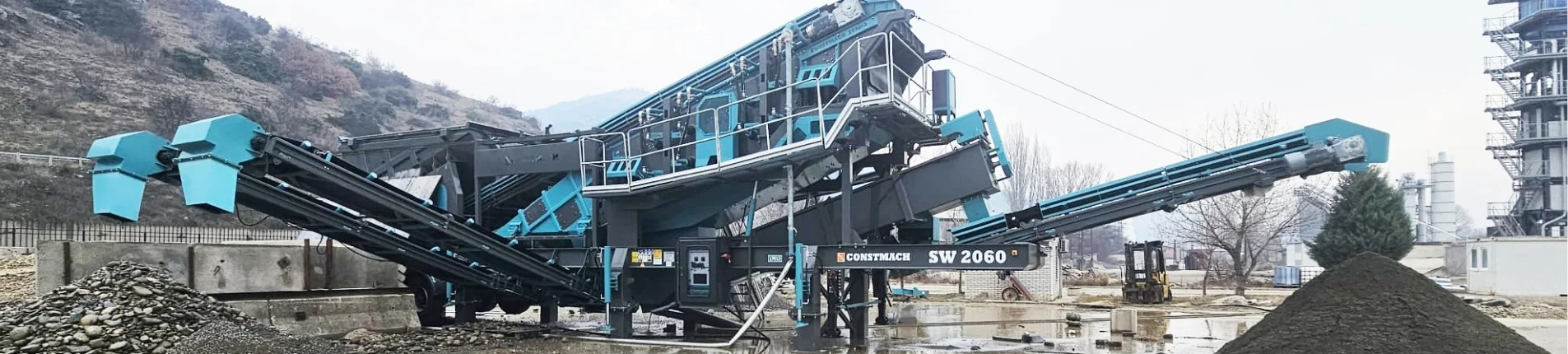
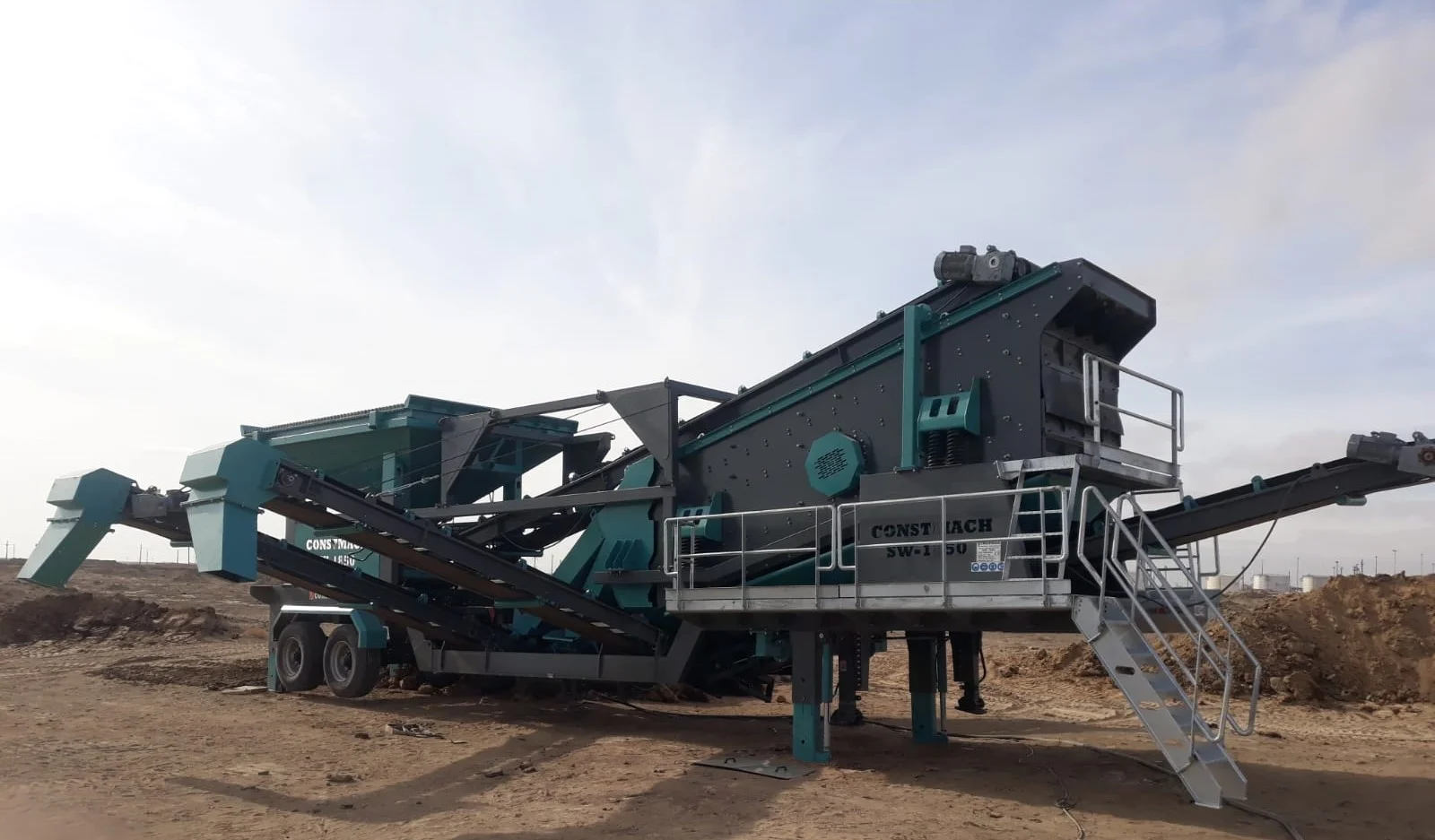
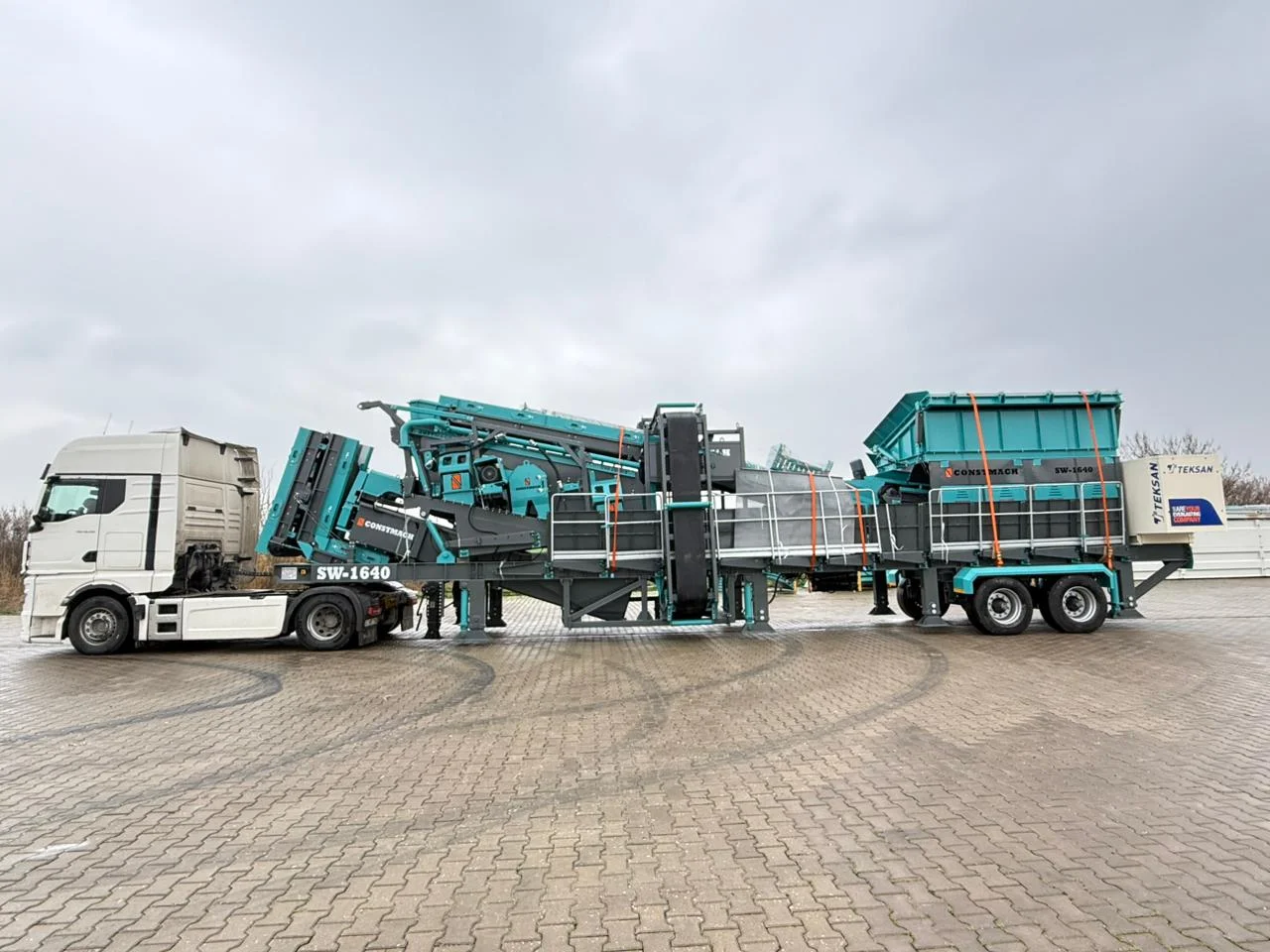
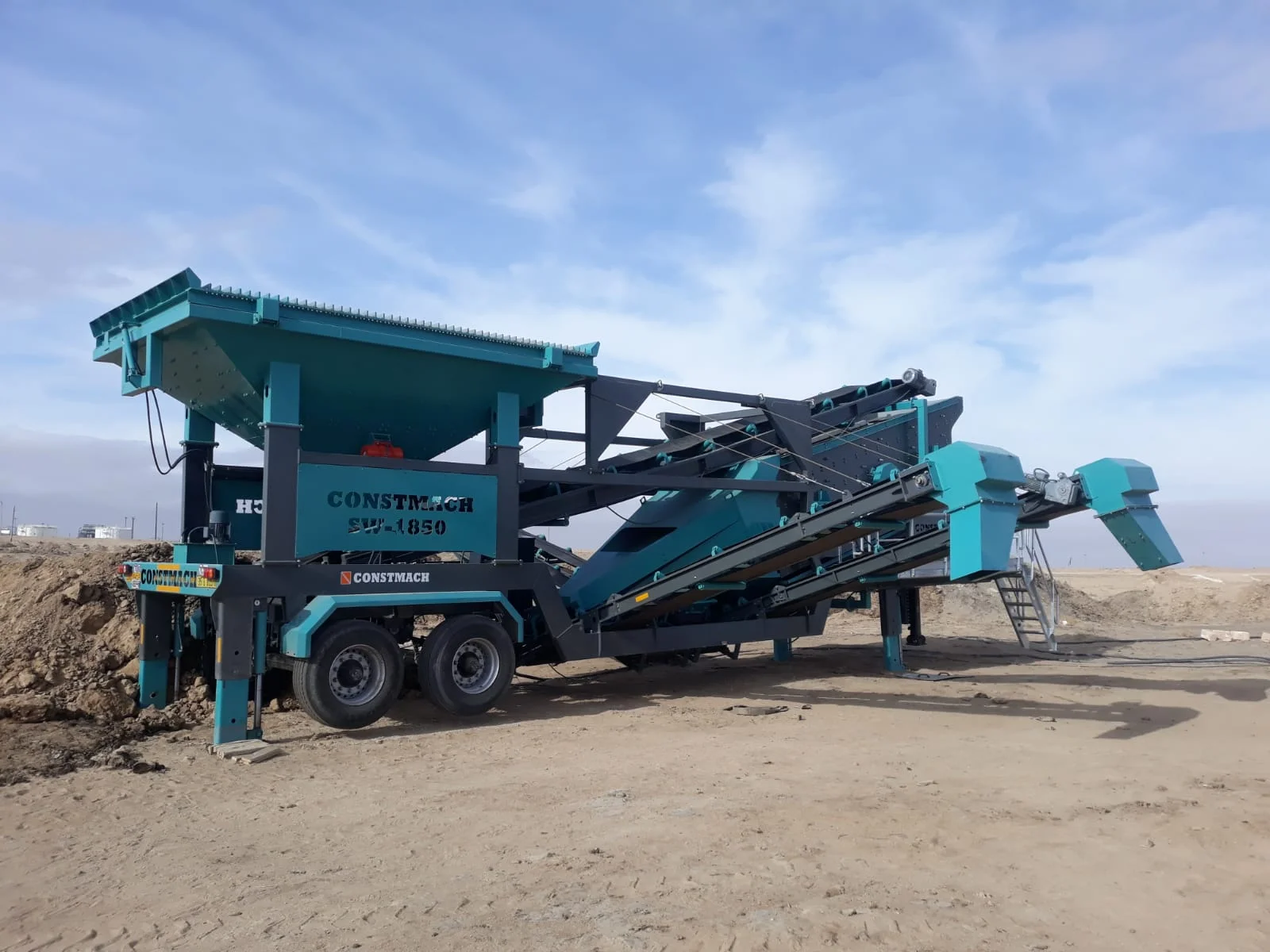
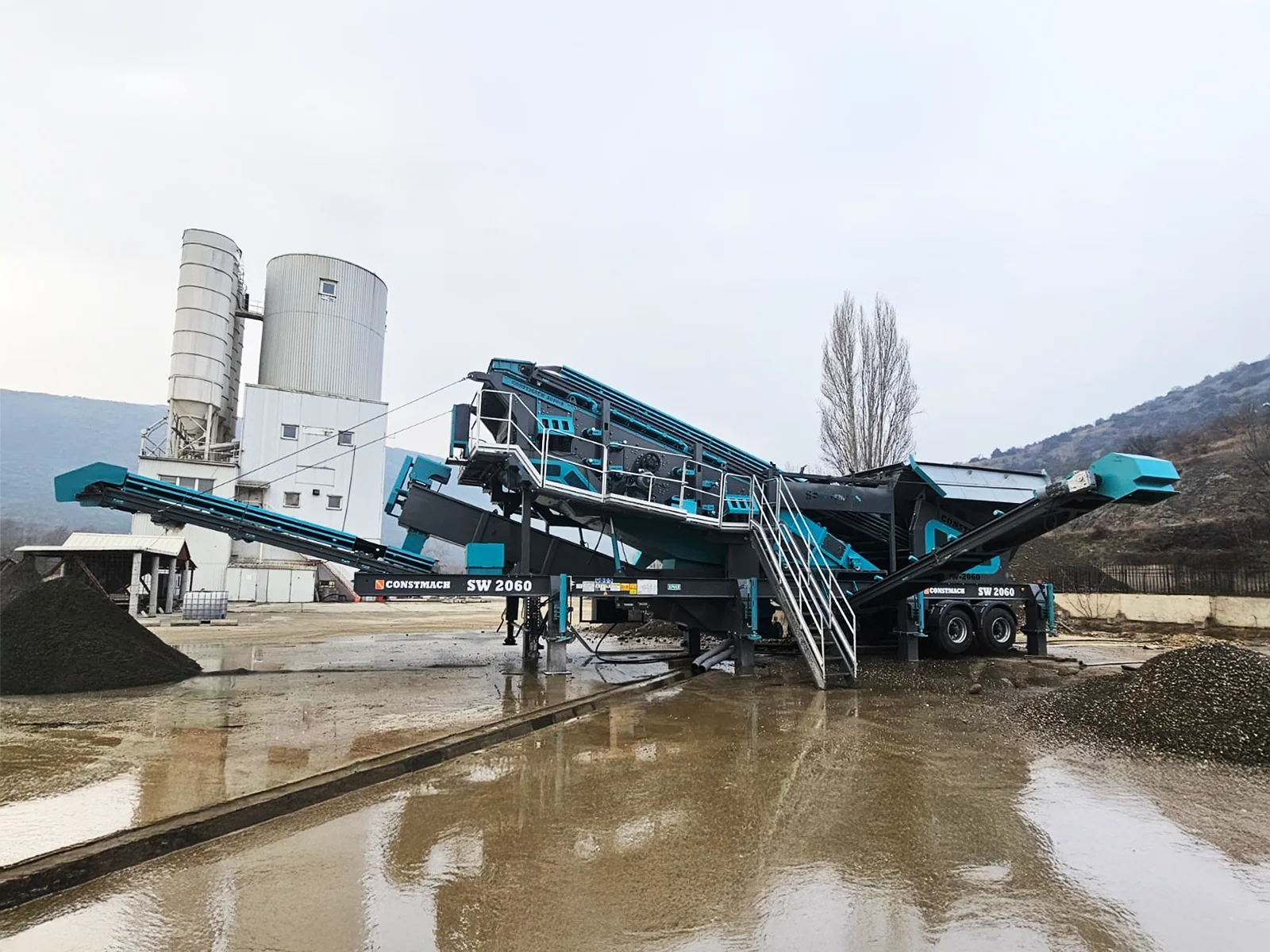
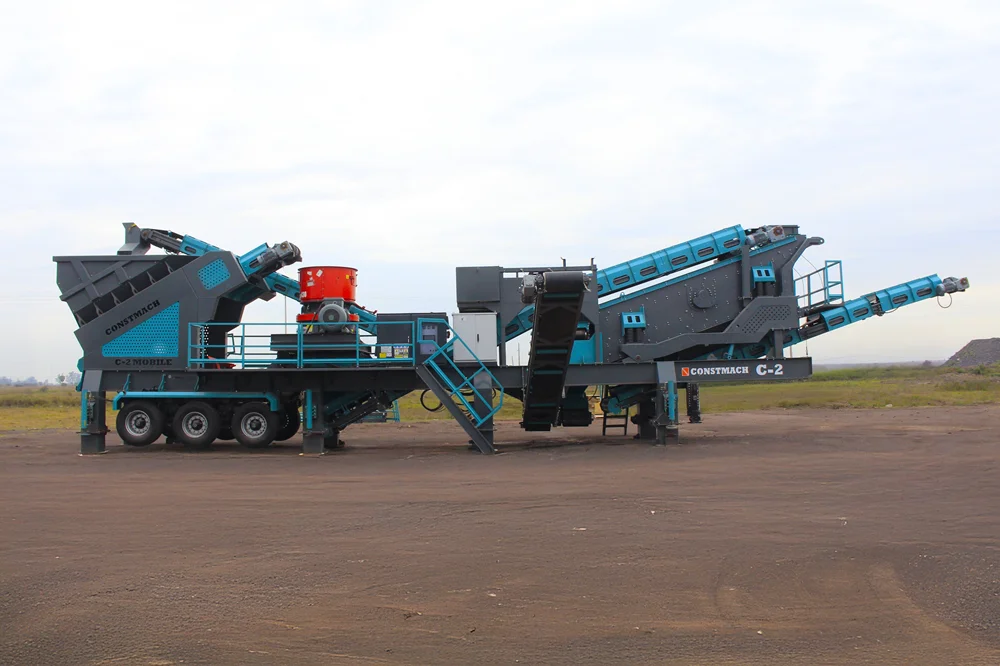
A Constmach mobile screening and washing plant (SW series) is a self-contained, wheel-mounted unit that screens and washes sand and gravel directly at the quarry or riverbed. Everything needed sits on one wheeled chassis with hydraulic support legs: feeding hopper, feeding conveyor, vibrating screen with an integrated spray washing system, fold-up stockpile conveyors, and a screw washer. It is relocatable and commissioned within hours rather than days.
What a Mobile Screening and Washing Plant Is
The SW series combines two jobs that producers normally split across separate machines: it grades the feed by particle size and it cleans the material of clay, silt and fine contamination. Both happen on a single trailer. Because the screen, the spray washing system, the screw washer and all the conveyors are mounted and pre-wired on one chassis, you do not build a fixed installation to start producing.
This matters most where the deposit moves. A river extraction point shifts season to season; a small quarry works one bench then another. A wheeled plant follows the material instead of forcing the material to come to a plant. You tow it in, lower the hydraulic legs, connect power and water, and run. That single decision, mobility over permanence, shapes everything else about how the plant is built and how it earns its keep.
How It Works, Stage by Stage
Feed goes into the hopper and rides the feeding conveyor up onto the vibrating screen. The screen separates the run-of-pit material into clean graded fractions by deck size. While the material travels along the screen, integrated spray bars flush water through the bed, washing clay and silt off the stone and out through the underflow.
The sand-bearing slurry drops to the screw washer. There the spiral scrubs the sand grains against each other, lifts the clean sand up the inclined trough and dewaters it as it climbs, so the discharge is washed sand that is ready to drain on the stockpile rather than a wet sludge. The graded stone fractions leave on the fold-up stockpile conveyors, each building its own pile.
Follow a single shovelful through the plant and the logic is clear. Dirty bank gravel enters mixed, wet and bound together with clay. By the time it leaves, it has been split into separate sized piles of clean stone and one pile of washed sand, with the unwanted fines carried away in the wash water. The plant does in one pass what a producer would otherwise stage across a screen, a scrubber and a dewatering step.
The Two Washing Actions
It helps to separate the two cleaning effects. Spray washing on the screen is a flushing action: water carries surface contamination through the mesh. The screw washer is a mechanical scrubbing action: the spiral abrades the sand and settles out the lightest fines while draining the product. One plant gives you both clean graded gravel and clean dewatered sand.
The two actions target different problems. Flushing removes contamination that sits on the surface of the stone, the loose clay and silt that a buyer can see and that pushes a sample over its fines limit. Scrubbing breaks the grip of clay that has bonded to the sand grains, the contamination that flushing alone will not shift. A deposit with light, loose dirt may be cleaned almost entirely on the screen; a heavy, plastic clay needs the screw washer working hard. Knowing which problem you have tells you how to set the plant up.
Why a Single-Chassis Approach
A conventional wash line is a set of foundations, steel structures and individually placed machines. It produces well, but it is fixed, it needs civil work, and it takes days to commission. The SW series trades that fixed plant for mobility. The trade is deliberate: you give up the very largest throughputs and the freedom to lay out a bespoke flowsheet, and in return you get a plant that arrives complete and runs the same day.
For a producer chasing a deposit, supplying a single project, or wanting to test a reserve before committing to fixed infrastructure, that exchange usually pays for itself in avoided civil cost and lost time alone.
There is a cash-flow argument as well. A fixed line ties up capital in foundations and structures that have no resale value and cannot move. A wheeled plant keeps its value because it can be sold, hired out, or moved to the next job. For a contractor whose work is project by project, an asset that travels is worth more than one bolted to a yard that the contract will leave behind.
Stationary Wash Line Versus the SW Mobile Plant
| Aspect | Fixed wash line | SW mobile screening and washing plant |
|---|
| Foundations | Cast foundations and steelwork required | None; hydraulic support legs on a wheeled chassis |
| Commissioning | Days, after civil works | Hours from arrival |
| Relocation | Effectively permanent | Tow to the next site and re-level |
| Footprint | Larger, spread across the yard | Compact, one trailer plus stockpiles |
| Functions on board | Distributed across separate units | Hopper, conveyor, screen with spray wash, screw washer, stockpile conveyors |
| Best fit | High, sustained tonnage at one site | Mobile reserves, river deposits, project supply |
The Constmach SW Range
Four models cover the working band from a small producer up to a substantial sand and gravel operation. The screen grows with the model so that larger feed rates still get enough deck area to grade and wash properly, and the screw washer is sized to match the sand fraction that the screen passes.
- SW-1240 handles 60 t/h on a 1,200 x 4,000 mm screen with a 400 x 4,000 mm screw washer.
- SW-1640 handles 80 t/h on a 1,600 x 4,000 mm screen with a 500 x 5,000 mm screw washer.
- SW-1850 handles 150 t/h on a 1,800 x 5,000 mm screen with a 600 x 6,000 mm screw washer.
- SW-2060 handles 200 t/h on a 2,000 x 6,000 mm screen with a 700 x 7,000 mm screw washer.
Notice that the screw washer scales faster than the screen between the smaller and larger models. That reflects how much sand a high-tonnage gravel feed produces: a 200 t/h plant needs a 700 mm spiral running through a 7,000 mm trough to scrub and dewater that volume of sand without backing up.
Reading the Model Numbers
The model code follows the screen size. SW-1850, for instance, carries the 1,800 x 5,000 mm screen. Once you know roughly what tonnage you need to put through, the model almost picks itself, and the matched screw washer comes with it. The capacities quoted are typical figures; very wet, very clayey or very fine feed lowers them, which is covered under sizing below.
Build and Wear Considerations
Washing plants live in an abrasive, wet environment, so the wear points are predictable. The screen media takes constant impact and is a planned replacement item; choosing the right aperture and media type for your grading extends its life. Spray bars and nozzles can scale or block where water is hard or silty, so they need periodic checking. The screw washer flights are the main mechanical wear part, abraded continuously by sand, and they are designed to be renewed.
The vibrating screen bearings and the screw washer gearbox and bearings are the rotating components that determine uptime. Keeping them clean of grit and correctly lubricated is the single biggest factor in how long the plant runs between stoppages. Constmach manufactures these units in-house and supplies the wear and spare parts through its after-sales network, so renewing media, nozzles and flights is a stocked-part exercise rather than a search.
The wet chassis itself deserves attention too. Spray and slurry find every seam, so the structure is built to shed water and the conveyor frames sit where run-off drains away from bearings rather than into them. A washing plant that is allowed to sit in its own mud corrodes from the bottom up, which is why the legs lift the chassis clear and why drainage around the plant is part of good site practice, not an afterthought.
How the Plant Fits a Production Line
The SW plant is usually the finishing and cleaning stage, fed by what has already been dug or crushed. In a natural sand and gravel operation it can be the whole line: raw alluvial material in, clean graded gravel and washed sand out. In a quarry it sits downstream of crushing and screening, taking the saleable size range and washing it to specification when the buyer demands clean, low-fines aggregate.
You will need a feed source into the hopper, whether that is a wheel loader, a feeder, or the discharge of an upstream machine, plus a way to manage the wash water. Many operators run the water through a settling pond or a recovery system so it can be reused, which keeps consumption and discharge under control.
Capacity and Sizing
Pick the model by the cleaned, graded tonnage you actually need to sell, not by the raw feed rate, because waste fines and oversize do not count toward saleable product. The quoted figures (60, 80, 150 and 200 t/h) assume reasonable feed. Three things pull real output below those numbers:
- Clay and silt load: heavily contaminated feed spends longer washing and loads the screw washer, lowering throughput.
- Fineness of the sand: very fine sand is easily lost to the overflow, so recovery, not just tonnage, becomes the limit.
- Moisture and stickiness: wet, plastic feed blinds the screen and slows separation.
If your grading is demanding or your material is dirty, size up rather than running the next model down at its ceiling. A plant working comfortably below its rated capacity washes cleaner and lasts longer than one held flat out.
It is also worth thinking in terms of split, not just total tonnage. A feed that is mostly fine sand loads the screw washer long before it troubles the screen, so the screw washer becomes the bottleneck and the right model is the one whose spiral can handle the sand, even if the screen looks oversized for the job. A feed that is mostly coarse gravel does the opposite: the screen does the work and the screw washer runs light. Reading your own grading curve before you choose tells you which component sets the limit.
Materials and Applications
The SW series is built for natural sand and gravel: river and stream deposits, pit-run alluvial material, and bank gravels that carry clay and silt. Typical products are washed concrete and plaster sand, graded gravel and single-sized chippings, and washed aggregate for concrete and asphalt where specifications cap the fines and clay content.
The common thread is contamination that has to come off and a size split that has to be made. Anywhere clean graded sand and gravel is needed without committing to a fixed installation, the plant earns its place: short-life reserves, scattered small deposits, river works, and projects that supply themselves and then move on.
The end markets reward the cleaning directly. Aggregate for concrete is judged on its fines and clay content because excess fines drink up cement and water and weaken the mix; washing the stone and sand brings the material inside specification and protects the price. The same washed sand and gravel serves road sub-base, drainage and filter media, mortar and plaster, and the aggregate feed for an asphalt plant, all of which penalise dirty material. The plant turns a marginal, dirty deposit into a saleable product.
Maintenance in Service
Routine attention is mostly inspection and lubrication. Walk the plant for blocked or worn spray nozzles, check the screen media for wear and tensioning, and watch the screw washer flights for thinning. Grease the screen and screw washer bearings on schedule and keep an eye on the gearbox oil. At each relocation, re-level the chassis on its hydraulic legs and recheck conveyor tracking before restarting.
Water management is its own maintenance task. Sumps and settling areas need clearing so that recovered water stays clean enough to wash with; dirty recycled water undoes the work the plant is doing. None of this is heavy maintenance, but skipping it shows up quickly as a dirtier product and shorter wear-part life.
A short daily routine pays back more than an occasional thorough one. Five minutes at start-up to confirm every spray nozzle is throwing a full fan, that the screen is tensioned, and that nothing is dragging on a conveyor will catch most of the faults that otherwise grow into a stoppage. Keeping a small stock of the fast-moving wear parts on site, a set of nozzles and a length of screen media, means a worn item is changed in the same shift rather than waiting on a delivery.
Common Mistakes to Avoid
- Buying on raw tonnage, not clean product. A model rated at 150 t/h does not yield 150 t/h of saleable washed material when the feed is dirty.
- Starving the water supply. Spray washing and the screw washer both need adequate flow and pressure; short water means poor cleaning and a wet, fines-laden sand.
- Ignoring the settling system. Recycling muddy water back to the spray bars defeats the purpose of washing.
- Running flat out continuously. Holding the plant at its ceiling accelerates media and flight wear and lets fines escape.
- Skipping the re-level after a move. An out-of-level screen and screw washer grade and dewater unevenly.
- Feeding oversize the screen cannot handle. Material above the deck rating belongs in front of a crusher, not on the washing screen, where it batters the media and blocks the deck.
How to Choose the Right SW Model
Start from the cleaned tonnage you must deliver, then add headroom for how dirty and how fine your feed is. Match that to one of the four capacities, and the screen and screw washer sizes follow automatically. Confirm your water supply can feed the spray bars and screw washer at the model flow, and confirm your power source matches the plant draw. Think about the number of graded fractions you need to sell, which depends on how the screen is decked.
If you expect to relocate often or work several small deposits, the SW series mobility is the whole point; if you are committed to one high-tonnage site for years, weigh it against a fixed wash line. Constmach application engineers will take your material, grading targets and site constraints and confirm the model before you commit, so the plant you receive is the one your deposit actually needs.
A short checklist keeps the choice honest. Write down the clean tonnage you must sell, the worst grading and clay load you expect to feed, the number of separate products the market wants, the water flow and pressure you can supply, and the power available on site. Those five figures, taken together, point at one model far more reliably than a headline capacity does, and they are exactly the figures the application engineers will ask for, so gathering them before the conversation shortens it considerably.