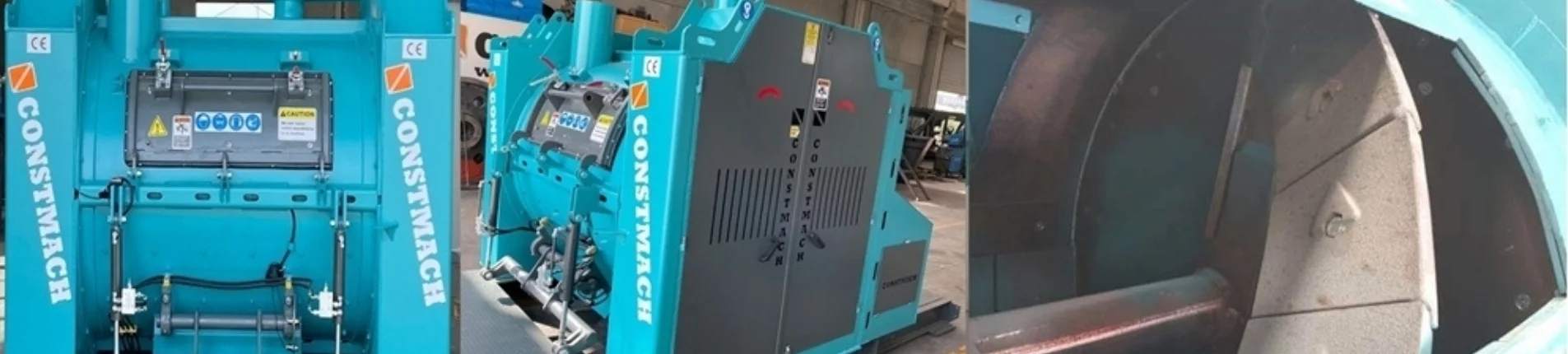
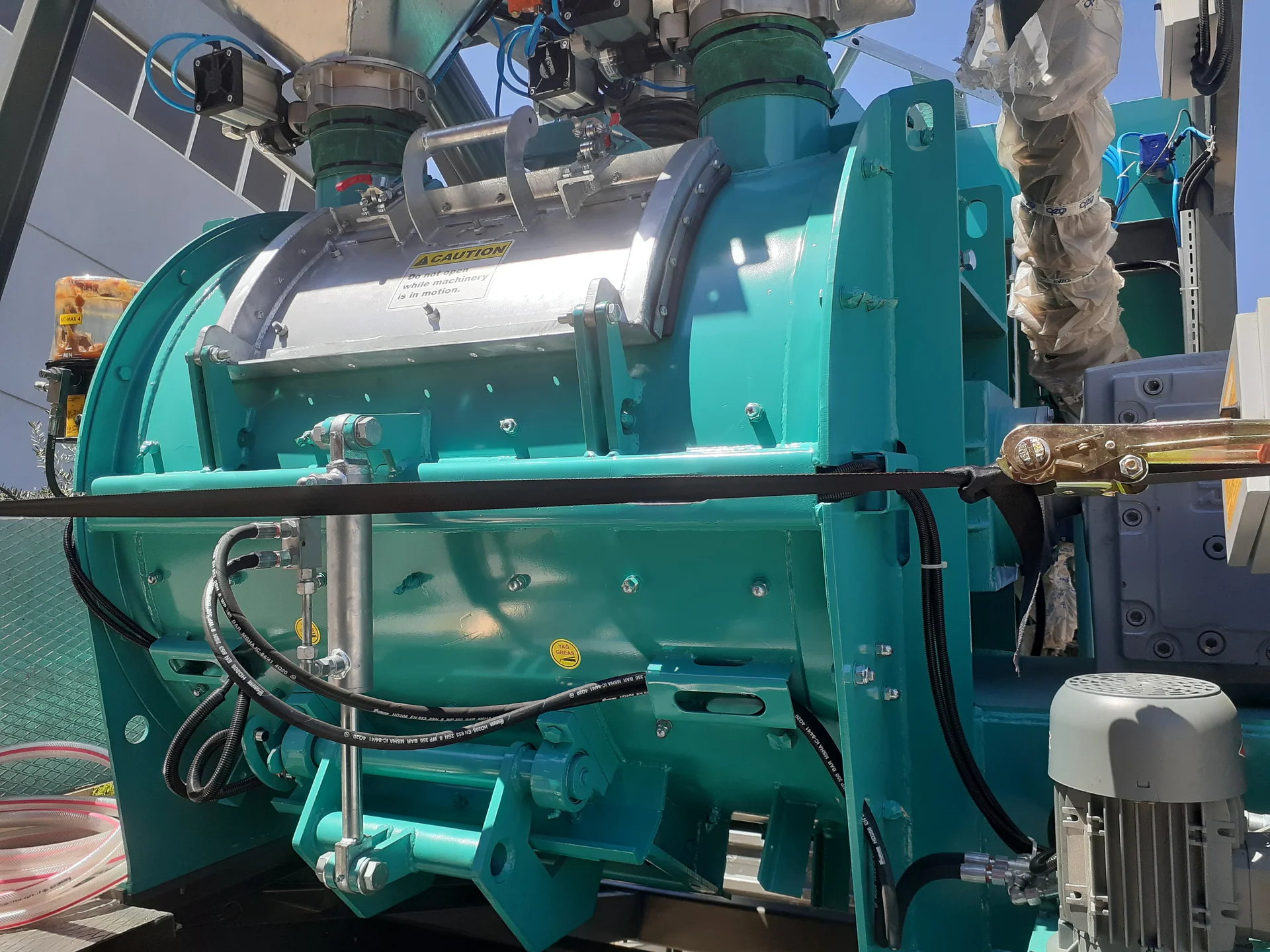
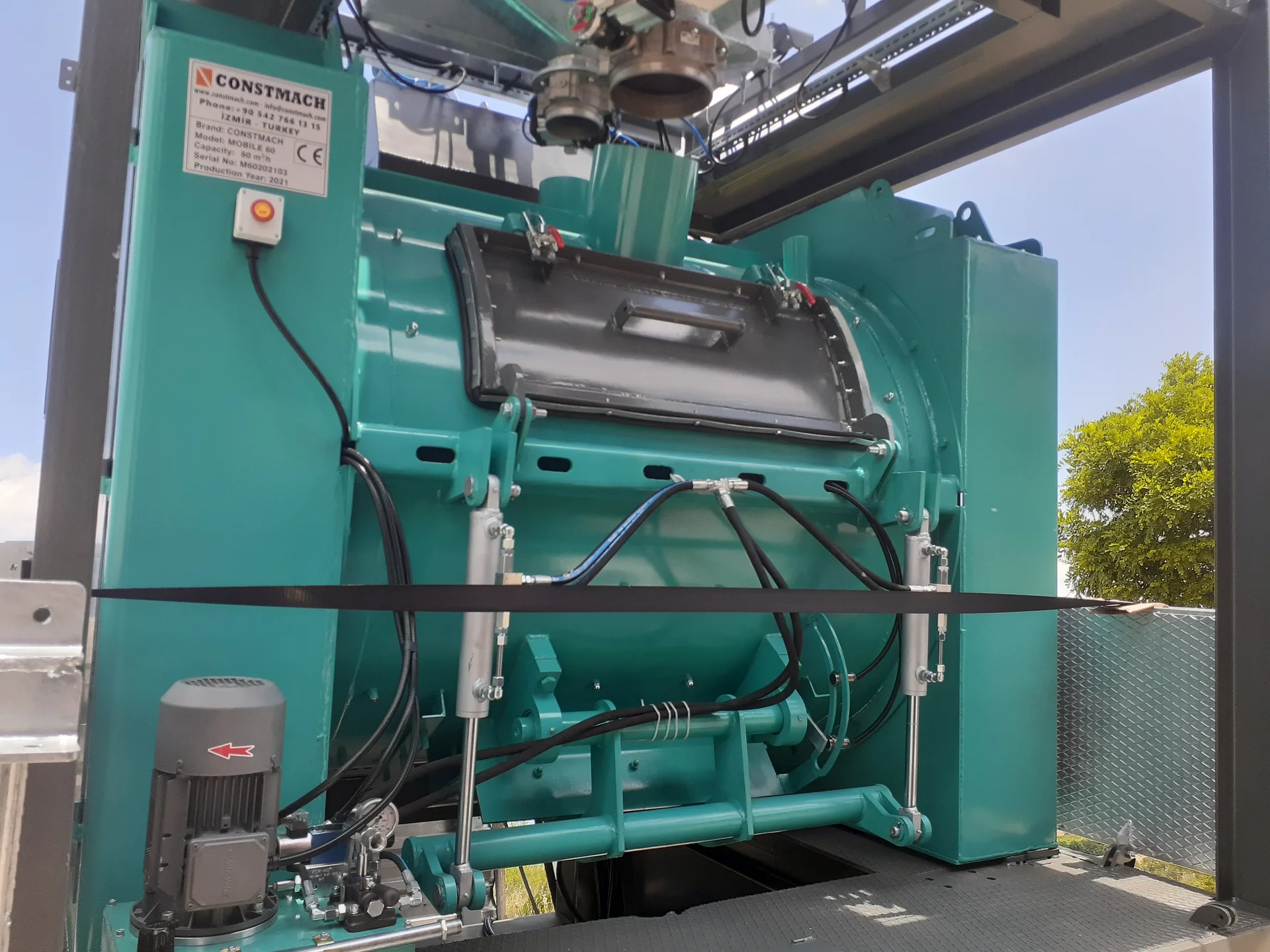
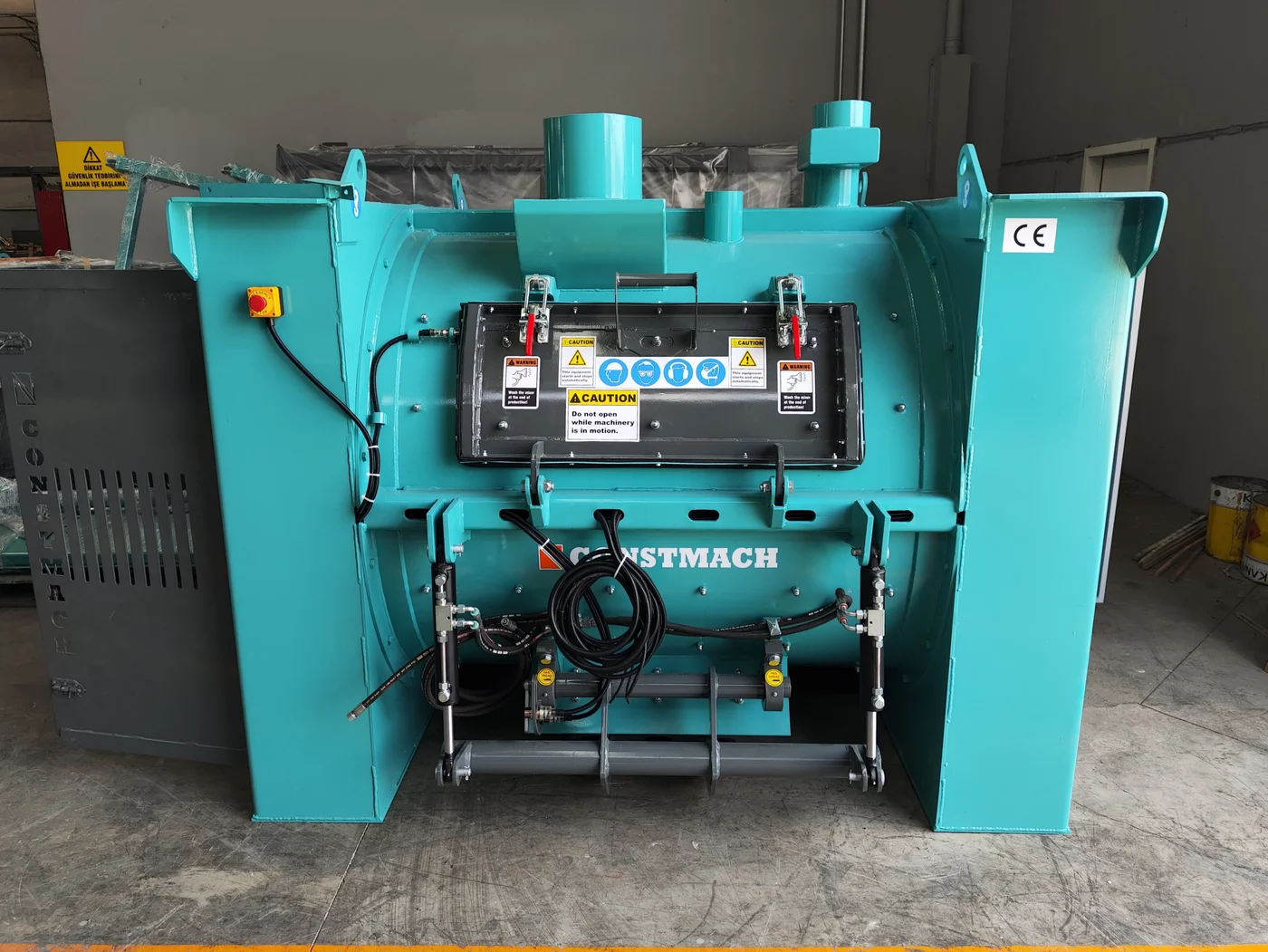
A single-shaft concrete mixer blends concrete with one horizontal shaft whose arms drive through the material in a trough, giving a thorough forced-action mix in a simple, economical machine. It is a sound choice for general ready-mixed concrete and for small to mid-sized plants where the very highest output is not needed. Constmach builds the single-shaft CSS range in three sizes, from the CSS-0.5 at 500 litres of compacted concrete per batch up to the CSS-2 at 2,000 litres.
What Is a Single-Shaft Concrete Mixer?
A single-shaft concrete mixer is a forced-action mixer with one horizontal shaft running along a trough. The shaft carries mixing arms and paddles that lift, throw and carry the material as it turns, combining cement, water and aggregate into a uniform batch. Like all forced-action mixers, it drives the tools through the concrete under power rather than relying on a tumbling drum, so it produces a controlled, even mix in a fixed chamber. The single shaft makes it simpler and more economical than a twin-shaft mixer, with one drive and one set of arms to maintain.
For a producer who needs reliable forced-action mixing without the output or intensity of a twin-shaft unit, the single-shaft mixer is the straightforward answer. It gives the consistency a batching plant needs at a lower cost, which is why it is a common choice for general concrete production.
How a Single-Shaft Mixer Works
The single shaft turns in the trough, and its arms are set at staggered angles so they bite into the material at different points along the length. As the shaft turns, the arms lift material and throw it forward and across, while the angle of the paddles walks the mix along the trough and back. This keeps the whole batch in motion and folds the materials together until they are evenly distributed. Scraper arms keep material moving off the trough wall and ends rather than caking there. When the cycle finishes, a discharge gate in the base opens and the batch drops into the truck, skip or transfer point below. The action is gentler than a twin-shaft mixer's overlapping pattern, but for standard concrete it gives a thorough, uniform mix.
Why Choose a Single-Shaft Mixer?
The single-shaft mixer suits producers who value simplicity and value for money:
- Economical. One shaft, one drive and one set of wear parts make it lower in cost to buy and to maintain than a twin-shaft mixer.
- Simple to run and service. Fewer parts mean less to inspect and maintain, which suits smaller operations.
- Good for general concrete. For everyday ready-mix and standard mixes, it gives a thorough, even batch.
- Right-sized for small to mid plants. Where output is moderate, it avoids paying for capacity and intensity you will not use.
For very high output, stiff and high-strength concrete or roller-compacted work, a twin-shaft mixer is the better tool. For fine, coloured precast a planetary mixer suits. But for general ready-mix at moderate volume, the single-shaft mixer is often the most sensible choice.
The Constmach CSS Range
The CSS range covers three sizes, so the mixer matches the plant rather than being over- or under-sized.
| Model | Charge volume | Compacted output | Drive |
|---|
| CSS-0.5 | 750 lt | 500 lt | 18.5 kW |
| CSS-1 | 1,500 lt | 1,000 lt | 37 kW |
| CSS-2 | 3,000 lt | 2,000 lt | Higher rating |
The charge volume is the loose material the mixer takes; the compacted output is the finished concrete it produces, which is the figure to size against. The CSS-0.5 is an economical mixing core for compact concrete plants and precast, the CSS-1 a mid-range unit for production-scale ready-mix, and the CSS-2 the largest single-shaft model, built for higher-volume ready-mix work. Above this, the twin-shaft CTS range takes over for the largest batches.
Build Quality and Wear Parts
Even a general-purpose mixer works in abrasive material, so the build still decides how long it lasts. Constmach makes the CSS mixers from the same hard-wearing materials as the rest of its range:
- Inner wear liners in HARDOX or an equivalent wear-resistant steel, protecting the trough
- Mixing arms and scrapers cast from NiHard, a hard, abrasion-resistant material
- A heavy-duty electric motor and a quality gearbox for the drive
- Bearings from established brands such as FAG, SKF or NACHI
- Automatic lubrication as standard, protecting the shaft seal and bearings
With a single shaft there is one shaft penetration to seal rather than two, which is part of what keeps the single-shaft mixer simple. The automatic lubrication feeds that seal and the bearings continuously, so the mixer stays sealed against cement and moisture through long service. The HARDOX liners and NiHard arms hold their shape under abrasion, keeping the mix efficient between part changes.
Mixing Quality and Consistency
The point of any forced-action mixer is an even batch, and the single-shaft mixer delivers that for standard concrete. Its arms distribute cement, water and aggregate through the trough so the concrete reaches its design strength and workability throughout, not in patches. Combined with accurate weighing and automatic moisture correction on the plant, this gives concrete a producer can rely on load after load. The plant's control system records each batch, so there is a traceable history for quality control. For everyday ready-mix, the single-shaft mixer's consistency is exactly what the job needs, achieved in a simple machine.
Single-Shaft vs. Twin-Shaft: Choosing Between Them
The two types answer different needs. A twin-shaft mixer has two overlapping shafts for the most intensive action, the largest batches and the most demanding mixes, and it is the choice for high-output plants and stiff or high-strength concrete. A single-shaft mixer has one shaft, costs less to buy and maintain, and gives a thorough mix for general concrete at moderate output. The decision usually comes down to two things: how much concrete you make, and how demanding your mixes are. High output or difficult mixes point to twin-shaft; moderate output and standard mixes make the single-shaft the more economical, sensible choice. Many smaller and mid-sized plants are well served by a single-shaft mixer.
Where Single-Shaft Mixers Are Used
Single-shaft mixers serve general concrete production across a range of work. Small and mid-sized ready-mixed concrete plants use them for daily supply to construction. Precast workshops use them for standard elements. They suit producers making everyday structural and general-purpose concrete where the output is moderate and the mixes are not unusually demanding. Wherever a plant needs dependable forced-action mixing without the scale of a twin-shaft unit, the single-shaft mixer fits.
The Single-Shaft Mixer in a Batching Plant
In a plant, the single-shaft mixer is fed from the weighing system above and discharges into the truck or transfer point below, with its operation timed by the plant's control system. Its batch size and cycle time set how much concrete the plant produces in an hour, so it is matched to the plant's target output. Because it is simpler and lighter than a twin-shaft mixer, it suits the structure and budget of small to mid-sized plants well. Sizing the mixer to the plant's output, with the weighing and truck logistics to match, is what lets the whole plant run smoothly at its rated capacity.
The Economical Route to Forced-Action Mixing
The single-shaft mixer is, in many ways, the value choice in forced-action mixing. It brings the consistency and control of a fixed mixer, accurate, even batches and a traceable record, at a lower purchase and running cost than a twin-shaft unit. For a producer whose output is moderate and whose mixes are standard, paying for twin-shaft intensity would be paying for capability the work does not use. The single-shaft mixer puts the budget where it counts: a sound, well-built mixer sized to the job. Over its life, the lower purchase price and the simpler maintenance keep the cost per cubic metre down.
Discharge, Cleaning and Maintenance
A single-shaft mixer discharges through a gate in the base of the trough, operated by the control system as part of the cycle. At the end of a shift the trough is washed out, because concrete left to harden builds up on the arms and liner and shortens their life. Maintenance centres on the wear parts and the seal: the liner, arms and scrapers are inspected and replaced before they thin too far, the automatic lubrication reservoir is kept topped up, and the gearbox, bearings and seal are checked on a schedule. With a single shaft there is less to inspect than on a twin-shaft mixer, which keeps the routine light. Keeping a stock of the common wear parts means a change is a planned job rather than an unplanned stop.
The Mixing Pattern in Detail
The single shaft does all its work in one rotating set of arms, so the arrangement of those arms matters. They are fixed at staggered angles along the shaft, which means at any moment different arms are lifting, throwing and pushing material at different points down the trough. As the shaft turns, each arm carves through the mix, lifts a portion and casts it forward and to the side, while the angle of the paddles also moves the mass slowly along the trough and back. Over a short cycle, every part of the batch passes under the arms many times, which is what brings the cement, water and aggregate together evenly. Scraper arms run close to the trough wall and ends so material does not sit and cake there. It is a simpler pattern than the twin-shaft mixer's overlapping action, but for standard concrete it reaches a thorough, uniform mix reliably.
Output in Practice: Batches per Hour
What a mixer adds to a plant is batches per hour, not just batch size. The cycle is load, mix and discharge: the single-shaft mixer fills from the weighing system, mixes in around a minute for a standard mix, and discharges through the base gate. Multiply the compacted batch by the cycles in an hour and you have the plant's mixing capacity. For the moderate outputs these mixers serve, that capacity is matched to the weighing and the truck cycle so the mixer is neither starved nor left waiting. When the mixer, the weighing and the trucks are balanced, the single-shaft mixer holds a steady output suited to a small or mid-sized plant. Sizing it to the plant's target, with a little margin, keeps the busier pours moving without paying for capacity the plant will rarely use.
Energy Use and Running Cost
Running cost is part of the single-shaft mixer's appeal. With a single drive, from 18.5 kW on the CSS-0.5 up through the range, it draws less power than a twin-shaft mixer of similar batch size, which feeds straight into a lower cost per cubic metre at moderate output. Combined with the lower purchase price and the simpler maintenance, the modest energy use makes the single-shaft mixer an economical mixing core for a plant whose output does not justify a larger drive. For a producer watching the cost of every batch, that efficiency adds up over a year of production.
Common Mistakes to Avoid When Choosing a Single-Shaft Mixer
The first mistake is sizing on charge volume rather than compacted output, which leaves the batch smaller than expected; size to the compacted figure, the concrete you place. The second is choosing single-shaft for work that really needs twin-shaft, such as high output or stiff, high-strength mixes, where the single-shaft mixer would be pushed beyond its strengths. The third is overlooking the wear parts and lubrication when comparing on price alone, since a cheaper mixer in softer materials can cost more over its life. Matching the type, the true output and the build to your work avoids all three.
How to Choose the Right CSS Model
Two questions usually settle the choice:
- What output does your plant need? Match the compacted batch and cycle time to your target. CSS-0.5 to CSS-2 covers compact concrete batching plants up to higher-volume ready-mix.
- How demanding are your mixes? Standard general concrete suits the single-shaft mixer well; stiff, high-strength or very high-output work points to a twin-shaft unit instead.
Settle these at the order stage and you get a single-shaft mixer matched to your plant and your concrete. Constmach builds the CSS range in-house, with HARDOX liners, NiHard arms and automatic lubrication as standard, and supports each mixer with spare parts and technical help through its working life.