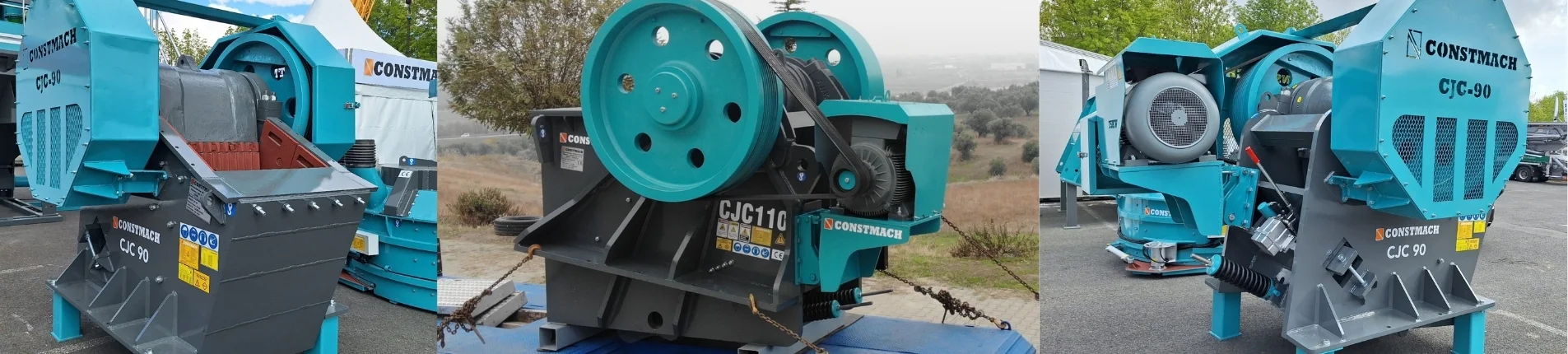
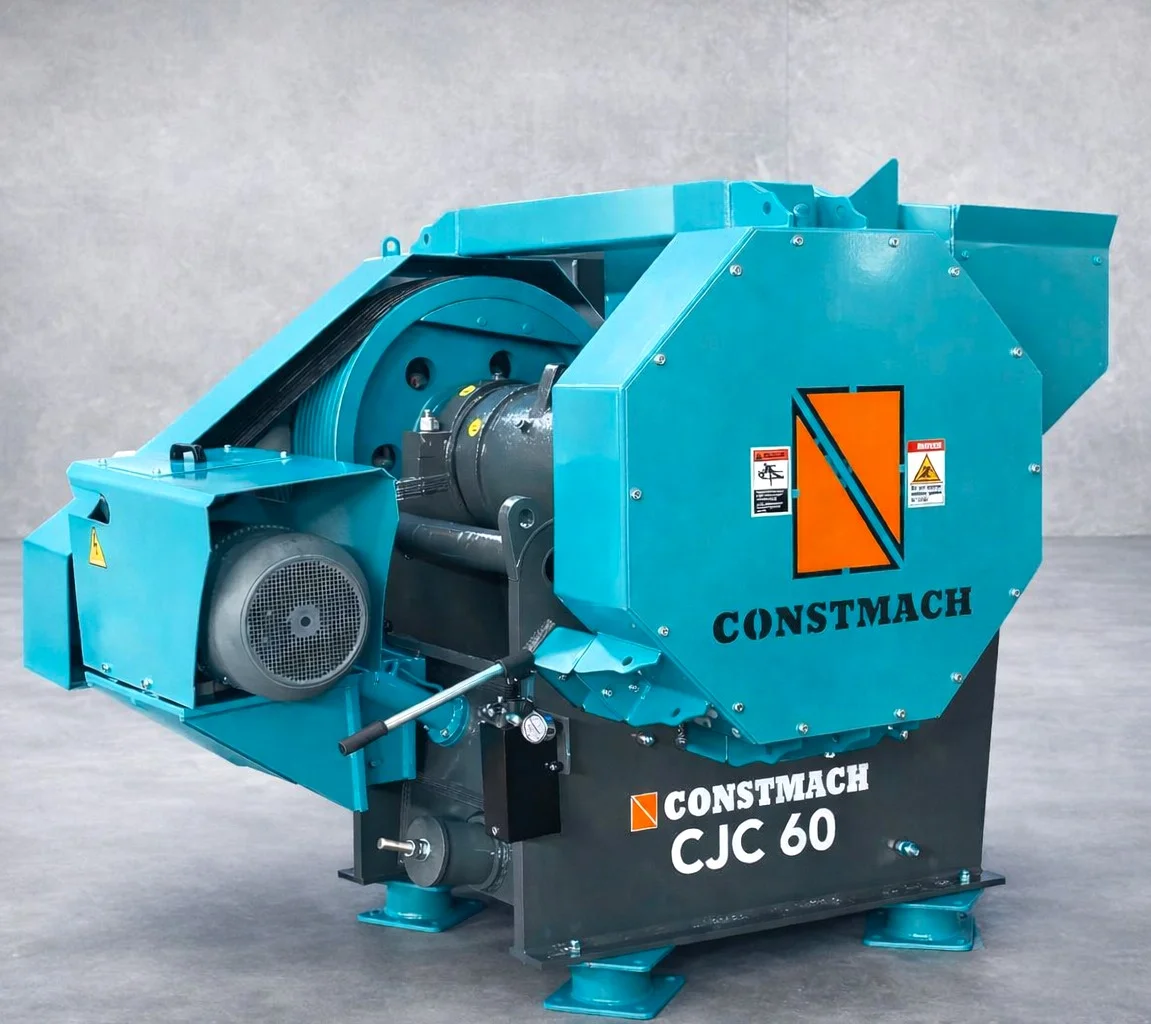
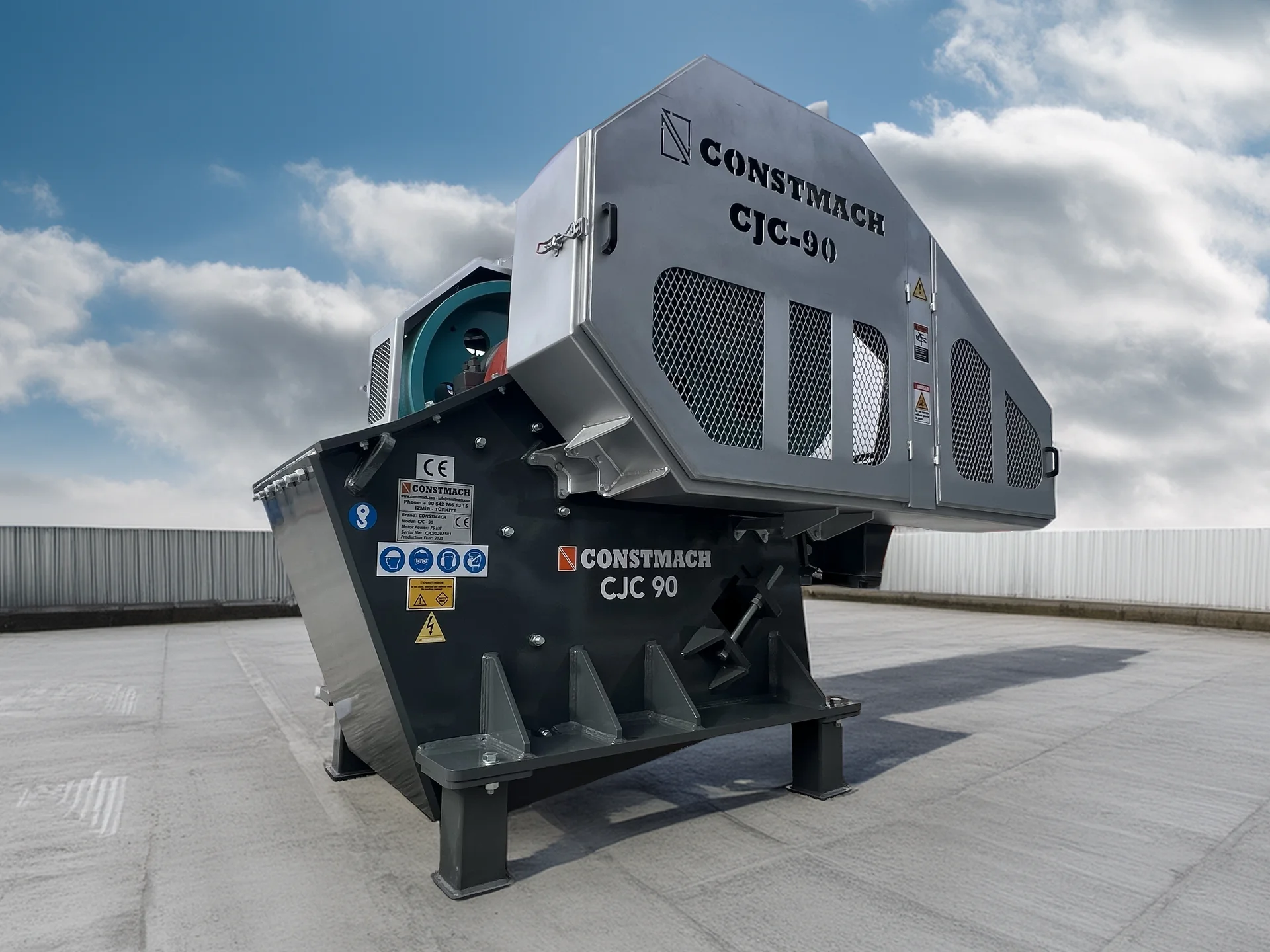
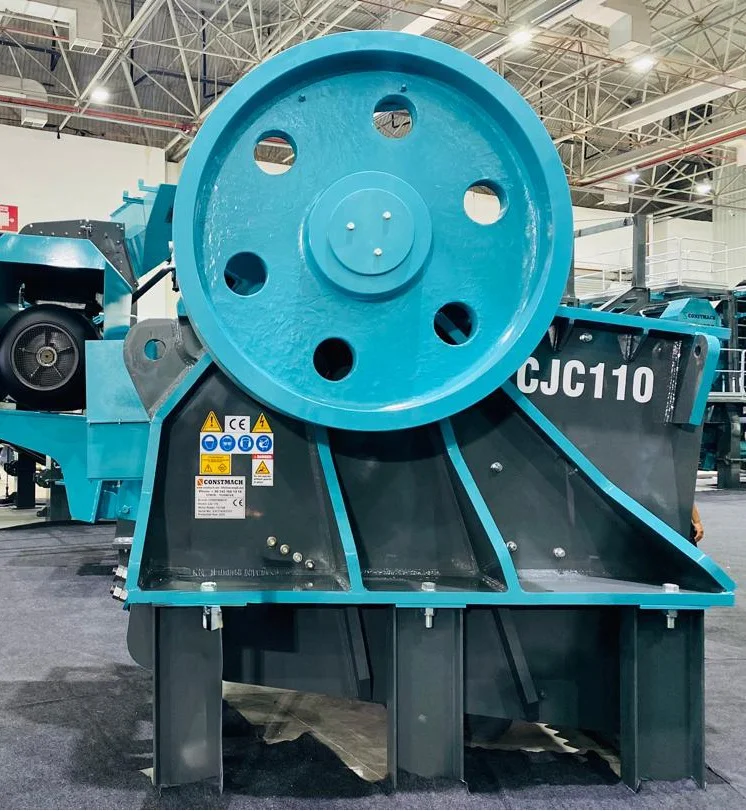
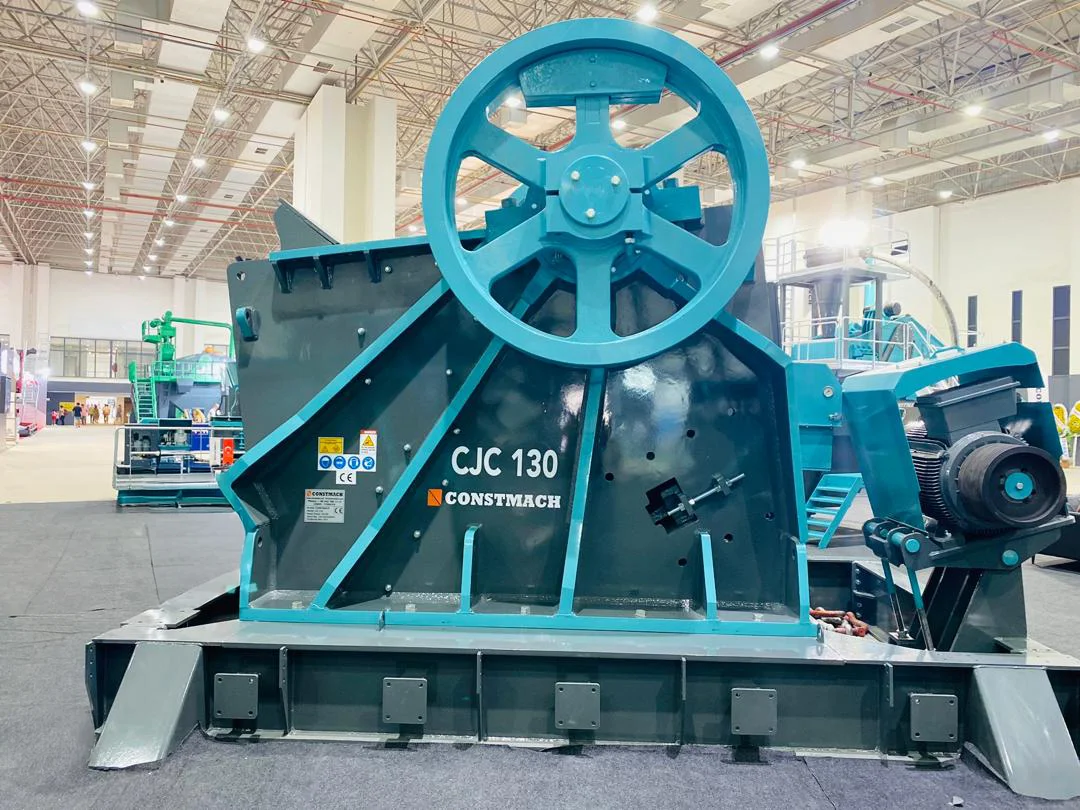
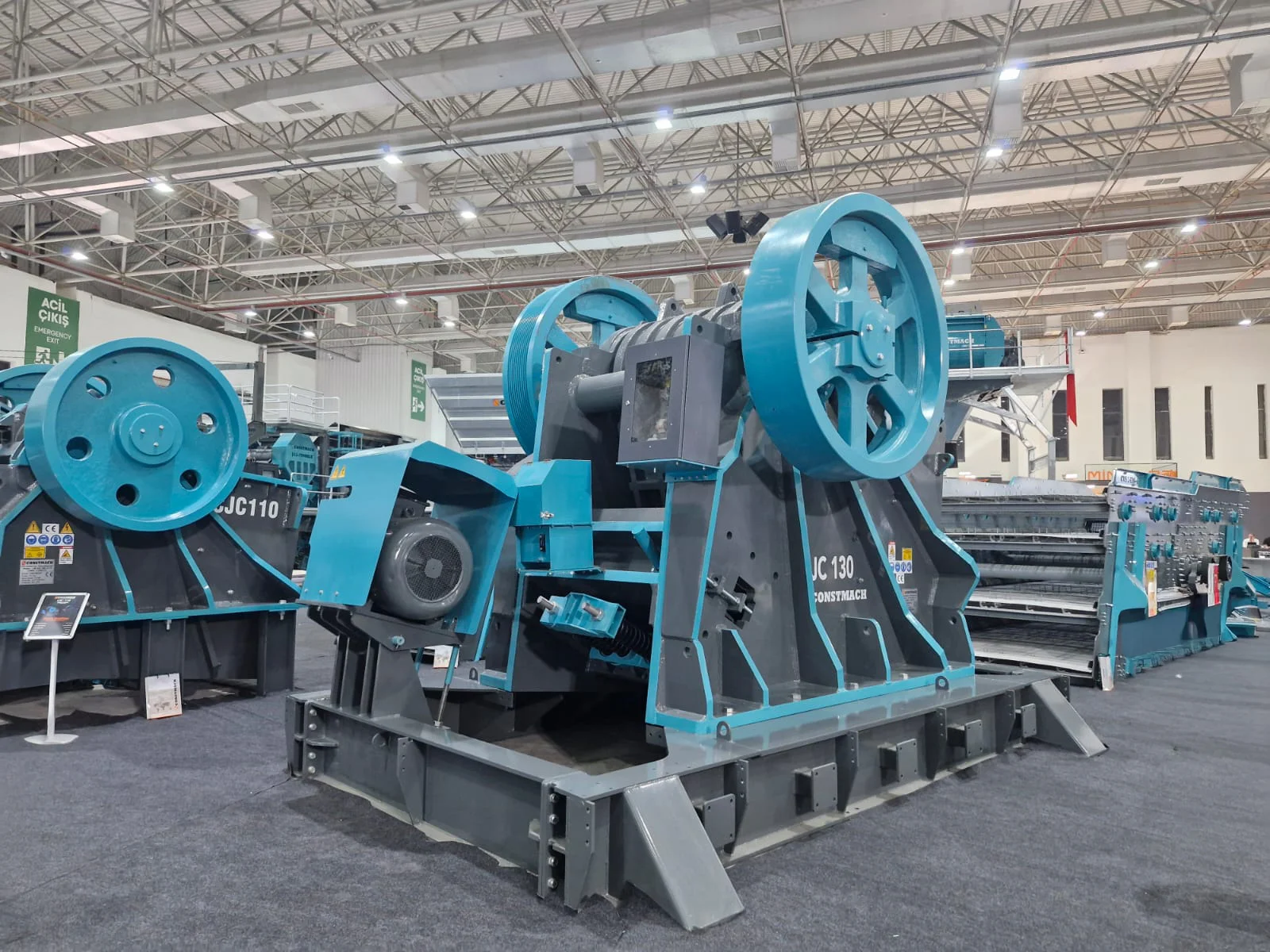
Constmach jaw crushers (CJC series) are single-toggle primary crushers that break rock by compression between a fixed jaw plate and a moving swing jaw driven by an eccentric shaft. The range runs from the compact CJC-60 with a 600x380 mm feed opening up to the CJC-140 with a 1,400x1,100 mm opening and 420-850 t/h output, suiting hard, abrasive feed as the first crushing stage.
What a jaw crusher is
A jaw crusher is the first machine most rock meets in a crushing plant. It takes large run-of-quarry stone straight from the face or the haul truck and reduces it to a size the rest of the plant can handle. The name comes from how it works: two jaw plates, one fixed and one moving, form a V-shaped chamber that squeezes the feed much as a nutcracker would.
Constmach builds this duty as the CJC series. Each machine is a single-toggle design, which means the swing jaw is driven directly by the eccentric shaft rather than through a separate toggle mechanism at the top. The result is a compact, hard-working primary crusher that copes well with the toughest, most abrasive rock a quarry can produce. A single-toggle layout also has fewer moving parts than the older double-toggle arrangement, so there is less to wear and less to grease, and the machine sits lower for a given feed opening.
How a jaw crusher works
Feed enters the top of the chamber through the feed opening. The swing jaw, hung from the eccentric shaft, moves towards and away from the fixed jaw in a tight elliptical path. On the closing stroke the rock is gripped and crushed by compression; on the opening stroke gravity carries the broken fragments lower into the narrowing chamber, where they are caught and crushed again.
This cycle repeats down the full height of the chamber until the material is small enough to fall through the discharge gap at the bottom. Because the action is purely compressive, a jaw crusher does not rely on impact or high tip speed to do its work. That is exactly why it handles high-strength rock so well: it applies enormous force slowly rather than striking the stone.
The elliptical motion matters. The swing jaw does not simply open and close like a hinge; it also moves the rock downward on each stroke, so the chamber feeds itself. This downward bite is what keeps material flowing and stops it sitting in one place and grinding. The eccentric shaft, the flywheels on either side of the machine and the toggle plate at the back all work together to turn the steady rotation of the motor into this controlled, repeated squeeze. The flywheels store energy between strokes and release it on the crushing stroke, which is how a relatively modest motor can apply forces measured in hundreds of tonnes.
The product size is set by the discharge gap, often called the closed side setting, or CSS. Widen the gap for a coarser product and higher throughput; narrow it for a finer product. On the CJC machines this setting is adjustable, so the same crusher can be tuned to suit different downstream stages or different end products. The toggle plate at the back of the machine doubles as a mechanical fuse: if an uncrushable object enters the chamber, the toggle is designed to fail before the frame or the shaft does, which protects the expensive parts of the machine.
Why a jaw crusher for primary duty
Primary crushing is the hardest job in the plant. The feed is large, uneven and often dirty, and the first machine has to accept all of it without choking or breaking. A compression crusher is the natural fit here because it generates the force needed to fracture big lumps of hard rock while tolerating the abuse of direct loading.
Jaw crushers are also forgiving. They handle slabby and irregular feed, swallow the occasional oversize lump, and keep running where other crusher types would struggle. For granite, basalt and river gravel, which are hard, high-strength and abrasive, the jaw crusher is the standard primary choice, and the rest of the line is sized around what it produces. An impactor would shape these materials nicely but would wear out fast on abrasive stone; a jaw crusher trades shape for survival, which is the right trade at the front of the line.
The Constmach CJC range
Five models cover the span from small quarry and recycling work up to high-tonnage aggregate production. The feed opening sets the maximum feed size and broadly tracks the capacity; the drive power rises with the size of the machine. The table below gives the headline figures.
| Model | Feed opening (mm) | Capacity (t/h) | Drive (kW) |
|---|
| CJC-60 | 600 x 380 | 60-110 | 30 |
| CJC-90 | 900 x 650 | 90-270 | 75 |
| CJC-110 | 1,100 x 850 | 150-420 | 132 |
| CJC-130 | 1,300 x 1,000 | 275-790 | 160 |
| CJC-140 | 1,400 x 1,100 | 420-850 | 200 |
The CJC-60 is the entry machine, compact enough for small quarries and demolition recycling. The CJC-90 and CJC-110 cover the bulk of mid-range aggregate work. The CJC-130 and the largest CJC-140 are built for high-tonnage primary duty, where a single crusher feeds a large secondary and tertiary line. Read the feed opening first and the capacity second: the opening tells you the biggest rock the machine will swallow, and the capacity band tells you how much it will move once it is running.
Notice how the numbers step up. The feed opening grows from 600 mm wide on the CJC-60 to 1,400 mm on the CJC-140, while installed power rises from 30 kW to 200 kW. Capacity climbs faster than either, from a 60-110 t/h band at the bottom to 420-850 t/h at the top, because a bigger chamber both accepts larger rock and processes far more of it per stroke. The overlap between bands is deliberate: a CJC-90 set wide can match a CJC-110 set tight, so two adjacent models often suit the same site, and the final choice comes down to feed size and headroom.
Build quality and wear parts
A primary crusher lives or dies on its structure. The frame has to absorb crushing forces that peak every stroke, plus the shock of oversize lumps and tramp material, without flexing or cracking. Constmach builds the CJC machines for that duty, with the rotating assembly and bearings sized to carry the load of continuous primary crushing.
The parts that actually touch the rock are the two jaw plates, the fixed plate and the swing plate. These are made from manganese steel, which work-hardens under the repeated impact of crushing so the wear surface gets harder in service. Both plates are replaceable, and they are the main consumable on the machine. Everything else is designed to outlast many sets of jaw plates. The plates are also profiled with teeth that grip the rock and improve the bite; as they wear the profile flattens, which is one of the signs an operator watches for when deciding whether to turn or change them.
Where it sits in the crushing line
The jaw crusher is the front door of the plant. A vibrating feeder, usually with an integral grizzly, meters raw feed into the crusher and scalps off the fines that do not need crushing. The crusher discharges onto a belt conveyor, which carries the product to the next stage.
From there the flow depends on the rock and the target product. A typical hard-rock line runs the jaw crusher product to a secondary crusher, often a cone, and then to a tertiary stage such as a vertical shaft impact crusher for shaping, with vibrating screens between stages to size the material. The jaw crusher sets the pace for everything downstream, so its capacity and setting decide how the whole line is balanced.
Each piece earns its place. The grizzly feeder removes dirt and undersize before it reaches the chamber, so the crusher only works on rock that actually needs reducing; that alone can lift effective capacity and cut plate wear. The discharge conveyor needs to be rated for the peak tonnage the crusher can produce, not the average, or it becomes the bottleneck. A magnet over that conveyor catches tramp steel before it can reach the cone downstream. Get the surrounding equipment right and the jaw crusher runs steadily; starve it or choke its discharge and the whole line surges.
Stationary and mobile lines
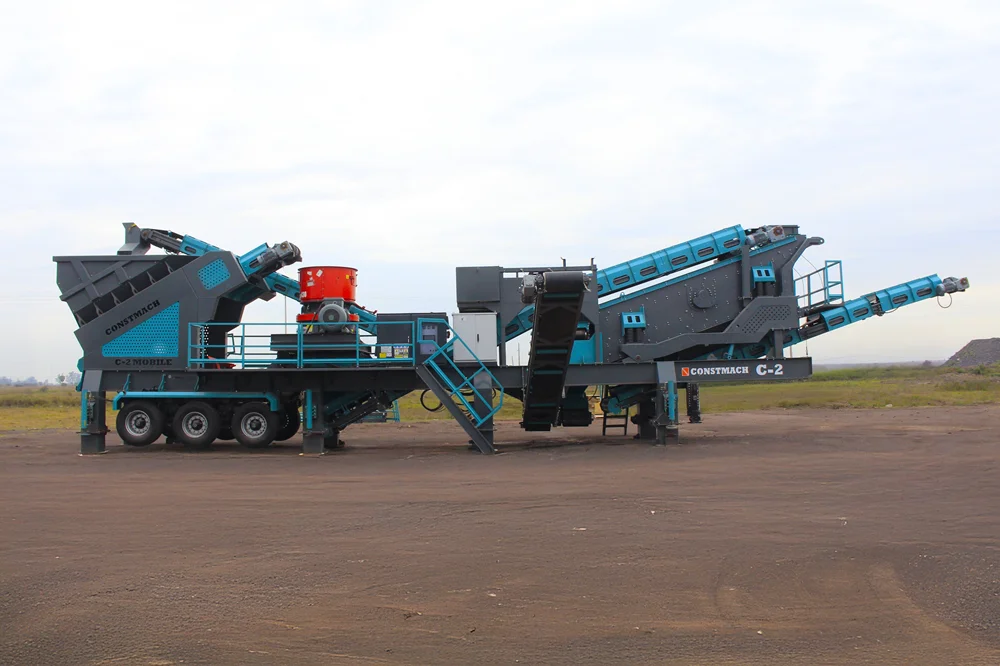
The same CJC crusher serves both stationary and mobile installations. In a stationary plant it is mounted on a steel or concrete foundation and fed from a fixed structure. In a mobile crushing plant it sits on a wheeled or tracked chassis, so the primary stage can move with the quarry face or between sites. The crushing principle and the wear parts are identical; only the way the machine is mounted and fed changes. A mobile unit suits contractors who move between jobs and recyclers working on different demolition sites; a stationary plant suits a fixed quarry where the same face is worked for years and the lowest cost per tonne matters most.
Capacity and sizing
Capacity figures on a jaw crusher are a range, not a single number, and for good reason. Throughput depends on the closed side setting, the feed size, the hardness and the moisture of the rock. A wide setting and a clean, blocky feed put you at the top of the band; a tight setting and difficult feed pull you down. The CJC range spans 60 t/h at the small end to 850 t/h on the CJC-140.
Two figures matter when sizing. First, the feed opening must comfortably accept your largest expected lump; as a rule the biggest feed should be no more than about 80% of the smaller opening dimension. Second, the throughput at your intended setting must meet the tonnage the rest of the plant needs. It is usually better to choose a crusher with a little headroom than to run a small machine at its limit, which accelerates wear and risks bridging.
A worked sizing example
Suppose a quarry blasts hard granite and the loader regularly picks up lumps around 650 mm across. The target is 300 t/h of minus-150 mm primary product to feed a cone stage. Start with the feed: 650 mm against the 80% rule needs a smaller opening dimension of at least about 810 mm, which rules out the CJC-60 and CJC-90 and points to the CJC-110, whose 850 mm dimension clears it. Now check tonnage. The CJC-110 carries a 150-420 t/h band; 300 t/h sits comfortably mid-band at a moderate setting, so the machine is not being pushed. That headroom means the operation can lift output later, or pass an off day of awkward feed, without changing the crusher. Had the target been 500 t/h, the CJC-110 would have been near its ceiling and the CJC-130 would be the safer pick. This is the logic in every sizing decision: clear the largest lump first, then place the required tonnage inside, not at the edge of, the capacity band.
Materials and applications
The CJC series is at its best on hard, high-strength, abrasive rock. Granite and basalt are the classic feeds, along with river gravel where the rounded, silica-rich stone would punish a softer crusher. These are the materials where compression crushing pays off and where the manganese jaw plates earn their keep.
Typical end uses for the product include aggregate for concrete and asphalt, road base and sub-base, railway ballast and general construction stone. The jaw crusher rarely makes the finished product on its own; it makes the well-sized primary feed that lets the secondary and tertiary stages produce the final gradings efficiently.
- Hard rock quarrying, including granite, basalt and similar high-strength stone.
- River gravel and alluvial deposits with abrasive, rounded feed.
- Aggregate production for concrete and asphalt mixes.
- Road base, sub-base and ballast.
- Demolition and construction recycling on the smaller models.
The economics of wear
On a primary crusher the biggest running cost over time is not power, it is wear, and almost all of that wear is the jaw plates. Two things drive how fast they go: the abrasiveness of the rock and how hard the machine is worked. High-silica granite and river gravel are the toughest on plates; softer limestone is gentler. A tight setting, constant oversize feed and an uneven, surging feed all accelerate wear, while a sensible setting and steady choke feeding stretch plate life.
The single most effective economy is getting full value from each set of plates. Manganese plates wear from the top of the chamber down, because that is where the biggest rocks land with most force. Because the plates are symmetrical they can usually be turned end-for-end once, putting the fresh end at the top and roughly doubling the life of the set before it is scrapped. Tracking tonnes crushed per set, rather than weeks in service, tells you the real cost per tonne and makes it easy to compare one period with another. Budget plates as a planned consumable, keep tramp metal out of the feed, and avoid forcing a fine product out of the primary stage, and the wear bill stays predictable.
Maintenance and wear parts
Routine maintenance on a jaw crusher is straightforward, which is part of why the type is so widely used. The CJC machines come with automatic lubrication as standard, so the bearings receive a metered supply of grease in service without relying on someone remembering to do it by hand. That single feature removes one of the most common causes of premature bearing failure.
The main scheduled task is managing the jaw plates. They wear from the top down and can usually be turned end-for-end once to even out the wear before replacement, getting more life from each set. Operators should watch the discharge setting, check the toggle and tension components, and keep the lubrication system topped up and clean. Tramp metal should be kept out of the feed wherever possible, because uncrushable steel is hard on plates and the toggle alike.
Operating tips for steady output
A few habits separate a crusher that runs well from one that fights its operator. Choke-feed the chamber: keep it roughly two-thirds to three-quarters full so rock crushes against rock, which improves product shape and spreads wear evenly across the plates. Regulate the feeder so the crusher is fed at a steady rate rather than in dumps, because surges waste capacity and shock the machine. Watch the discharge for slabby or oversize product, which usually means the setting has opened up as the plates wear and needs resetting. Listen to the machine; a change in sound often signals a problem before any gauge does. Keep the area under the discharge clear so product flows away freely, since a backed-up conveyor will pack the chamber and stall it. None of this is difficult, but doing it consistently is what keeps tonnage up and cost per tonne down.
Common mistakes to avoid
Several recurring errors shorten the life of a jaw crusher and cut its output. Knowing them in advance is the cheapest form of protection.
- Oversize feed. Loading lumps too large for the opening causes bridging at the top of the chamber and stalls throughput. Match feed size to the machine.
- Running too tight a setting. Forcing a fine product out of a primary crusher overloads it and burns through jaw plates. Let the secondary stage do the fine work.
- Uneven or surging feed. A jaw crusher works best choke-fed at a steady rate. Dumping rock in batches wastes capacity and stresses the machine.
- Ignoring lubrication. Even with automatic lubrication, the system needs the right grease and periodic checks.
- Letting tramp metal through. Uncrushable material damages plates and can crack the toggle.
How to choose the right model
Start with the rock and the largest feed size, because that sets the minimum feed opening you can use. Then fix the tonnage the plant must produce and the product size you want from the primary stage, which together point to a capacity band. Cross those against the table and you will usually land on one or two candidate models.
From there, weigh installed power against your site supply, and think about whether the crusher will live in a stationary plant or move with a mobile line. If you expect the operation to grow, choosing the next size up gives headroom that costs little now and saves a machine swap later. Constmach's application engineers size the crusher against your material and target output, so the choice rests on real figures rather than a guess. The right jaw crusher is the one that meets today's tonnage comfortably and still has something in hand for tomorrow.