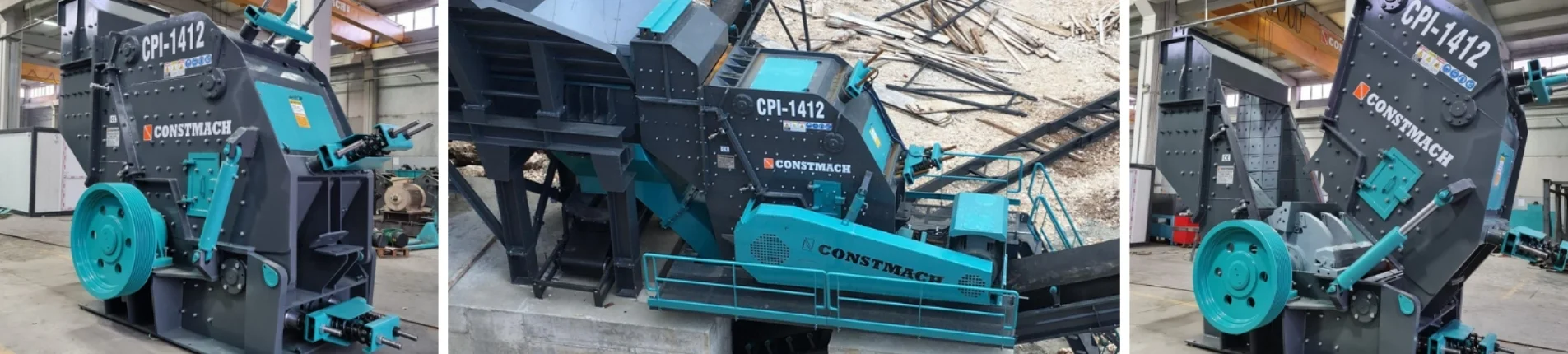
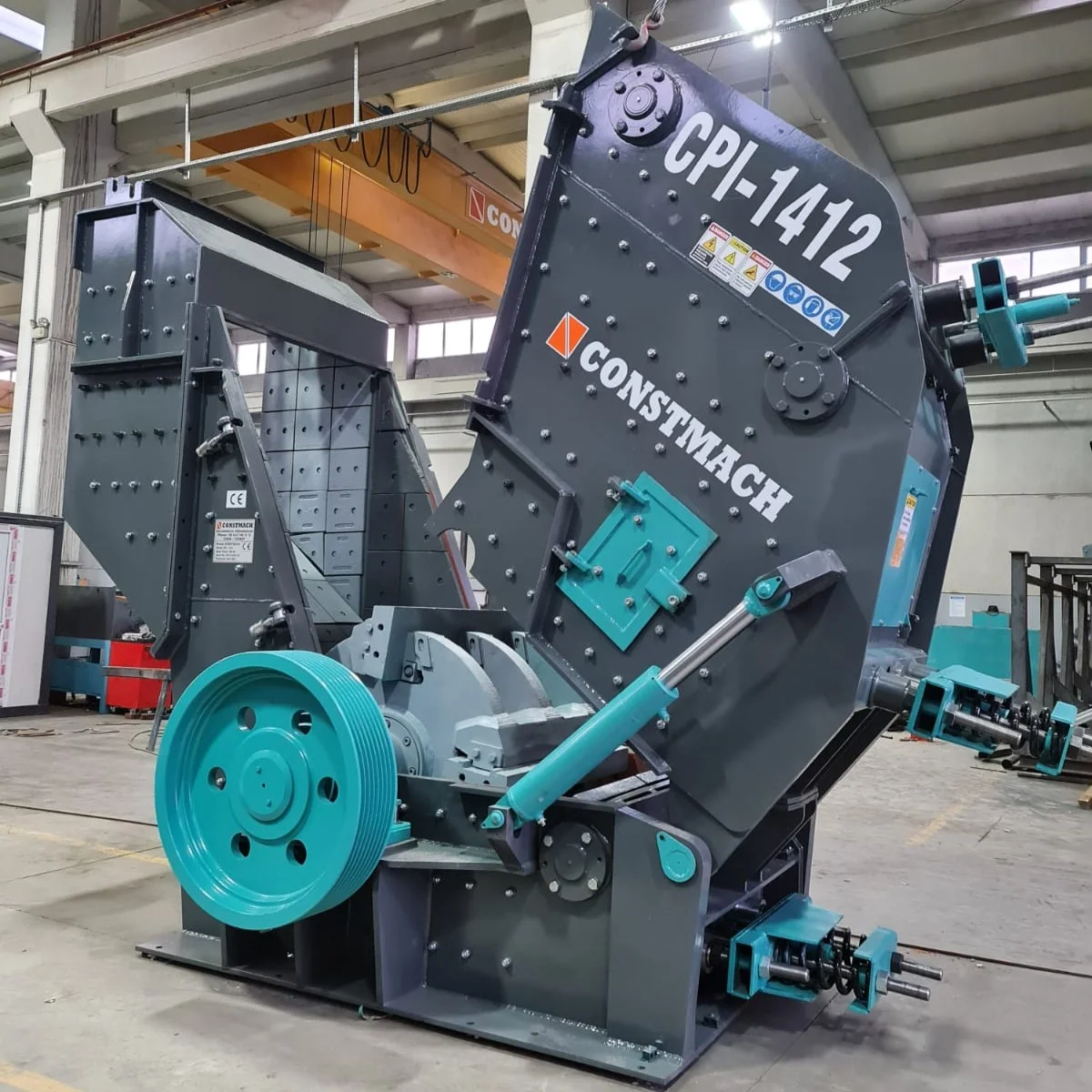
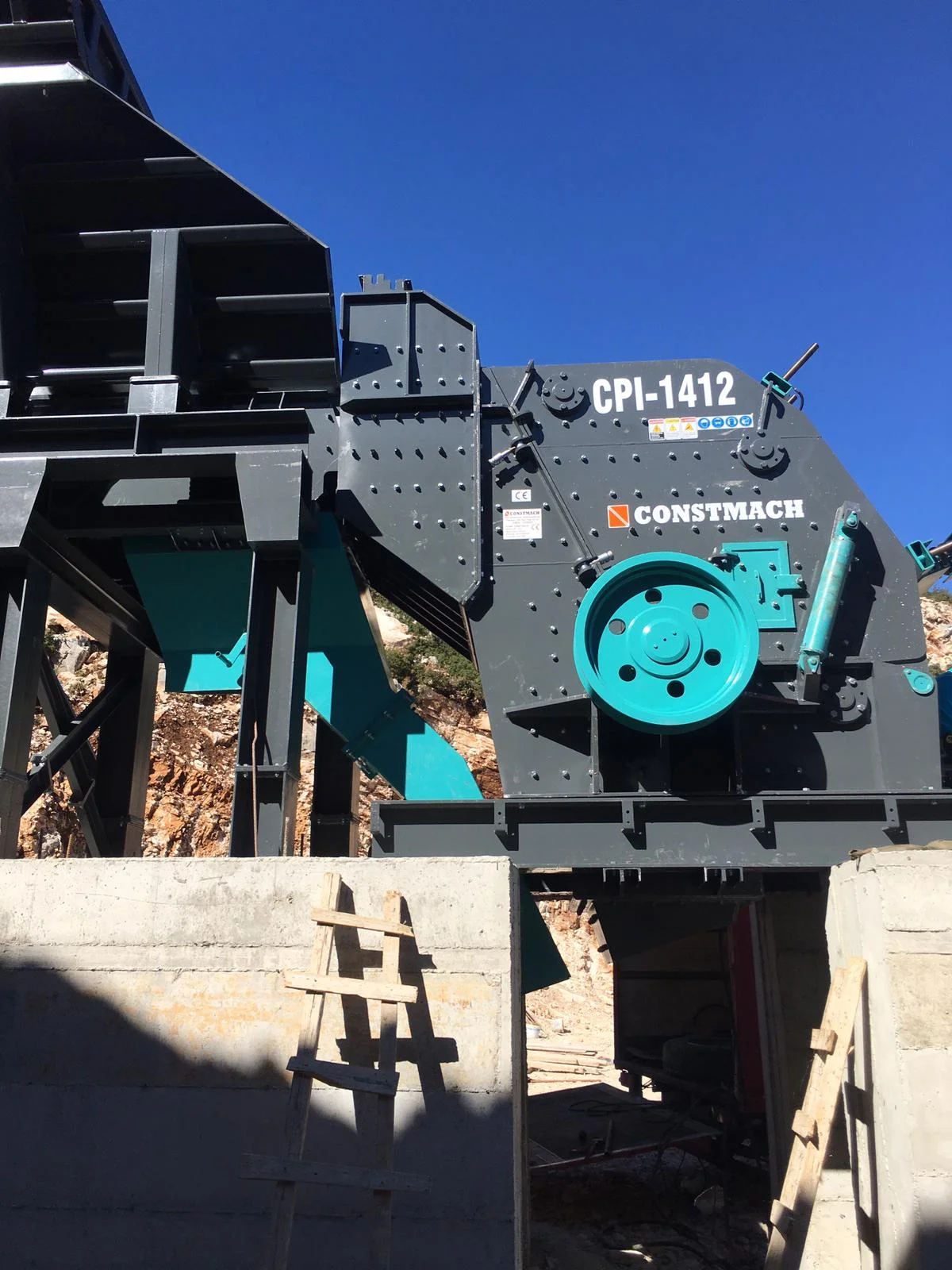
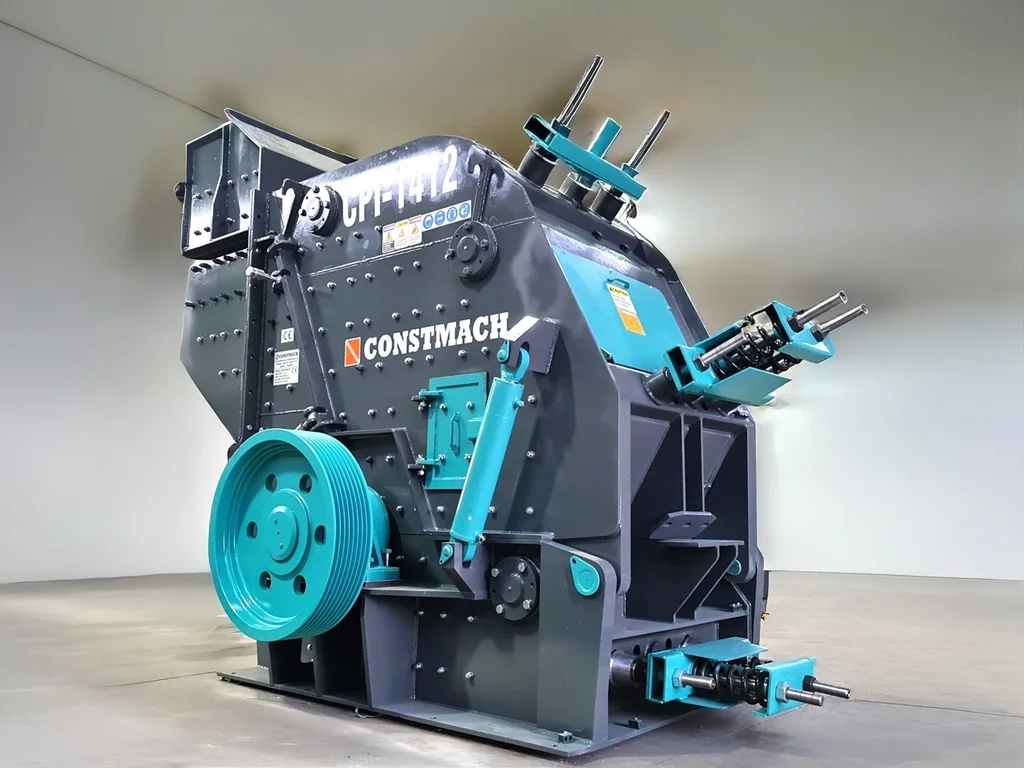
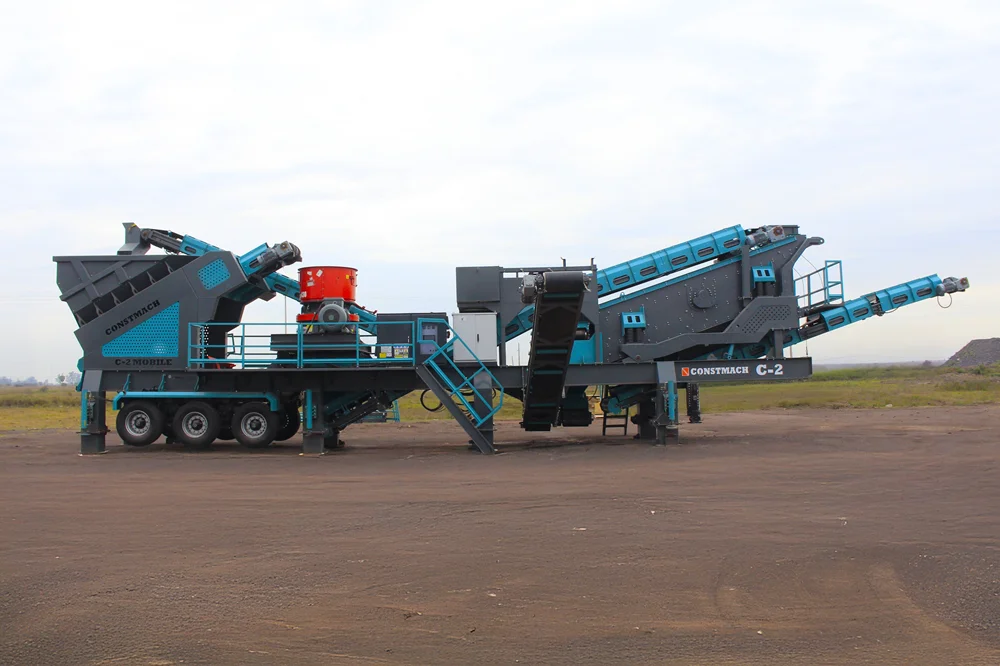
A primary impact crusher is a first-stage machine that reduces feed by impact rather than compression: manganese blow bars on a high-speed rotor strike the rock and hurl it against adjustable breaker plates. Constmach builds three CPI models, from the CPI-1412 at 200-250 t/h to the CPI-1620 at 400-600 t/h, all producing a cubical product with a high reduction ratio.
What a primary impact crusher is
A primary impact crusher sits at the front of a crushing line and takes run-of-quarry rock straight from the loader or feeder. Inside, a heavy rotor spins at high speed carrying several manganese-steel blow bars, sometimes called impeller bars. As feed enters the chamber, the bars hit it hard and throw it against breaker plates fixed to the housing. The rock breaks along its natural cleavage planes, which is why the product comes out well-shaped instead of slabby.
The Constmach range is the CPI series: the CPI-1412, CPI-1415 and CPI-1620. These cover the bulk of medium-hardness primary duties, from a single mobile unit on a small limestone operation up to a large fixed plant feeding a downstream screening and washing circuit. Because the impact crusher delivers a high reduction ratio in one pass, it often does work that would otherwise need both a primary and a secondary machine.
How impact crushing works
Impact crushing is fundamentally different from the squeezing action of a jaw or cone crusher. Three mechanisms do the work. First, the blow bar strikes the incoming rock directly. Second, the rock is thrown against the breaker plates and fractures on contact. Third, the broken fragments collide with each other and with the chamber as they fall, getting further reduced before they discharge.
Two settings govern the result: rotor speed and the gap between the rotor and the breaker plates. The breaker plates are adjustable, so the operator can open the gap for a coarser product and higher throughput, or close it for a finer, tighter gradation. Higher rotor speed generally produces more fines and a finer curve; lower speed eases wear and yields a coarser product. Getting these two right for the rock and the target gradation is the heart of running an impact crusher well.
Because the breaking energy comes from velocity rather than a fixed mechanical squeeze, the impact crusher does not need the massive frame and toggle of a jaw, nor the spider and mantle of a cone. The energy lives in the spinning rotor mass, and the rock meets that energy the instant it drops into the bar circle. This is why feed must be presented evenly and continuously: a starved chamber wastes rotor energy on air, while a flooded one drags the rotor speed down and coarsens the product.
Why choose an impact crusher for primary duty
The main reason is product shape and reduction. Impact breaking follows the rock's weak planes, so you get cubical particles with few flaky or elongated pieces, exactly what aggregate for concrete and asphalt needs. The reduction ratio is high, which means a single impact crusher can often take a large feed down to a product size that a jaw crusher would only reach with a second machine behind it.
That has a real commercial effect. On the right feed, a primary impact crusher can shorten the flowsheet, cut the capital cost of a second crushing stage and reduce the conveyors and structures that go with it. Fewer transfer points also means fewer places for material to build up. The trade-off is wear, which is why feed selection matters so much.
The Constmach CPI range
Three models cover small to large primary applications. All three share the same working principle and the same wear-part philosophy; they differ in rotor size, the maximum lump they will accept, installed power and throughput.
| Model | Rotor (mm) | Max feed (mm) | Drive | Capacity (t/h) |
|---|
| CPI-1412 | 1,400 x 1,250 | 900 x 900 | 250 kW | 200-250 |
| CPI-1415 | 1,400 x 1,540 | 1,000 x 1,000 | 315 kW | 350-400 |
| CPI-1620 | 1,600 x 2,000 | 1,300 x 1,300 | 2 x 250 kW | 400-600 |
The CPI-1412 suits compact plants and mobile chassis where 200-250 t/h is enough. The CPI-1415 steps up the rotor width and power for mid-sized fixed plants in the 350-400 t/h band. The CPI-1620 is the large unit, with a twin 2 x 250 kW drive and a 1,300 x 1,300 mm feed opening that swallows big quarry lumps, delivering 400-600 t/h. Choose the model by the largest stone you must accept first, then check that its capacity band matches your target tonnage.
A worked sizing example
Suppose a limestone quarry needs roughly 380 t/h of crushed aggregate and the loader routinely tips lumps up to about 950 mm across. The headline tonnage points at the CPI-1415, which sits in the 350-400 t/h band. But check the feed opening: the CPI-1415 accepts up to 1,000 x 1,000 mm, so a 950 mm lump clears it with only a thin margin. On a deposit that throws the occasional oversize block, that margin is tight, and a single bridged stone stops the feed.
Now run the same numbers against the deposit honestly. If oversize is common, stepping up to the CPI-1620 buys both a 1,300 x 1,300 mm opening and a 400-600 t/h band, giving comfortable headroom on lump size and tonnage at the cost of a larger drive and a bigger structure. If the quarry is well blasted and oversize is rare, the CPI-1415 is the economical fit and a hydraulic breaker at the hopper can deal with the odd block. The point is that the decision turns on the feed, not on the catalogue tonnage alone. Two sites needing 380 t/h can correctly end up with different machines.
Build quality and wear parts
The parts that take the punishment are the manganese-steel blow bars and the breaker plates. Manganese is used because it work-hardens under repeated impact: the more it gets struck, the tougher the working surface becomes, which gives a sensible service life on medium-hardness limestone and dolomite. The blow bars are designed to be turned or replaced as a set so the rotor stays in balance.
The rotor itself is a heavy, balanced assembly. Its mass carries the energy that does the breaking, so it is built to run hour after hour without losing balance. Automatic lubrication is standard, feeding the bearings on a set schedule so they are not left to manual greasing intervals that get missed on a busy shift. The breaker plates are mounted so their gap to the rotor can be reset as they wear, holding the product size steady over the life of the liners.
Where it fits in the crushing line
In a typical limestone flowsheet, run-of-quarry rock is dumped into a feed hopper and metered out by a vibrating feeder, often with an integral grizzly that scalps off the fines and dirt before they reach the chamber. The primary impact crusher takes the scalped feed and reduces it in one pass. Its product drops onto a belt conveyor that carries it to a vibrating screen.
From the screen, on-size aggregate goes to stockpile and oversize returns for reprocessing. Because the impact crusher's reduction ratio is high, many limestone plants run it as the only crushing stage, with screening doing the rest. Where a tighter or finer product is needed, a secondary crusher and a closed screening loop are added behind it. The CPI integrates cleanly with Constmach feeders, screens and conveyors as a matched line.
Matching feeders, screens and conveyors
The crusher is only as steady as the equipment around it. The vibrating feeder ahead of it should be sized so it can deliver the crusher's rated tonnage without surging, and ideally controlled off the crusher load so the chamber stays evenly fed. A grizzly section on that feeder pays for itself twice over: it keeps dirt and fines out of the chamber, which protects the bars, and it lifts effective throughput because the crusher is not wasting energy re-breaking material that was already fine.
Downstream, the discharge conveyor and the screen must be able to clear everything the crusher produces at peak. A screen that is undersized for the crusher will back up, and that backlog eventually chokes the crusher. As a rule, size the screen and main conveyor with headroom above the crusher's top capacity, not at it, so a burst of fine product or a moment of high throughput does not stall the line. Matching the whole train to the crusher, rather than buying each piece in isolation, is what turns a nominal 400 t/h on paper into 400 t/h on the stockpile.
Capacity and sizing
Quoted capacities, 200-250, 350-400 and 400-600 t/h, are guide figures for typical medium-hardness limestone at a normal product setting. Real throughput shifts with feed size, rock hardness and moisture, how worn the blow bars are, and how fine you set the product. A coarser setting lifts tonnage; a fine one lowers it.
Size the machine in two steps. First, make sure the feed opening accepts your largest expected lump with margin: there is no point matching tonnage on paper if the crusher chokes on big stones. The CPI-1620's 1,300 x 1,300 mm opening, for example, handles coarse quarry rock the smaller models would bridge. Second, pick the capacity band that sits comfortably above your target rate, leaving headroom for harder patches in the deposit and for the gradual drop in output as wear parts age.
Materials and applications
Primary impact crushers are at their best on medium-hardness, low-to-medium abrasion stone. Limestone and dolomite are the classic feeds and where these machines earn their keep: high reduction, cubical product, sensible wear. Typical end products are aggregates for concrete and asphalt, road base and sub-base, and feed for lime or cement processes.
Just as important is what they are not for. Very hard, highly abrasive rock such as granite, basalt or river gravel with a heavy quartz content chews through blow bars fast and pushes the wear cost up steeply. For those feeds a jaw crusher is the right primary, taking the impact crusher's place at the front of the line. If your deposit is hard or abrasive, say so early; the wrong crusher type is an expensive mistake to fix later.
Understanding wear economics
The case for an impact crusher rests on a simple trade. You save on capital and on stages by getting a high reduction ratio in one machine, and you pay for it in wear metal. On the feeds these machines are built for, that trade is firmly in your favour: manganese bars on medium-hardness limestone last well, and the cost per tonne of product stays low. Push the same machine onto abrasive rock and the wear side of the ledger swells until it swamps the saving.
The useful way to think about it is cost per tonne crushed, not the sticker price of a set of bars. A set that lasts twice as long on the right feed is cheaper per tonne even if it costs more to buy. Three levers move that number. Feed selection is the biggest: keep the machine on the rock it was designed for. Operating discipline is the second: even feeding, no tramp metal, bars changed before they wear into the rotor seats. Genuine wear parts are the third: correctly cast manganese in the right profile holds its shape and its gap longer than a cheap substitute, so the product stays on spec and the change interval stays long. Tracking bars and plates in tonnes crushed, then costing them against tonnes produced, turns wear from a surprise into a planned line on the budget.
Maintenance and wear-part management
Day-to-day upkeep is mostly about the wear parts. Inspect the blow bars regularly and turn or change them before they wear past their usable profile: leaving them too long lets the gap grow, coarsens the product and can damage the rotor seats. Replace bars as a balanced set so the high-speed rotor stays true.
Reset the breaker-plate gap as the plates wear to hold product size and keep tonnage up. Automatic lubrication looks after the bearings, but the system itself needs checking: confirm it is delivering, keep the reservoir topped up and use the specified grease. A few habits make a real difference:
- Keep tramp metal out of the feed; uncrushable steel is the quickest way to damage blow bars and the rotor.
- Feed evenly across the rotor width rather than dumping to one side, so wear is spread and the machine stays balanced.
- Track wear-part life in tonnes crushed, not days, so you can forecast changeouts and order spares before they stop the plant.
- Watch for vibration; a sudden rise usually means a broken or unevenly worn bar.
Operating tips for steady output
A primary impact crusher rewards a calm, even feed. Start the rotor first, let it come up to full speed, then start the feeder; never bury a stationary or slowing rotor in rock. Keep the chamber consistently fed at the rate the rotor can handle, since both starving and flooding cost you product quality. When you change the product, change one thing at a time: adjust the breaker-plate gap, run a sample, then adjust again, rather than moving gap and speed together and losing track of which did what.
At shutdown, run the chamber empty before stopping the rotor so the next start is clean. Listen to the machine: a steady running note tells you the chamber is loaded right, while a racing note means it is starved and a labouring note means it is choked. Operators who learn the sound of a well-fed crusher keep tonnage and shape consistent without staring at a gauge all shift.
Common mistakes to avoid
The most expensive error is feeding the wrong rock. Putting hard, abrasive stone through an impact crusher gives short blow-bar life and a running cost that quickly outweighs the saving on a second stage. Match the crusher type to the deposit first.
Other recurring problems: choking the chamber with lumps bigger than the feed opening, which stalls the rotor and stresses the drive; running the bars past their limit to squeeze out a few more tonnes, which damages costlier components; and letting tramp metal into the feed. Undersizing is also common, with buyers picking a machine on its headline capacity without checking the feed opening, then finding it bridges on the bigger quarry stones. Size on both feed opening and tonnage, every time.
How to choose the right model
Start with the rock. Confirm it is medium-hardness, low-to-medium abrasion, limestone or dolomite, and that an impact crusher is genuinely the right primary. If the feed is hard or abrasive, a jaw crusher is the better choice and Constmach can supply it. Next, measure your largest feed lump and choose a model whose opening accepts it with room to spare.
Then set your target tonnage and pick the capacity band above it: the CPI-1412 for 200-250 t/h, the CPI-1415 for 350-400 t/h, or the CPI-1620 for 400-600 t/h. Consider whether the crusher will run as the only crushing stage or feed a secondary, since that affects your product setting and screen sizing. Constmach's application engineers will review your rock data, feed size and gradation targets and recommend the model and chamber setup that fit, rather than leaving you to guess from a spec sheet.
Stationary and mobile options
The CPI range is offered for both fixed and mobile plants. A stationary crushing plant suits a settled quarry with a long production life, where the crusher is mounted on a permanent structure and tied into fixed conveyors and screens. A mobile crushing plant carries the same crusher on a wheeled or tracked chassis, so it can move between pits or follow the face. The crusher and its wear parts are the same; the difference is the supporting structure and how the plant is fed and discharged. Which one fits depends on your site life, the number of locations you work and how often you need to relocate.
A note on selection
A primary impact crusher is one of the most cost-effective ways to crush medium-hardness rock, provided the feed matches the machine. Get the rock type, the feed opening and the capacity band right and the CPI series delivers a cubical, well-graded product at a low cost per tonne, often without a second crushing stage. The value is in matching the model to the duty, and that is worth taking the time to do properly before any steel is ordered.