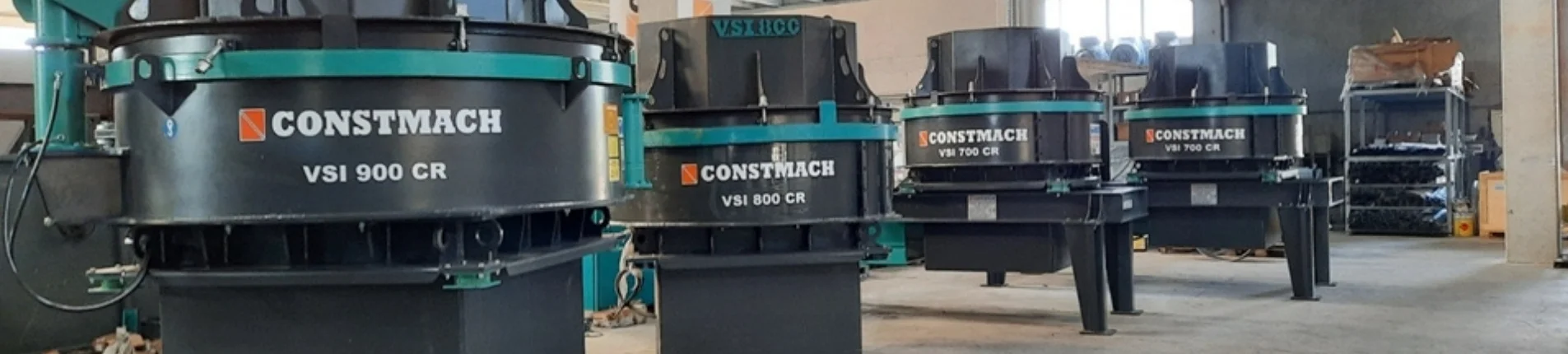
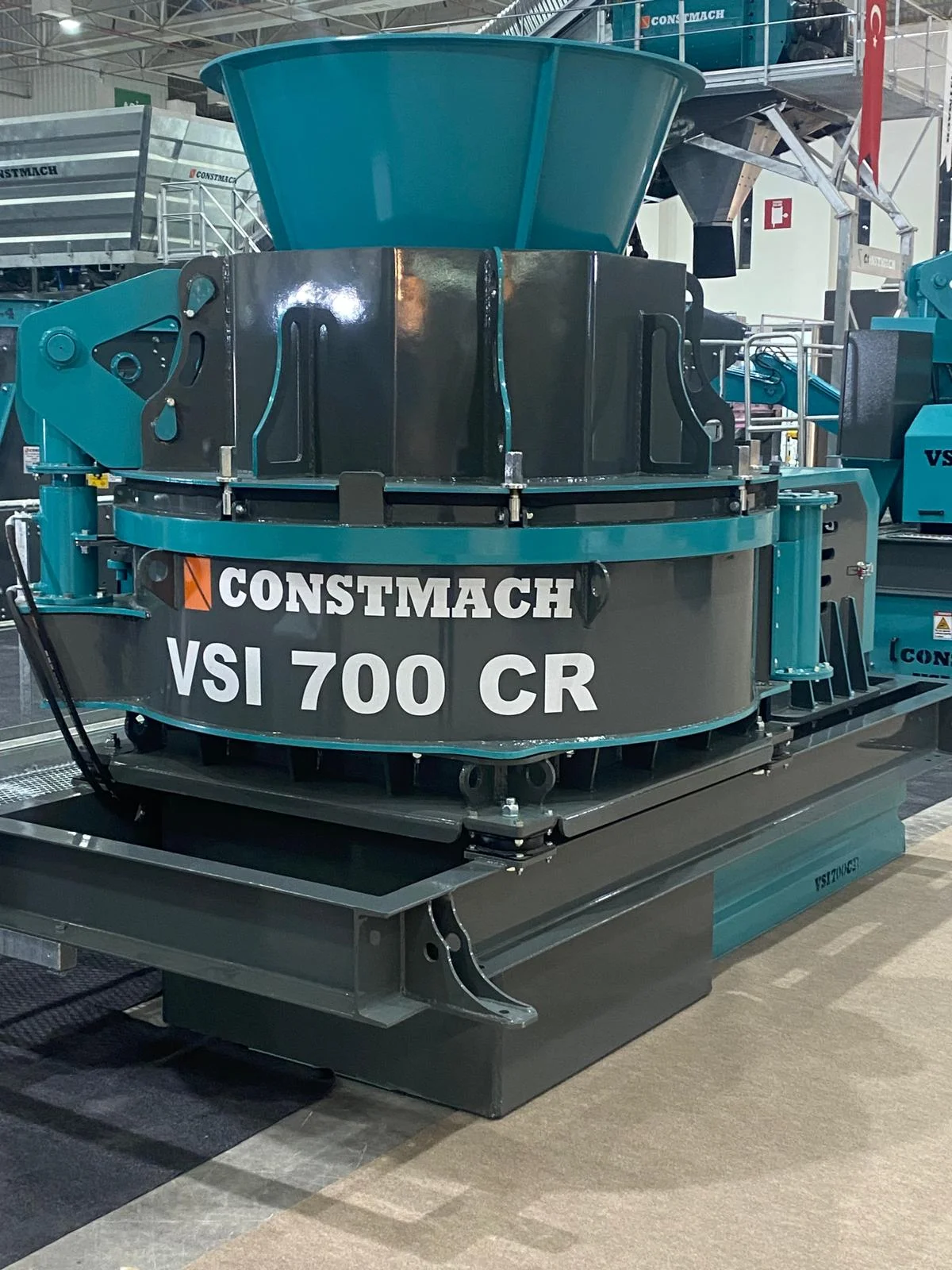
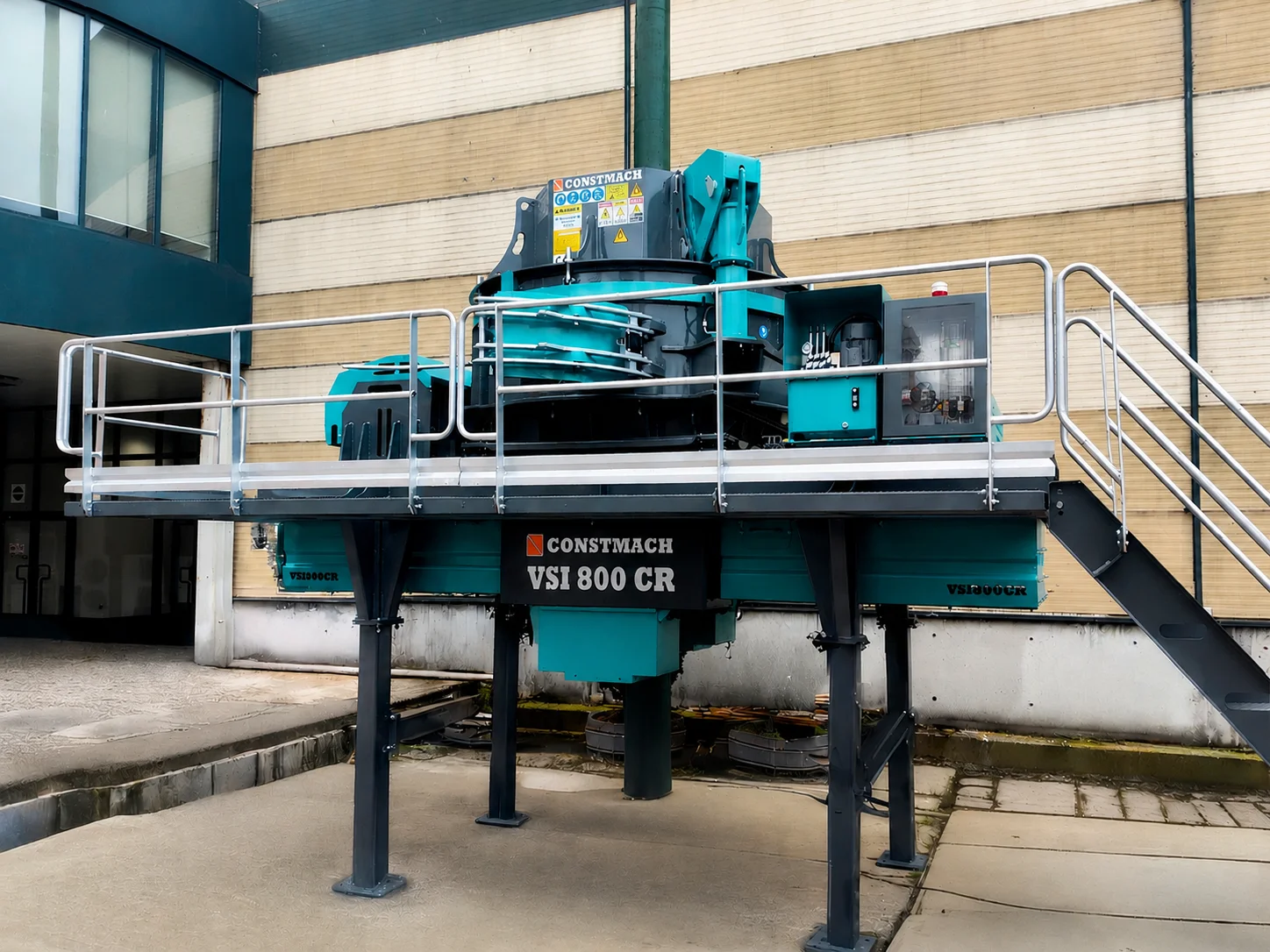
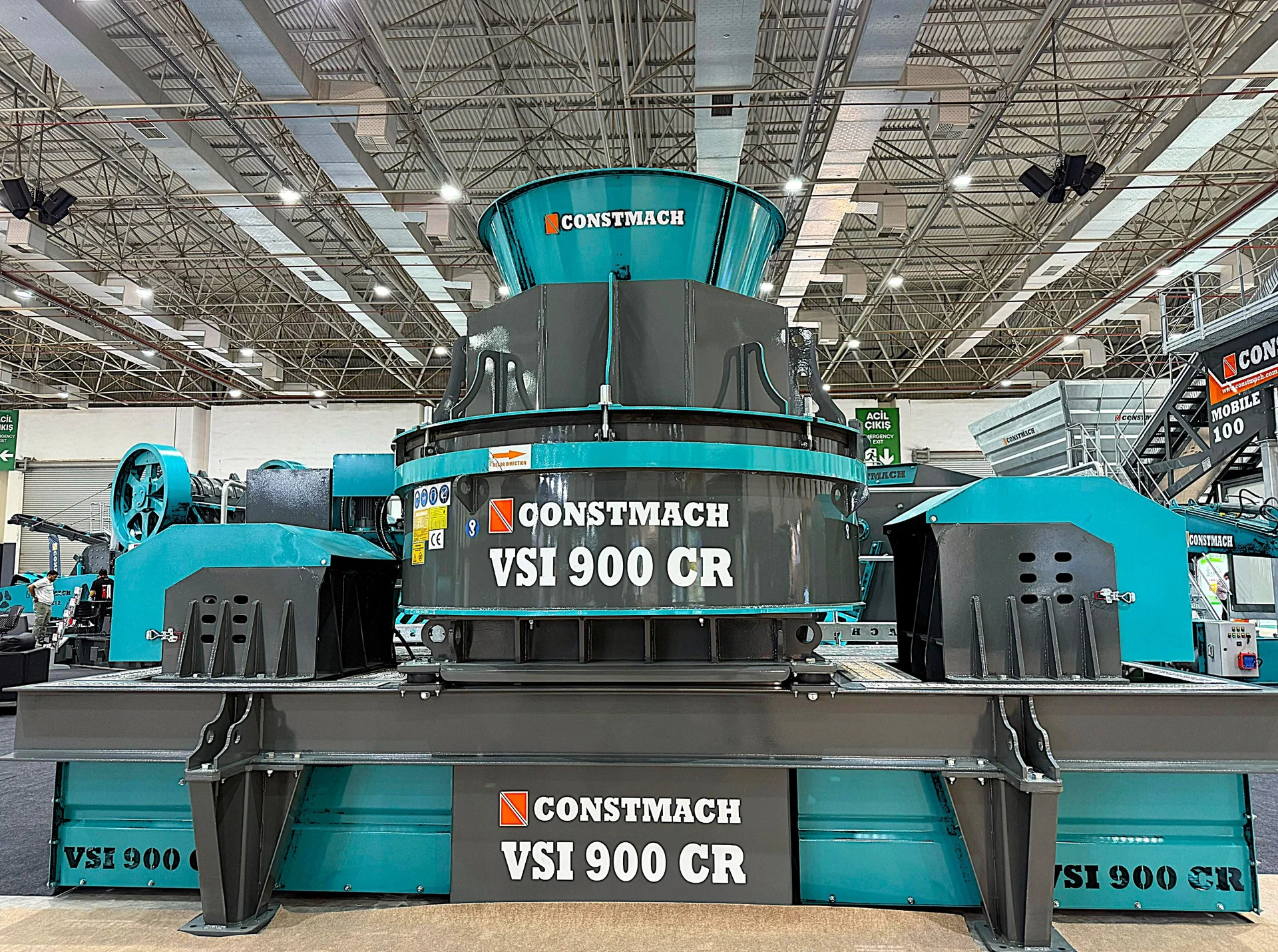
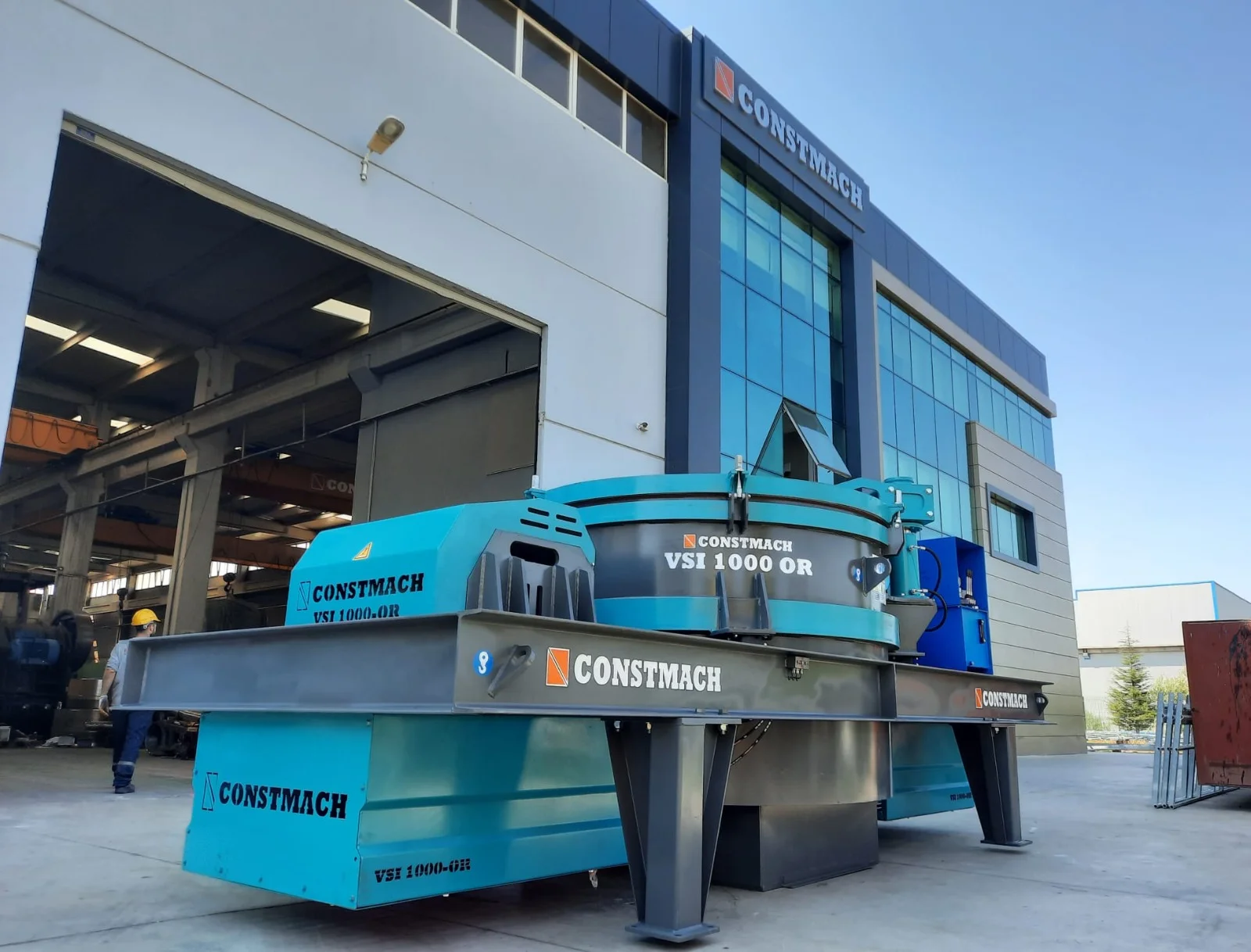
A vertical shaft impact crusher (VSI) is the sand-making and final-shaping machine in an aggregate plant: feed drops into the centre of a high-speed vertical rotor and is flung outward at velocity to break on impact. Constmach builds four VSI models, from the 700 mm closed-rotor unit at 60-100 t/h up to the 975 mm open-rotor machine at 250-300 t/h, converting crusher fines into manufactured sand and cubical aggregate.
What is a vertical shaft impact crusher?
A vertical shaft impact crusher is a tertiary, fine-crushing machine whose rotor spins on a vertical axis rather than a horizontal one. That single difference defines what it does. Instead of squeezing rock between two surfaces, it accelerates the material and lets velocity do the breaking. The result is not just smaller particles but better-shaped ones.
In a Constmach plant the VSI sits at the end of the crushing line. By the time material reaches it, jaw and impact or cone crushers have already reduced the rock to a small, manageable size. The VSI takes those fines and turns them into manufactured sand and cubical fine aggregate. It is the machine that lets a quarry produce sellable sand on site instead of buying in natural river sand.
The vertical axis matters for a practical reason. A horizontal-shaft impactor throws material against fixed breaker bars and tends to make a coarser, less consistent shape. A vertical rotor spins material symmetrically and discharges it in a 360-degree pattern, so every grain takes a similar path and meets the impact surface at a similar angle. That symmetry is what produces a tight, repeatable gradation, which is exactly what a sand specification demands.
How a VSI crusher works
Feed enters through the top and falls into the centre of a rotor turning at high speed. Centrifugal force throws each particle outward and accelerates it to high velocity before it leaves the rotor tips. What happens next depends on the rotor configuration.
In a closed-rotor (CR) machine the accelerated particles strike a fixed metal anvil ring around the rotor. This is the classic rock-on-anvil arrangement. The hard impact against steel produces aggressive shaping and a high proportion of fines, which suits less abrasive feed where anvil wear stays reasonable.
In an open-rotor (OR) machine the particles instead strike a bed of the same material held in a rock-on-rock chamber. The rock breaks against rock rather than against a wear part. Because the impact surface is the feed itself, wear-part consumption drops sharply, which is why the open rotor is chosen for more abrasive material. The trade-off is a slightly different product gradation, but for hard, silica-rich rock the running-cost saving is decisive.
Two numbers govern the result: rotor tip speed and feed rate. Tip speed sets how hard each particle hits and therefore how much energy goes into shaping; raise it and you make more sand and a finer product, but you also lift wear-part consumption. Feed rate sets how much material is in flight at once. Push too much through and particles start colliding before they reach the impact surface, which softens the breakage and wastes energy. A well-run VSI holds both in balance for the gradation the plant is selling.
There is also a flow detail worth knowing. Most VSI rotors throw a controlled share of the feed down through a central gap as a bypass stream, so not every grain is accelerated to full velocity. That bypass tempers the gradation and keeps the rotor from over-producing the finest fractions. Adjusting the rotor and the feed split is part of dialling a machine in to a particular sand curve.
Why use a vertical shaft impact crusher?
Particle shape and sand. Jaw, cone and primary impact crushers all do their job well, but the product can carry flaky or elongated particles, and natural sand is not always available or affordable. A VSI fixes both problems. The high-velocity impact knocks corners off flaky grains and rounds the gradation toward a cubical, well-graded product.
Shape is not cosmetic. Cubical aggregate packs better and needs less water and binder to reach a given workability, so a concrete or asphalt producer buying well-shaped sand spends less on cement or bitumen for the same mix. Flaky, elongated grains do the opposite: they interlock poorly, raise water demand and weaken the mix. A VSI improving the shape of the fine fraction has a direct effect on what the downstream customer can make.
The other reason is supply. Many sites have plenty of stone but a shortage of fine sand. A VSI manufactures sand from crushed rock, so the quarry can meet a sand specification without trucking in river sand. That is a commercial advantage as much as a technical one, and in regions where river extraction is restricted it is often the only route to a saleable sand at all.
The Constmach VSI range
Constmach offers four vertical shaft impact crushers covering small shaping duties up to high-tonnage sand production. The lightest, the VSI-700-CR, weighs around 6,500 kg and runs a single motor, which makes it easy to add to an existing plant. The three larger models use twin motors for higher throughput. The closed-rotor models suit standard and lower-abrasion feed; the open-rotor VSI-1000-OR is built for abrasive material where rock-on-rock crushing protects the running cost.
| Model | Rotor diameter | Configuration | Capacity (t/h) | Drive |
|---|
| VSI-700-CR | 700 mm | Closed rotor / anvil | 60-100 | 110 kW (single motor) |
| VSI-800-CR | 800 mm | Closed rotor / anvil | 150-200 | 2 x 160 kW |
| VSI-900-CR | 900 mm | Closed rotor / anvil | 200-250 | 2 x 185 kW |
| VSI-1000-OR | 975 mm | Open rotor / rock-on-rock | 250-300 | 2 x 200 kW |
The naming tells you what you are getting. The number is the rotor diameter in millimetres; CR marks a closed rotor with an anvil ring; OR marks an open rotor that crushes rock on rock. Capacity rises with rotor size and installed power, so model selection follows from your target tonnage and the abrasiveness of the feed. The VSI-1000-OR carries a 975 mm rotor rather than a literal 1000 mm one; the model number rounds the class, while the rotor figure is the real dimension.
Closed rotor or open rotor?
This is the first decision, and it is driven by your rock. Choose a closed-rotor (CR) machine when the feed is moderately abrasive and you want maximum shaping and fines generation; the anvil ring delivers a hard, controlled impact. Choose the open-rotor (OR) machine when the feed is hard and abrasive, such as high-silica gravels and quartzitic rock, because rock-on-rock crushing keeps wear-part cost down over the life of the plant.
When the closed rotor wins
For limestone and other less abrasive stone, anvil wear is acceptable and the closed rotor gives the most aggressive sand-making. The anvil presents a hard, unyielding face, so more of the impact energy goes into fracturing the grain rather than into a forgiving bed of rock. That is why three of the four Constmach models are closed-rotor: most aggregate feed sits in the moderate-abrasion band where the anvil pays off.
When the open rotor wins
For abrasive feed, the consumables on an anvil machine would wear quickly and push up cost per tonne. The VSI-1000-OR sidesteps that by letting the material form its own crushing surface. The rock bed that builds up in the chamber is continuously refreshed by incoming feed, so the wearing surface is effectively free. You give up a little of the closed rotor's shaping intensity, but on quartzite or river gravel the lower consumable bill more than makes up for it.
Build quality and the wear path
Inside a VSI, everything that touches accelerated rock is a wear part: the rotor tips, the wear plates lining the rotor, and either the anvil ring (CR) or the rock-on-rock chamber components (OR). Constmach uses hardened, replaceable wear components on these surfaces so that the structure and bearings are protected and only the consumables need periodic replacement.
The rotor and bearing assembly carry the load of a heavy mass spinning at speed, so balance and bearing-housing rigidity matter. An out-of-balance rotor sends a cyclic force into the bearings on every revolution, and at VSI speeds that force compounds quickly into vibration and heat. Constmach manufactures the major structural parts in-house, which keeps quality control and spare-part supply under one roof and means the rotor leaves the works balanced as an assembly.
Automatic lubrication as standard
Bearing life in a high-speed rotor depends on clean, consistent lubrication. Every Constmach VSI ships with an automatic lubrication system as standard, so the bearings receive the right amount of grease or oil on schedule without relying on an operator to remember. This reduces the most common cause of premature bearing failure and keeps maintenance predictable. It also removes a daily manual task from the operator, which matters on a plant where the crew has a whole circuit to watch rather than a single machine.
Where the VSI fits in the crushing line
The VSI is the last crusher in the chain. A typical flow runs: primary jaw crusher, then a secondary crusher (impact or cone), then the VSI for shaping and sand-making, with vibrating screens and belt conveyors moving and classifying material between stages. The screens close the circuit so that oversize returns to the VSI and only product-sized sand and aggregate leaves.
The feeder ahead of the VSI deserves attention. The machine likes a steady, choke-controlled feed rather than surges, because a flood of material followed by a gap upsets the rotor load and the gradation along with it. A belt feeder or a vibrating feeder drawing from a surge bin smooths the flow, and the bin itself buffers the VSI from the stop-start rhythm of the upstream crushers and screens.
Downstream, the closing screen does two jobs. It pulls finished sand and fine aggregate out as product, and it returns the oversize that has not yet been shaped enough back to the VSI. Sizing that return is a real part of the design, because everything circulating consumes capacity that is not leaving as product. Belt conveyors tie the loop together, and their speed and width have to suit both the fresh feed and the recirculating load, not just the net output.
Because the VSI shapes fines rather than reducing large rock, it should never see oversize feed. Its maximum feed size is low by design. Feeding it correctly sized material is what protects the rotor and delivers consistent product.
Capacity and sizing
Rated capacity runs from 60-100 t/h on the VSI-700-CR up to 250-300 t/h on the VSI-1000-OR. Those figures depend on feed gradation, the fraction you are trying to convert to sand, rotor speed and how tightly you close the circuit. A machine recirculating a large oversize fraction will show lower net product than its through-capacity suggests.
Size the VSI to the sand it must produce, not just to the tonnage passing through it. If your plant needs, say, 80 t/h of manufactured sand from a given feed, the right model is the one that delivers that net product after the screen returns are accounted for. Constmach application engineers size the machine against your gradation rather than a headline number.
A worked sizing example
Suppose the target is 120 t/h of manufactured sand passing a defined sieve, and your feed and rotor settings convert roughly 60 per cent of what enters the rotor into that product on a single pass. The other 40 per cent comes off the closing screen as oversize and goes round again. To deliver 120 t/h net, the machine has to handle about 200 t/h through the rotor once the recirculating load is included. That puts the duty in the VSI-800-CR or VSI-900-CR band rather than on a machine whose nameplate merely reads 120. Read a capacity figure as through-capacity and always work back to net product through the conversion ratio and the recirculating load; the gap between the two is where under-sized plants disappoint. The conversion ratio depends on rock, feed gradation and how hard you run the rotor, so a real selection uses your numbers, not these illustrative ones.
Materials and applications
The VSI handles the pre-crushed fine fraction of most quarried rock: limestone, basalt, granite, river gravel and similar aggregates. The product is manufactured sand for use as aggregate in concrete and asphalt, plus cubical fine aggregate where shape is specified.
- Manufactured sand to replace or supplement natural and river sand.
- Cubical fine aggregate for concrete and asphalt mixes.
- Shaping of crusher product to reduce flaky and elongated particles.
- Upgrading the fines from an existing plant that falls short on sand.
That last point is worth emphasising. A VSI does not have to be designed in from the start. It can be added to an existing plant to make up a sand shortfall, taking the fine product that is already being produced and converting it into a saleable sand.
Wear economics: closed rotor versus open rotor over time
The choice between an anvil machine and a rock-on-rock machine is, in the end, an arithmetic problem played out over thousands of operating hours. On moderately abrasive limestone, an anvil ring lasts a sensible interval and the closed rotor's stronger shaping earns its keep, so the cost per tonne of product stays low and the CR machine is the right buy. Push the same closed rotor onto quartzite or a silica-heavy gravel and the anvil wears in a fraction of the time; you spend more on consumables, you spend more on the labour and downtime to fit them, and the cost per tonne climbs.
The open rotor changes the sum. By crushing rock on rock, it turns the abrasive feed into its own wearing surface, so the parts that wear are the rotor tips and plates rather than a large steel anvil. Consumable spend per tonne drops and the replacement intervals stretch out, which on abrasive rock is where the open rotor pays back its slightly gentler shaping. The honest way to compare the two is not the purchase price but the total of wear parts, labour and lost production over a year at your tonnage and your abrasiveness. Match the configuration to the rock and that total stays in control; mismatch it and consumables quietly become the largest line in the running cost.
Maintenance and wear parts
Maintenance on a VSI centres on the wear path. Rotor tips, wear plates and the anvil ring or rock-on-rock components are the items you replace on a cycle that depends on how abrasive your feed is and how many tonnes you run. Inspecting these on a set schedule and changing them before they wear through protects the rotor body.
The open-rotor design exists precisely to stretch these intervals on abrasive rock. With the automatic lubrication system handling the bearings, the routine work is largely wear-part inspection and replacement, plus keeping the feed correctly sized so the rotor is not overloaded or fed oversize. Replacing wear parts as a balanced set rather than piecemeal keeps the rotor true, and noting the tonnes run between changes turns maintenance from a surprise into a forecast you can budget for.
Operating tips for a steady sand product
A few habits separate a VSI that holds its gradation from one that drifts. Keep the feed steady and choke-fed rather than letting it surge, so the rotor sees a constant load. Watch the drive current as a proxy for how hard the machine is working; a sudden rise usually means a flooded chamber or a slug of oversize, and a sudden drop means the feed has run thin. Keep oversize out of the inlet, since the VSI is a shaper, not a primary breaker, and a stray large rock punishes the rotor tips. Sample the product off the screen regularly and adjust feed rate and rotor speed in small steps rather than large ones, because the response is sensitive and over-correcting just moves the problem the other way. Log wear-part hours so a tip or plate change is planned into a shift rather than forced by a failure.
Common mistakes to avoid
- Feeding oversize. The VSI shapes fines. Putting large rock into it stresses the rotor and wastes wear parts. Keep within the rated maximum feed size.
- Choosing a closed rotor for abrasive feed. The anvil will wear fast and your cost per tonne will climb. Match the configuration to the rock.
- Sizing on through-capacity alone. Net sand product after screen returns is what matters; ignore it and the plant under-delivers.
- Neglecting rotor balance and wear-part replacement. Worn or uneven wear parts cause vibration and shorten bearing life.
- Running an open circuit. Without a closing screen, gradation drifts and oversize escapes into the product.
How to choose your VSI
Start with the rock, then the tonnage, then the plant context. First decide closed rotor or open rotor based on abrasiveness: less abrasive feed points to a CR model, hard abrasive feed points to the OR machine. Next, set your target net sand production and pick the rotor size and drive that meets it. Finally, consider how the machine integrates: a single-motor VSI-700-CR at around 6,500 kg is the simplest unit to retrofit, while the twin-motor models suit purpose-built high-tonnage circuits.
A VSI is a focused tool. It does one job, sand-making and shaping, and it does it well when it is correctly matched to the feed and fed correctly sized material. Get the configuration and sizing right against your own gradation and the machine pays back through on-site sand production and a more saleable, cubical aggregate.