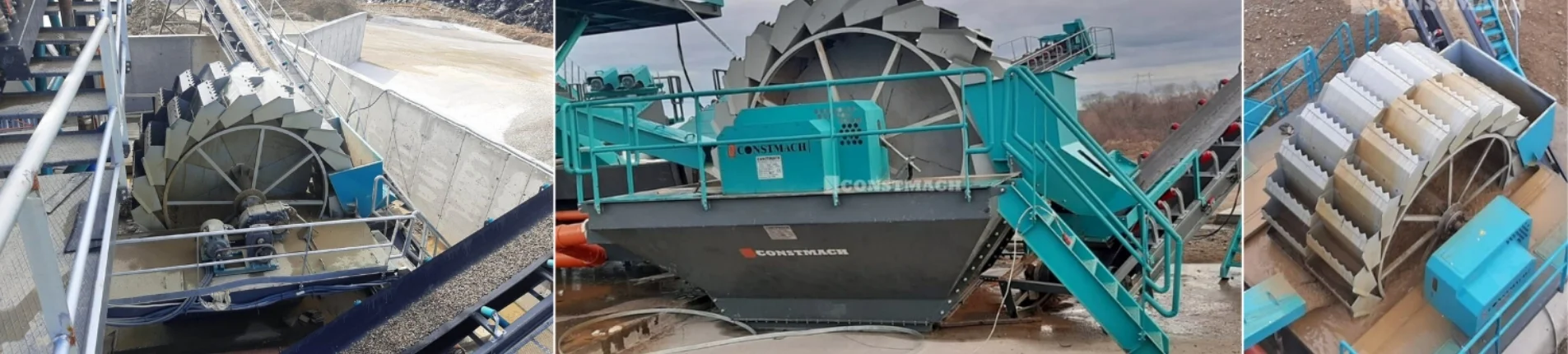
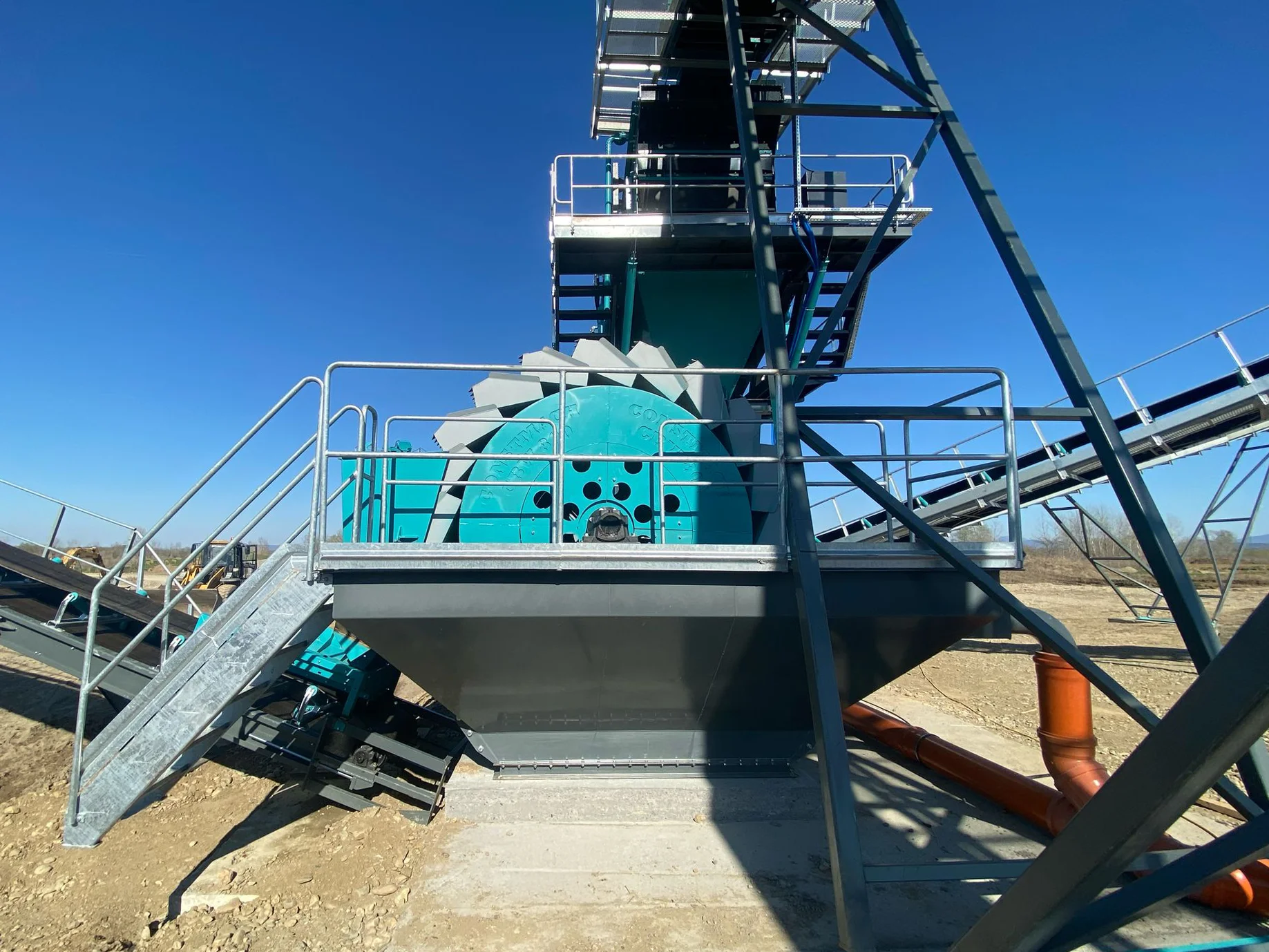
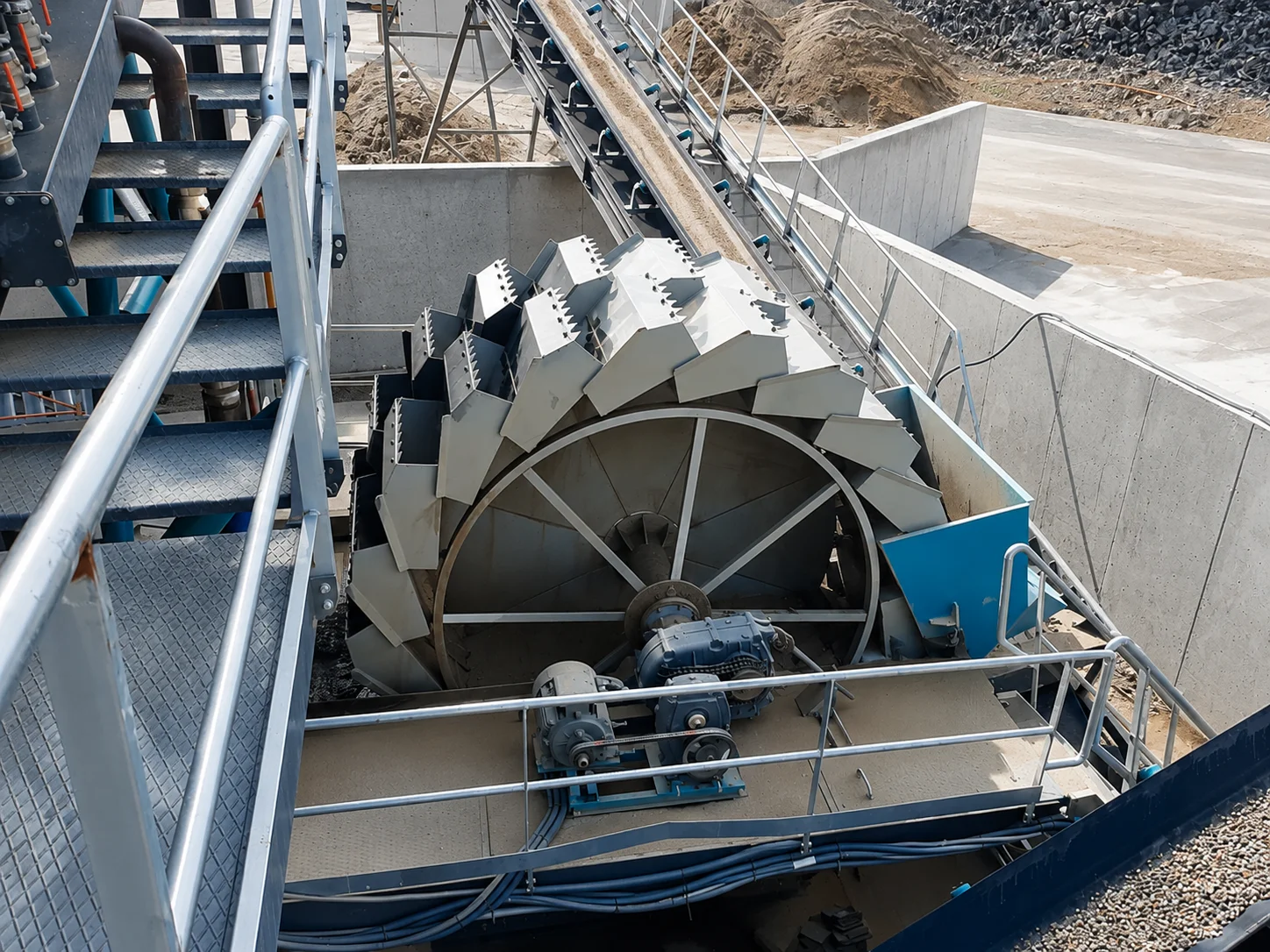
A wheel (bucket) washer is a rotary sand-washing unit that lifts clay and silt out of sand to raise its quality. Sand and water are agitated in a tank; clay and light fines overflow as dirty water, while a slowly turning wheel fitted with perforated buckets scoops the clean, heavier sand from the tank floor and lifts it to a discharge chute. Constmach builds these units as the CBW series.
What a Wheel (Bucket) Washer Is
The wheel washer, also called a bucket wheel sand washer, is a settling-and-lifting machine. Its job is narrow and important: separate fine clay and silt from saleable sand so the finished product meets gradation and cleanliness limits. Constmach manufactures this machine as the CBW series, with the bucket wheel as the working heart of the unit.
It is the preferred washer for high-clay feed. Where sand arrives heavily contaminated with sticky clay or excess silt, the wheel washer copes better than the alternatives because it relies on settling and overflow rather than aggressive scrubbing alone. The result is cleaner sand with controlled loss of the fine fraction you want to keep.
How the Wheel Washer Works
Feed sand and process water enter the tank together. Agitation breaks up clay lumps and puts the contaminated water into suspension. The lighter clay particles and silt stay suspended and float off over a weir as dirty overflow water, which is sent away for settling or to a thickener. Meanwhile the heavier sand grains sink to the bottom of the tank.
A large wheel turns slowly through that settled bed. Around its rim sit perforated buckets that dip into the sand at the tank floor, scoop a load of clean, drained sand, and carry it upward as the wheel rotates. The perforations let free water drain back into the tank during the lift. At the top of the arc, each bucket tips its load onto the discharge chute. The cycle repeats continuously.
The slow wheel speed is deliberate, not a limitation. A gentle rotation gives each bucket time to settle and drain its sand before it tips, so the discharged product leaves partly dewatered and the fine sand has time to drop out of the overflow water instead of being washed away. On the CBW-800 the wheel turns at just 2.5 rpm, which is the pace that makes the settling work.
Why This Approach for High-Clay Sand
High-clay feed is where many washers struggle. Screw (spiral) washers move sand by mechanical conveying, which works well but can carry more fine sand off in the overflow on coarser material and draws more power. The wheel washer separates by density and settling first, then lifts only the settled bed. That separation step is what makes it forgiving of dirty, sticky feed. The clay never has to be torn apart by force; it is simply floated off while the good sand drops where the buckets can reach it.
- It handles dirty, high-clay feed without choking on the contamination.
- It loses less fine sand than a screw washer on coarser sand, protecting your yield.
- It uses low water and low power compared with other washer types.
- The design is simple, with few stressed parts, which keeps maintenance straightforward.
The Constmach CBW Range
Constmach offers the wheel washer in two main sizes. Both run a 3,000 mm wheel carrying 40 perforated buckets. The difference between them is throughput, so the choice comes down to the tonnage your line needs to feed and wash. The table below sets out the published figures.
| Model | Wheel diameter | Buckets | Wheel speed | Drive | Capacity |
|---|
| CBW-800 | 3,000 mm | 40 buckets (800 x 550 mm) | 2.5 rpm | 5.5 kW | 80-90 m³/h |
| CBW-1000 | 3,000 mm | 40 buckets | – | – | 110-120 m³/h |
The 5.5 kW drive on the CBW-800 shows how little installed power this machine needs to move serious tonnage. That low energy draw is one of the reasons the wheel washer earns its place on long-running sand lines, where running cost matters as much as purchase price. The CBW-1000 shares the same wheel diameter and bucket count but is built for higher throughput, so it suits lines feeding more sand per hour.
Build and Wear Features
The wheel washer is built around a steel tank and a fabricated wheel carried on a central shaft and bearings. The buckets are bolted around the rim so individual units can be replaced as they wear, rather than scrapping the whole wheel. Constmach manufactures these units in-house, which gives consistent fabrication quality and direct control over plate thickness, weld quality and bucket geometry.
Because the working speed is low, mechanical stress and impact wear stay modest compared with high-speed washing equipment. The slow rotation means bearings, drive and structure all live an easier life. Wear concentrates where sand and water move against steel, mainly the buckets and the lower tank, and those are the parts to inspect and renew over the machine's life. Plate thickness in the wash zone and the quality of the bucket perforations decide how long the wear parts last before they need attention.
Where It Fits in a Washing Line
The wheel washer sits in the sand-washing stage of an aggregate line, after crushing and screening have produced a sand-sized fraction. Feed reaches it as a sand-and-water slurry or as sand fed with added process water. The clean sand leaving the discharge chute is wet, so the wheel washer is often paired with a dewatering screen immediately downstream to drop the moisture and deliver a drier, stackable product.
This pairing is common because each machine does one job well: the wheel washer removes clay and silt, and the dewatering screen removes water. Together they turn dirty raw sand into a clean, conveyable product ready for stockpile or load-out. Upstream of the washer, a feeder and screen set the gradation; downstream, conveyors carry the finished sand to storage. The washer is one stage in that chain, and it performs best when the stages around it are matched to its rated flow.
Typical Line Position
The wheel washer follows the crushing and screening stages and feeds the dewatering stage. A common layout runs in this order: raw feed is crushed and screened to produce a sand fraction; that sand, carried with process water, enters the wheel washer where clay and silt overflow and clean sand is lifted out; the wet sand then drops onto a dewatering screen that drains the water for a drier finished product. The dirty overflow water from the washer is routed to a settling pond or thickener so the water can be reclaimed and the fines settled out.
Capacity and Sizing
Sizing a wheel washer starts with the tonnage of sand you need to wash per hour and the cleanliness target for the finished product. The CBW-800 covers 80-90 m³/h and the CBW-1000 covers 110-120 m³/h, so the two models bracket most small-to-mid sand lines. Pick the model whose rated range comfortably exceeds your steady feed rate, leaving headroom for surges.
Two factors push real throughput toward the lower end of the rated band: very high clay content, which increases the washing duty, and a tight fine-sand retention target, which favours running with more settling time. If your feed is exceptionally dirty, size up rather than running a smaller unit at its limit. A washer that always runs flat out has no margin for the days when the feed turns wetter or dirtier than planned, and that is exactly when good sand starts going over the weir.
Materials and Applications
The wheel washer is built to clean natural and crushed sand for the aggregate trade. Typical applications include:
- Sand for concrete and asphalt production, where clay and silt limits are strict.
- Plaster and masonry sand that must meet cleanliness specifications.
- Recovered sand from quarry and pit operations carrying heavy clay contamination.
- Manufactured sand from crushing that needs the fines and clay washed out.
The defining application is high-clay feed. Anywhere the raw sand arrives sticky with clay or loaded with silt, the wheel washer is the machine specified to bring it back to specification with minimal loss of good sand. The cleaner the finished sand has to be, the more the settling-and-overflow principle earns its keep.
Maintenance
Maintenance on a wheel washer is modest because the machine runs slowly and has a simple layout. Routine attention focuses on a short list of items:
- Inspect the buckets for wear and perforation blinding; replace worn buckets individually.
- Check the perforations are draining freely and clear any that have packed with clay.
- Lubricate and monitor the central shaft bearings on schedule.
- Watch the drive and reducer; the low load makes faults easy to spot early.
- Keep the overflow weir clean so the dirty water carries off cleanly.
Because wear parts are bolted and accessible, most renewals can be done on site with basic tools, keeping downtime short. Constmach supplies spare parts and after-sales support so consumable buckets and bearings are available when you need them. A short shutdown to swap a few buckets is far cheaper than running blinded perforations that let clay carry through into the product.
Common Mistakes to Avoid
The most frequent sizing error is choosing a unit on price alone and then running it above its rated band when the feed turns out dirtier than expected. A washer at its limit overflows good sand and falls short on cleanliness. Match the model to the dirtiest feed you expect, not the average.
A second mistake is skipping the dewatering screen and shipping sand straight off the discharge chute. The product is still wet at that point, and without dewatering the moisture content can be too high for downstream handling or sale. A third is neglecting the overflow water management: if the dirty overflow has nowhere to settle, fines build up, the recycled water turns muddy, and the separation degrades. Each of these is easy to design out at the planning stage and expensive to fix once the line is running.
Water Management and Recovery
The overflow water is not waste to be ignored; it is part of how the machine works and a cost to manage well. The dirty water leaving the weir carries the clay and silt that the wheel washer has separated from the sand. Sent to a settling pond or a thickener, that water drops its fines and clears, and a large share of it can be pumped back to the tank as process water. Designing for recovery keeps fresh-water draw low and reduces the volume of slurry the site has to handle. Where a thickener is used, the recovered fines come off as a paste that is far easier to dispose of than a pond full of muddy water. The cleaner the recycled water is kept, the better the washer separates, because muddy make-up water leaves more silt in the finished sand. On a tight site, this water loop often decides whether the line is practical, so it is worth planning alongside the washer rather than after it.
Operating for Consistent Quality
A wheel washer rewards steady operation. The two levers an operator has are feed rate and water flow, and the aim is to hold both constant so the settled bed in the tank stays at a stable depth. Feed surges push sand through faster than it can settle, and good sand then leaves over the weir; a starved feed wastes installed capacity. Matching the upstream feeder to the washer's rated flow is the single most useful thing an operator can do for product quality. Water flow sets how aggressively the fines are floated off: too little and clay carries through with the sand, too much and fine sand is lost to the overflow. The right balance is found on the actual feed and then held. Once those two settings are dialled in for a given sand, the machine runs with little intervention, and the quality of the finished product stays even from shift to shift.
Wheel Washer Versus Screw Washer
Buyers often weigh the wheel washer against a screw (spiral) washer. The wheel washer wins on high-clay feed and on fine-sand retention with coarser material, and it draws less power and water. The screw washer has its own strengths, particularly on finer sand and where a compact footprint matters, but for dirty feed and yield protection on coarser sand the wheel washer is usually the better fit. The CBW figures in the table above define what the wheel washer delivers, and they make the comparison concrete: a 5.5 kW drive moving 80-90 m³/h is a low-energy way to clean a lot of sand.
How to Choose
Start with three numbers: required throughput, the clay and silt content of your worst feed, and the cleanliness specification the finished sand must meet. Those three set the model. The CBW-800 suits lines around 80-90 m³/h; the CBW-1000 covers 110-120 m³/h. If your feed is consistently high in clay, the wheel washer is already the right family, and you simply size for tonnage with headroom.
From there, plan the line around the machine: a settling provision for the overflow water, a feed arrangement that delivers sand with process water, and a dewatering screen downstream for a drier product. A wheel washer chosen this way, with the duty understood before purchase, gives clean sand at low running cost for years. The right selection is the one that matches your dirtiest feed and your real tonnage, with the simple, low-power design of the CBW series doing the rest.