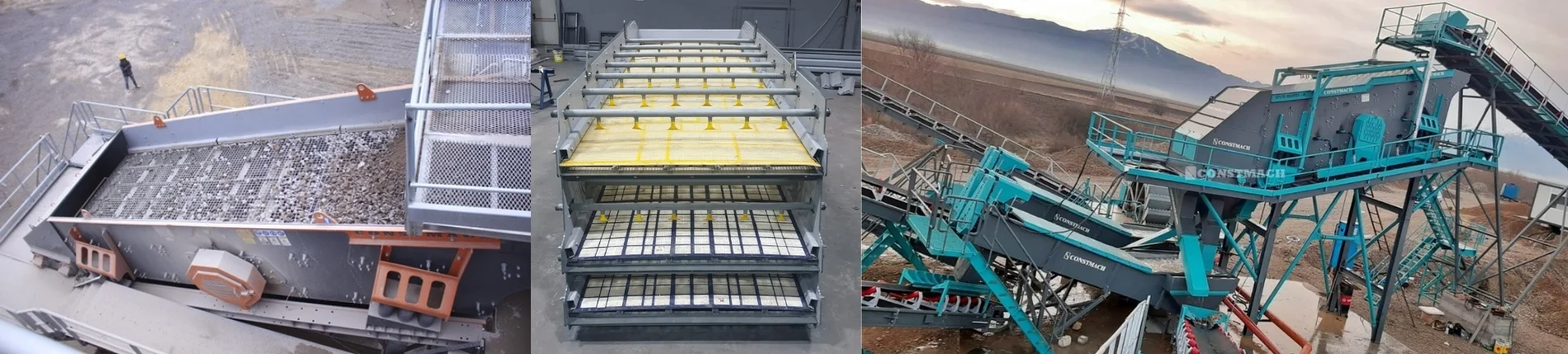
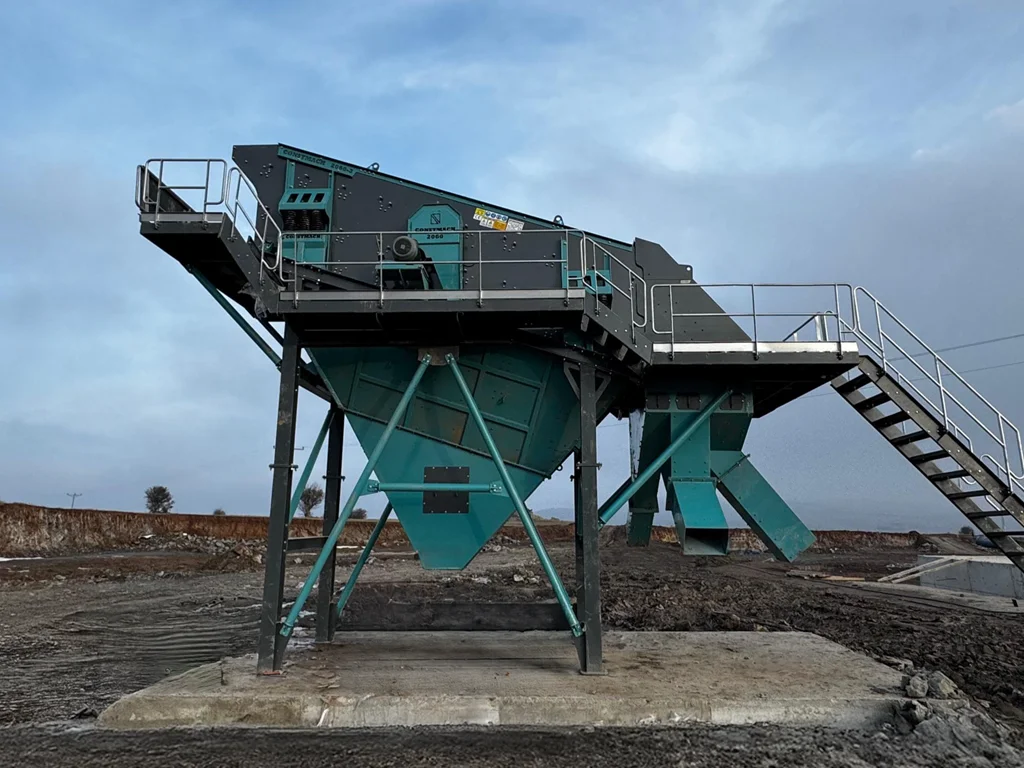
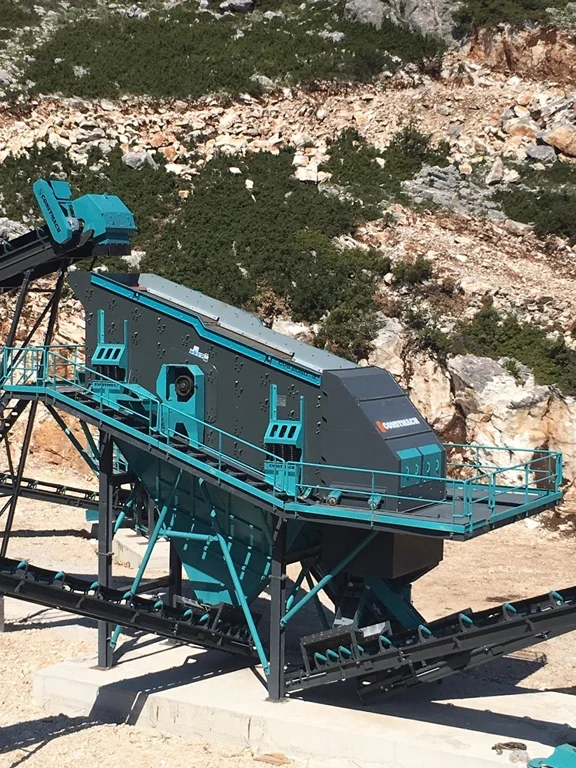
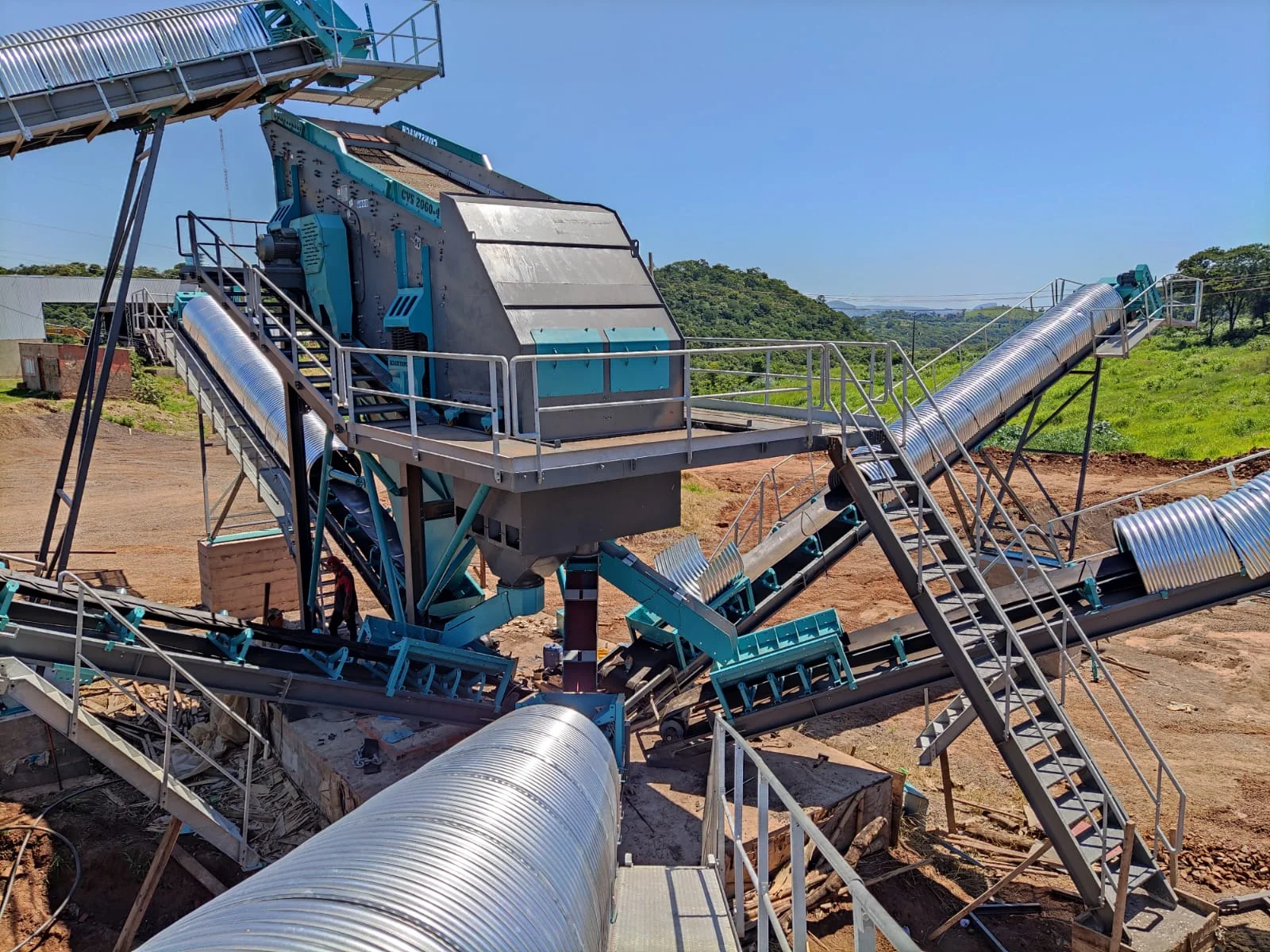
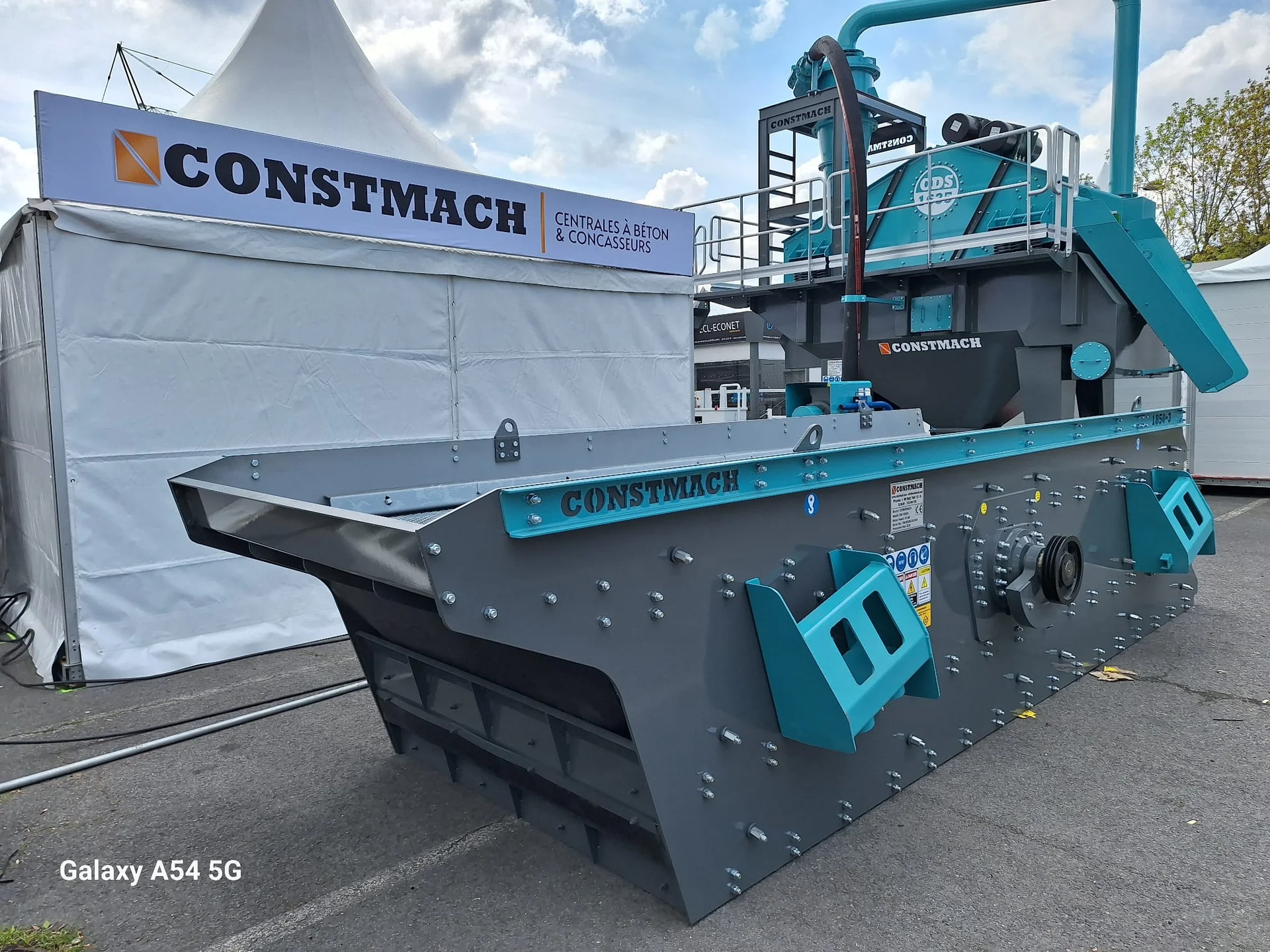
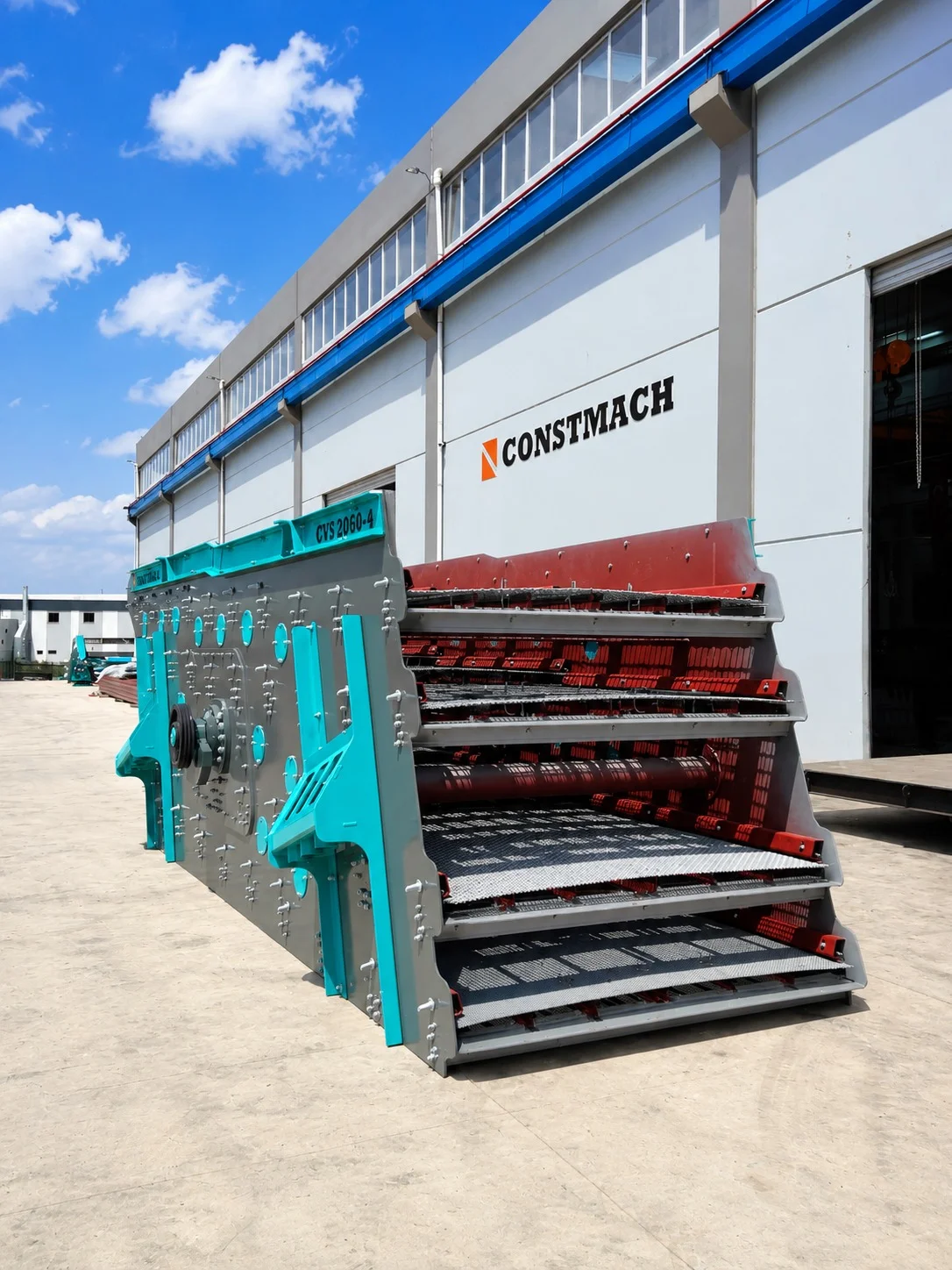
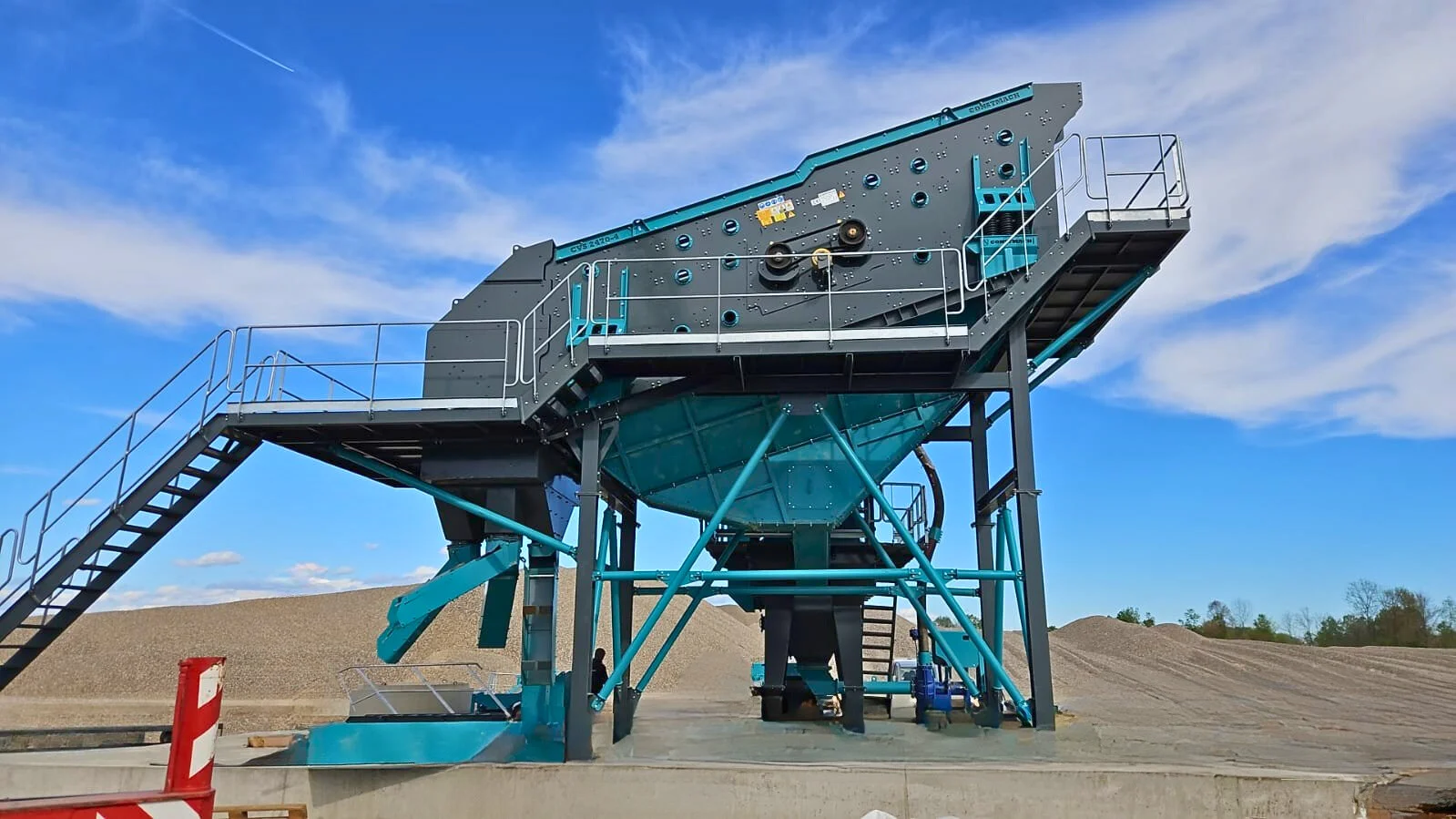
A vibrating screen is a size-separation machine. It splits a single crushed feed into several graded products by passing it across inclined wire, polyurethane or rubber decks while the box vibrates. The Constmach CVS range spans six inclined models, from the CVS-1240 at 70-95 t/h up to the CVS-2470 at 268-336 t/h, in 2, 3 and 4 deck configurations. Pick the deck count and the model to the duty and you turn raw crusher output into clean, saleable fractions in a single pass.
What a vibrating screen actually does
The job is sizing. Material coming off a crusher carries a mix of fractions, from oversize lumps down to fines, and the screen separates that mix into clean products by particle size. Feed lands on the top deck. As the box vibrates, particles smaller than the mesh aperture drop through; anything larger keeps moving across the deck towards the discharge end. Stack two, three or four decks and you grade the feed in one machine instead of running the stream through several.
Constmach CVS inclined screens are built around this principle. A two-deck unit gives you three products: the oversize off the top deck, an intermediate fraction, and the fines that fall through to the base. A three-deck unit gives four products, and a four-deck unit gives five. Each deck adds another cut point, so the number of stockpiles you can produce at the same time rises with the deck count rather than with the number of machines on site. That is the whole appeal of a multi-deck screen: more cuts, one footprint, one drive, one set of springs.
How an inclined vibrating screen works
The screen box sits on an inclined frame, supported on springs that isolate the vibration from the surrounding structure. A vibrating motor or a shaft exciter throws the box in a circular or near-circular motion. That motion does two things at once. It stratifies the bed, so fines work their way down through the coarse material to the deck surface where they can find a hole, and it conveys the oversize along the incline towards discharge. Without stratification the fines would simply ride on top and pass over the end with the oversize.
Aperture size sets the cut. A 20 mm square mesh passes roughly everything under 20 mm and rejects the rest. The angle of inclination, the stroke and the speed together decide how fast material travels across the deck and how many chances each particle gets to find an opening. Set those right and the screen runs at high efficiency without blinding the deck or carrying fines over into the oversize. Set them wrong and you either flood the deck or lose product to the wrong pile.
Why the inclined screen is the workhorse of the plant
Most aggregate operations need several sized products, not one. The inclined vibrating screen is the standard tool for making those cuts because it handles high throughput, accepts a wide feed range and runs continuously with little attention. It is the component that turns crusher output into spec-compliant material a customer will actually pay for.
It also closes the circuit. Oversize off the top deck is the fraction the crusher has not yet reduced to size, so that material is returned to a crusher for another pass. The on-spec fractions drop onto their own conveyors and head to stockpile. Without the screen there is no clean way to separate the two, and no way to guarantee a product meets its grading. The screen is what gives the plant control over its top size and its final gradation.
The Constmach CVS range
Six models cover light secondary screening through to heavy primary-circuit duty. The table below lists the box size, capacity and drive for each. Capacity figures are typical ranges and depend on feed gradation, moisture, mesh aperture and the number of decks in service, so treat them as a starting point rather than a guarantee.
| Model | Box size (mm) | Capacity (t/h) | Drive |
|---|
| CVS-1240 | 1,200 x 4,000 | 70-95 | Vibrating motor or shaft exciter |
| CVS-1640 | 1,600 x 4,000 | 100-130 | Vibrating motor or shaft exciter |
| CVS-1650 | 1,600 x 5,000 | 130-160 | Vibrating motor or shaft exciter |
| CVS-1850 | 1,800 x 5,000 | 140-180 | Vibrating motor or shaft exciter |
| CVS-2050 | 2,000 x 5,000 | 170-220 | Vibrating motor or shaft exciter |
| CVS-2470 | 2,400 x 7,000 | 268-336 | Vibrating motor or shaft exciter |
The CVS-1240 carries 4.8 m2 of deck area; the CVS-1640 has 6.4 m2, the CVS-1650 has 8 m2, the CVS-1850 has 9 m2, the CVS-2050 has 10 m2 per deck, and the CVS-2470 reaches 16.8 m2 as the largest unit in the range. As a worked example of how weight and power scale with deck count, the CVS-1240 weighs about 7,400 kg with a 7.5 kW drive in 2-deck form, 7,700 kg with an 11 kW drive in 3-deck form, and 8,000 kg with an 11 kW drive in 4-deck form. The pattern holds across the range: each deck you add brings more steel and, beyond the first, more drive power to keep the heavier box moving at the working stroke.
Build quality and the parts that take the punishment
A screen lives or dies on its structure. The side plates, cross members and feed box take constant cyclic loading, so they are made from heavy plate and stiffened to resist fatigue cracking. The springs and the drive mounting are sized for the working stroke, because an out-of-balance machine destroys bearings and welds in short order. A screen is, in effect, a controlled vibration, and everything in the box exists either to make that vibration useful or to survive it.
The wear part is the deck mesh. Constmach screens accept replaceable meshes in wire, polyurethane or rubber. Wire gives sharp, accurate cuts and the highest open area, which suits dry secondary and tertiary sizing. Polyurethane and rubber last far longer on abrasive or sticky feeds and cut noise sharply, at the cost of some open area. The right choice depends on the material, the aperture and how hard the deck is worked. Many plants run a mix: wire on the coarse top deck where wear is moderate and cut accuracy matters, polyurethane lower down where the finer cuts and the abrasion sit.
Where the screen sits in the crushing line
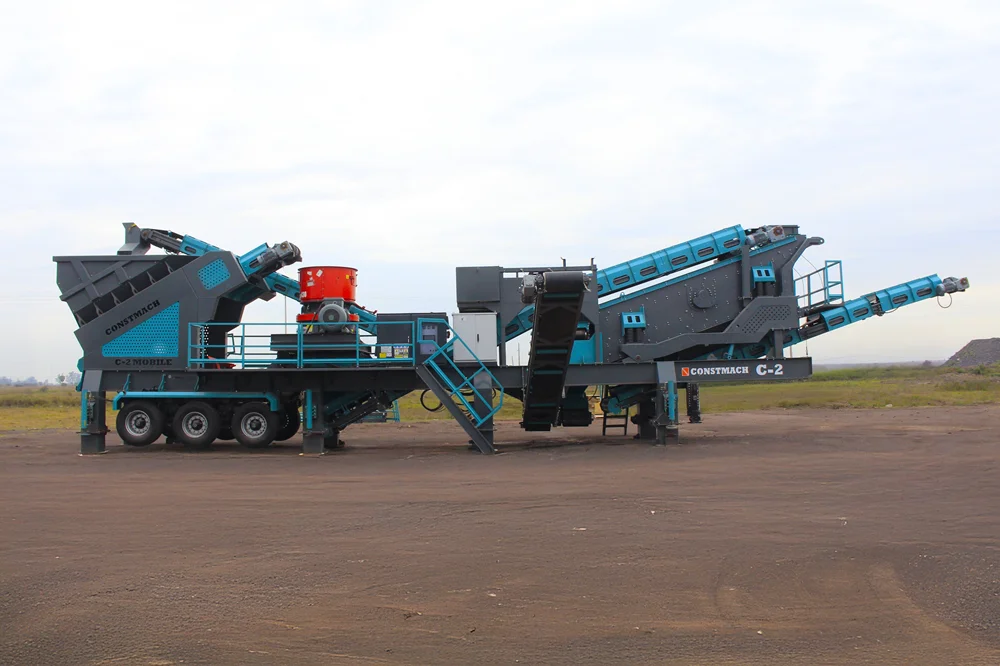
A screen rarely works alone. After the primary jaw crusher, a heavy scalping or sizing screen separates oversize for further crushing. After the secondary or tertiary crusher, finishing screens make the final product cuts. In a closed circuit, the top-deck oversize loops straight back to the crusher feed, and that loop is what controls the top size of the finished aggregate. Open the loop and the top size drifts; close it tightly and you hold a consistent product.
Feed reaches the screen by vibrating feeder and belt conveyor, and the sized fractions leave on their own conveyors to dedicated stockpiles. Matching screen capacity to crusher throughput matters here. An undersized screen becomes the bottleneck and floods, backing material up into the crusher; an oversized one wastes capital and deck area that never earns its keep. Constmach sizes the screen against the crushers and conveyors so the whole line runs in balance rather than fighting itself.
A worked sizing example
Take a plant that needs 150 t/h of finished product split into a 0-5 mm sand, a 5-15 mm chip and a 15-25 mm aggregate, with anything above 25 mm returned to the crusher. That is three product cuts plus the oversize return, which points to a three-deck screen producing four fractions. Suppose the governing fraction, the one that decides the area, is the 0-5 mm cut, and the feed is moderately damp.
The coarse top deck does easy work and is rarely the limit. The bottom deck making the 5 mm cut on damp feed is where the area gets eaten, because fine cuts on moist material screen slowly and the open area on the finest mesh is the smallest. Sized purely on bulk tonnage a smaller model might look adequate, but once the fine-cut efficiency and the moisture are taken into account the duty lands on a mid-range box such as the CVS-1650 or CVS-1850, with spray bars available if the 5 mm cut needs washing to run cleanly. The lesson is general: size from the tightest, governing cut, not from the headline tonnage, and allow margin where moisture or near-mesh material is present.
Sizing the screen to your throughput
Capacity is not a single number. It depends on the feed gradation, the smallest aperture in the deck, the moisture content and whether you screen wet or dry. A fine cut on damp material needs far more deck area than a coarse cut on dry feed at the same tonnage. The published ranges are a guide; the correct model comes from the actual application.
- More near-mesh material in the feed means lower efficiency at a given area, so allow margin.
- Moisture promotes blinding on fine wire decks; polyurethane panels or spray bars help.
- Each additional deck reduces the open area available for the finest cut, which can govern capacity more than the headline figure.
The practical method is to start from the tonnage you need on the tightest fraction, then work back to the deck area and model that delivers it at a sensible efficiency. That is why the range steps up steadily in deck area from 4.8 m2 to 16.8 m2: you match the area to the governing cut rather than overpaying for tonnage you cannot use.
Materials and applications
CVS screens handle the materials a quarry or recycling yard sees every day: hard rock such as granite and basalt, limestone, river gravel, and recycled demolition material. They produce graded aggregate for concrete and asphalt, road base, sub-base, railway ballast and manufactured sand fractions. The same machine sizes feed for further processing, for example separating the right band to feed a sand-making vertical shaft impact crusher.
For washing duty, spray bars can be added across the decks. Wet screening flushes fines through the mesh and rinses clay and dust off the product, raising cleanliness on materials that would otherwise blind a dry deck. This turns the same screen into a washing screen where a clean, low-fines aggregate is specified, without buying a separate machine for the job.
Wear economics and operating tips
Mesh is the recurring cost, and the right choice is an economic decision as much as a technical one. Wire is cheap to buy and quick to fit, but on abrasive granite or basalt it can wear through in a fraction of the time a polyurethane panel lasts. Once you account for the labour of each changeout and the production lost while the deck is down, the more expensive long-life panel often gives a lower cost per tonne screened. The way to know is to track panel life on your own material and compare cost per tonne, not cost per panel.
A few operating habits protect both the meshes and the box. Keep the feed spread evenly across the full deck width, because a stream that hugs one side wears a channel in the mesh and leaves the rest of the deck idle. Run the deck at the correct tension; a loose panel flexes, blinds and fails early. Listen for changes in the bearing note and keep the drive lubricated to schedule. Inspect the springs and feed box for the first signs of cracking, since catching a crack early is a weld and catching it late is a new component. None of this is complicated, but doing it consistently is the difference between a screen that runs for years and one that limps from one breakdown to the next.
Maintenance and wear parts
Day-to-day maintenance is straightforward. Check the deck tension and condition, listen for bearing noise, keep the drive lubricated to schedule, and inspect the springs and feed box for cracks. A screen that is kept in balance and properly tensioned runs for a long time between major interventions.
Mesh is the consumable. Wire panels are quick to swap and cheap, but wear faster on abrasive feed. Polyurethane and rubber modules cost more up front and last much longer, which often gives a lower cost per tonne on hard, abrasive rock. Keep a set of spare meshes for your common cuts so a worn or blinded panel never stops the plant. Constmach supplies the meshes and the structural wear parts as standard.
Signs a deck needs attention
- Oversize appearing in a product fraction usually means a torn or holed mesh.
- Fines carrying over to oversize points to blinding, the wrong aperture or too little area.
- Localised mesh wear in one band suggests poor feed distribution across the deck width.
Common mistakes to avoid
The most frequent error is choosing a model on tonnage alone and ignoring the cut size. A high nominal capacity means nothing if the finest aperture cannot pass the required fines through the available open area. Specify the cut points first, then the tonnage, then the model.
Other recurring problems: feeding the screen unevenly across its width, which wastes one side of the deck; ignoring moisture and then fighting blinding on a dry wire deck; and skipping mesh inspection until oversize contaminates a stockpile. Mounting the screen on a structure that is too flexible is another, because the supporting steel must take the dynamic load without amplifying it.
How to choose the right CVS model
Work through it in order. First, decide how many products you need in one pass; that fixes the deck count at 2, 3 or 4. Second, set the cut points and the tightest aperture. Third, take your required tonnage on the governing fraction and the feed gradation, and select the model whose deck area carries it at a good efficiency. Fourth, decide dry or wet, and add spray bars if the material needs washing.
For a small secondary circuit, the CVS-1240 or CVS-1640 is usually enough. Mid-size aggregate plants tend to land on the CVS-1650, CVS-1850 or CVS-2050. High-tonnage primary and large quarry circuits call for the CVS-2470 with its 16.8 m2 deck. The right answer balances deck area, cut size and the rest of the line, and Constmach's application engineers can confirm the choice against your feed before you commit.