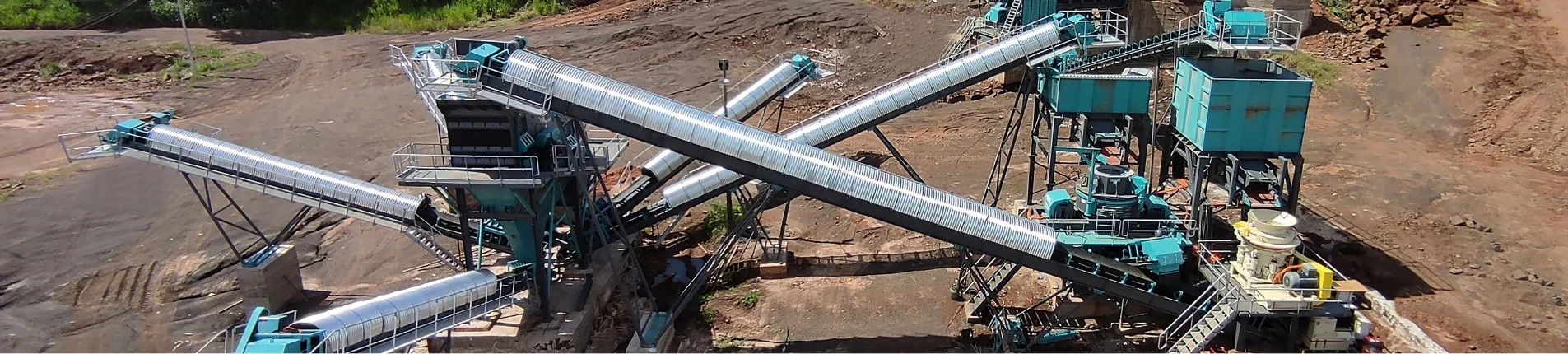
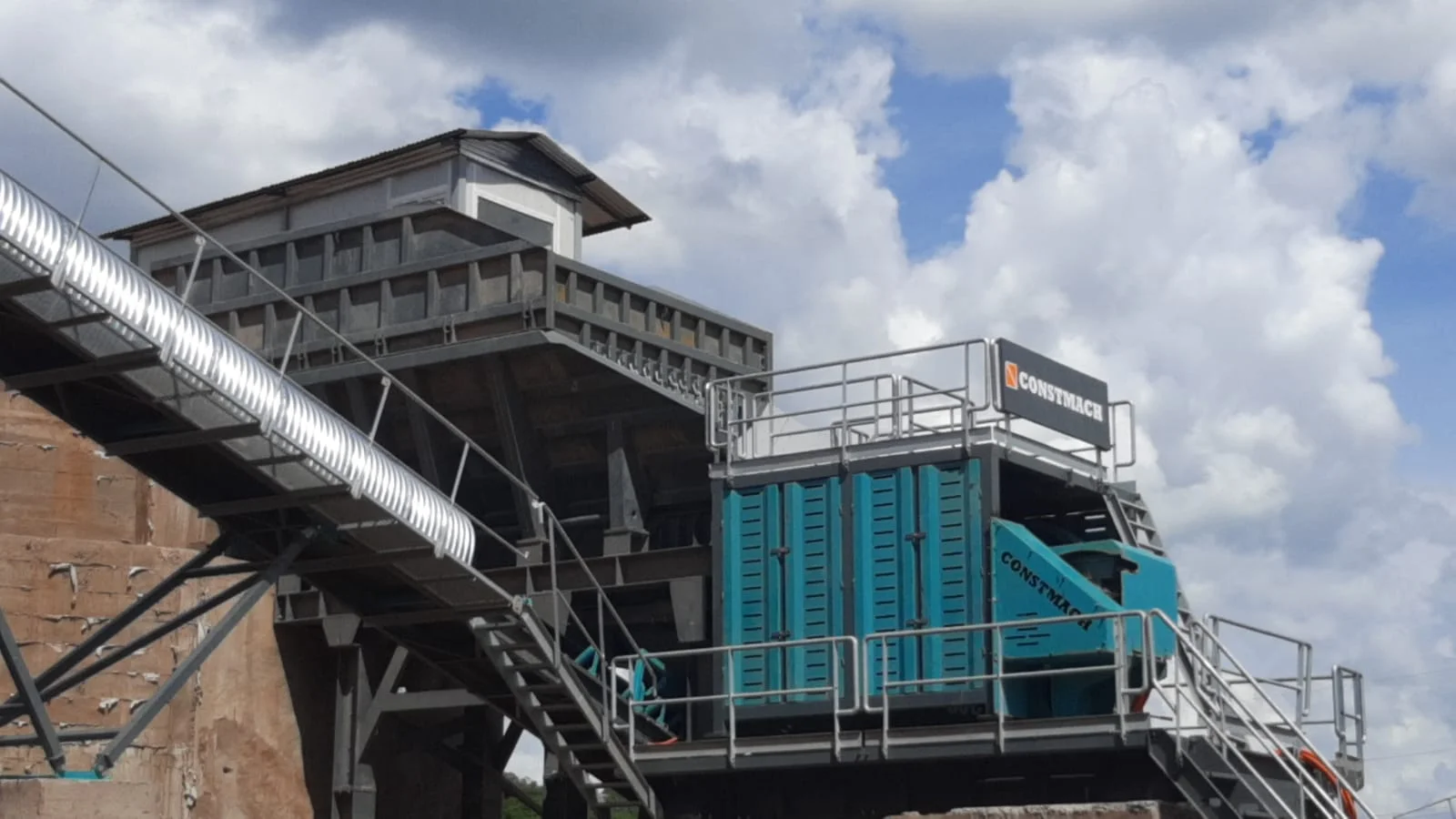
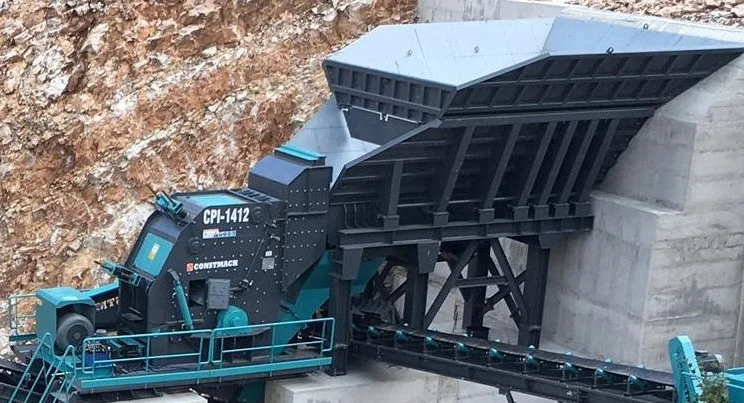
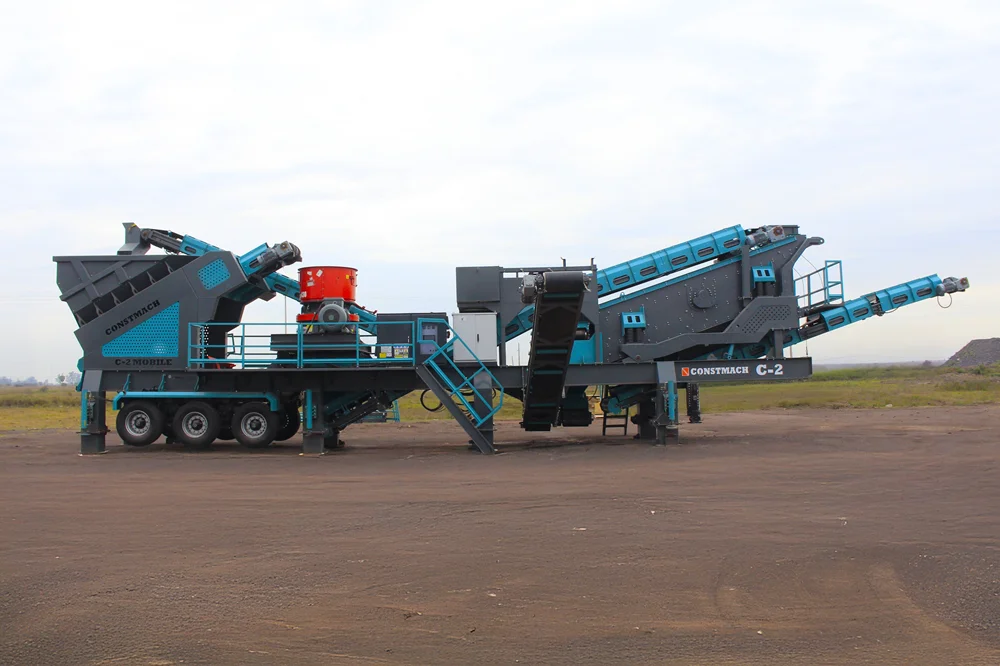
A vibrating feeder is the first machine in a crushing line, metering a controlled, uniform flow of raw rock from the feed hopper into the primary crusher. Constmach builds CPG vibrating grizzly feeders across four models, from the CPG-09 at 80-100 t/h up to the CPG-13 at 350-500 t/h, with hopper volumes typically 8, 10 or 15 m3 and an integrated grizzly section that lets fines bypass the crusher.
What a Vibrating Feeder Is
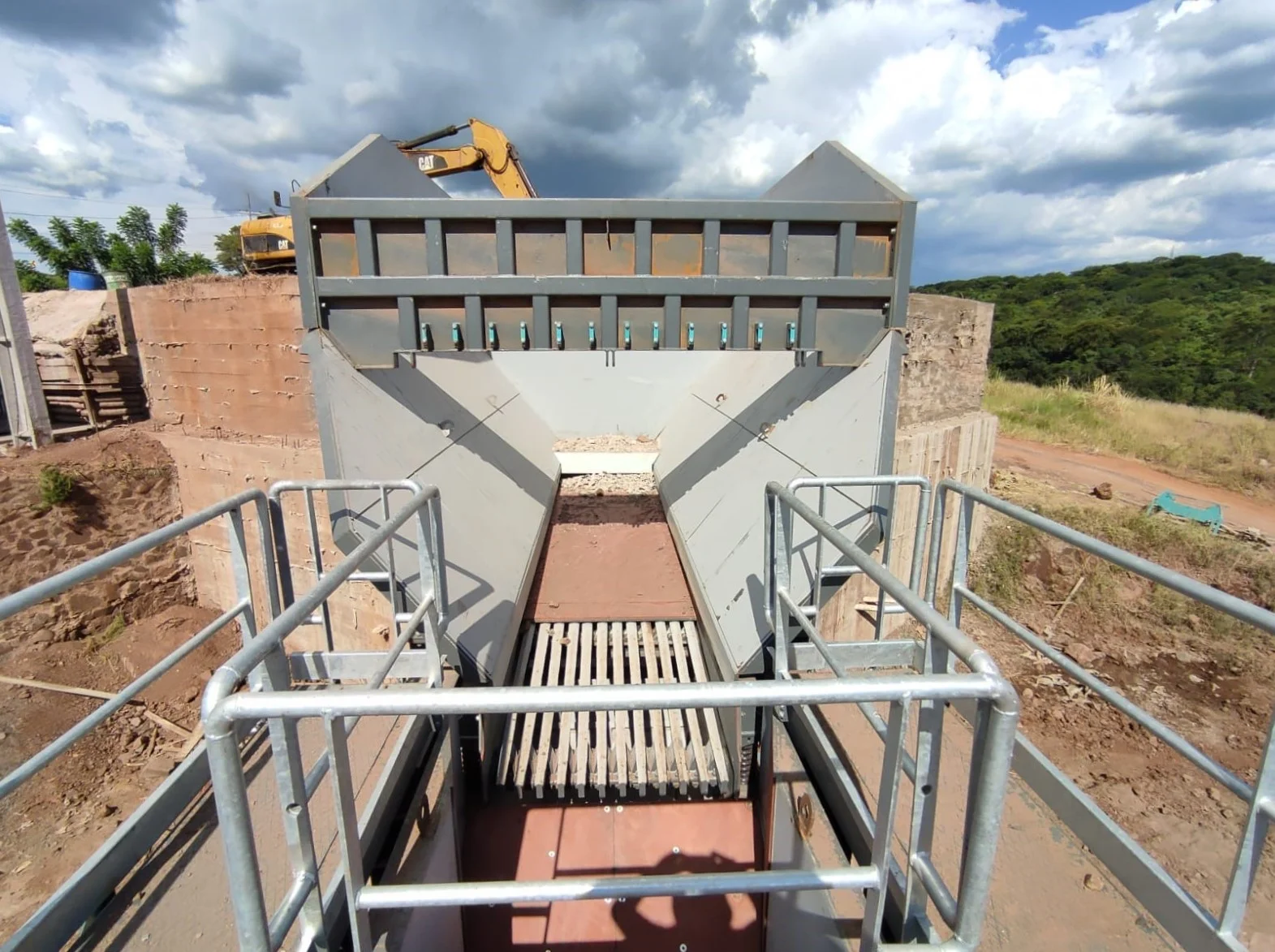
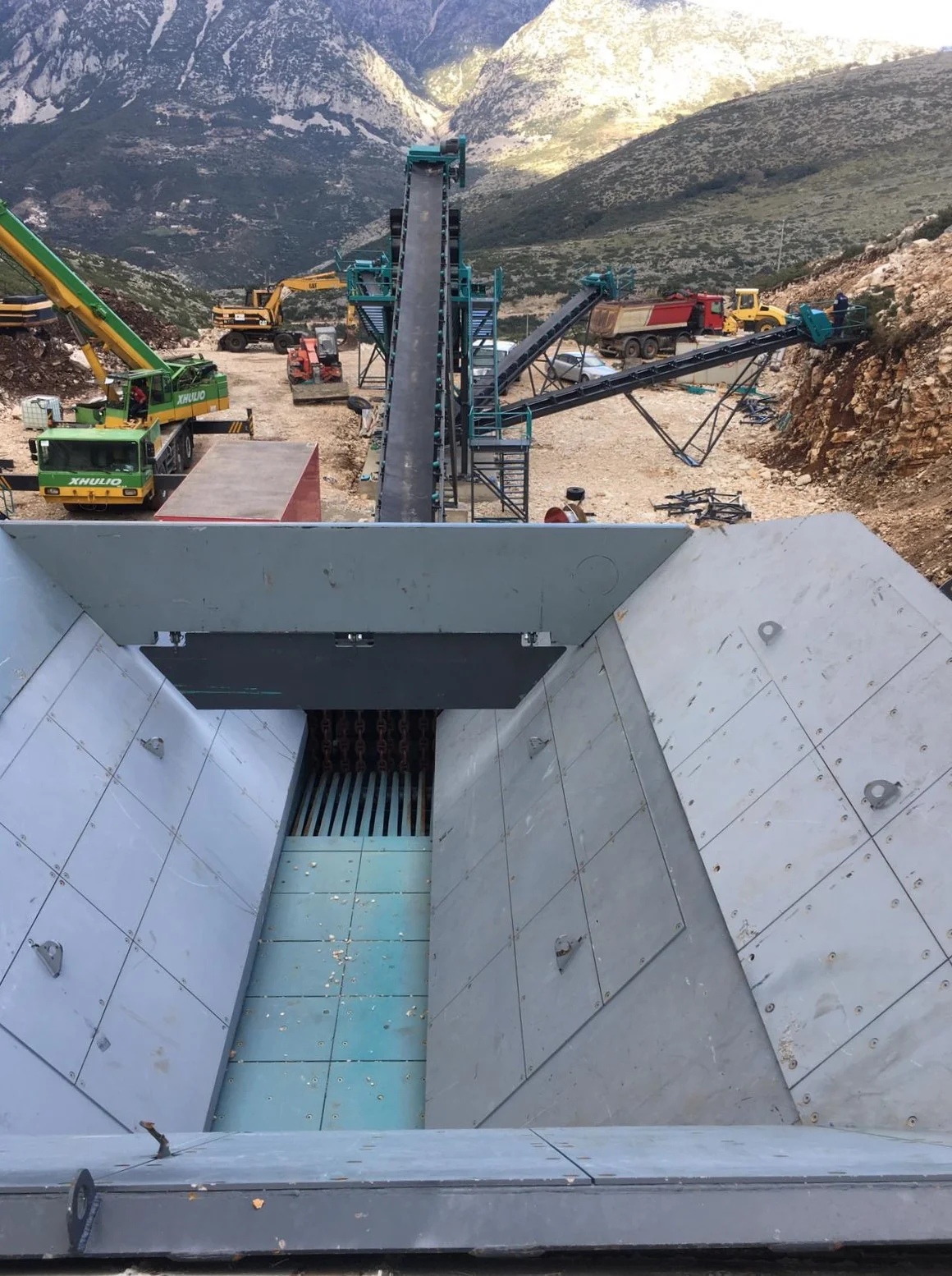
A vibrating feeder sits directly under the feed hopper at the head of the crushing line. Its job is simple to state and harder to do well: take whatever a loader bucket or dump truck drops into the hopper and pass it on to the primary crusher at a steady, regulated rate. Constmach CPG vibrating grizzly feeders combine two functions in one body. The feeding section moves material forward under controlled vibration; the grizzly section, built from spaced bars at the discharge end, screens out the fines and undersize before they ever reach the crusher.
The word "grizzly" refers to those heavy parallel bars. The gaps between them are sized to your job. Anything smaller than the gap drops through and bypasses the primary crusher entirely. Everything larger carries on to the crusher jaws or rotor. That split is the whole point of the design, and it changes the economics of the entire line.
How a Vibrating Feeder Works
Material lands in the hopper from above. The feeder body, mounted on springs, is driven into a controlled oscillation either by a pair of unbalanced vibrating motors or by a shaft-mounted exciter. That oscillation throws the rock forward in small, repeated hops along the feeder pan. By adjusting the drive, the operator sets the speed at which material advances, and therefore the tonnes per hour delivered to the crusher.
As the bed of material travels along the pan, it reaches the grizzly bars near the discharge lip. The continued vibration shakes loose fines and undersize, which fall through the bar gaps into a chute below. The retained oversize slides off the end and into the crusher inlet. Because the feed rate is set at the drive, the crusher receives an even, predictable stream rather than the slugs and gaps you get from direct dumping.
The mechanics reward a closer look. The two unbalanced motors run in opposite directions, and their eccentric weights cancel out the sideways forces while reinforcing the force along the line of travel. The result is a straight-line throw, set at an angle to the pan, that lifts each piece slightly and moves it forward before it lands again. Stroke and frequency together decide how aggressively the bed advances. A longer stroke at a lower frequency suits coarse, blocky feed; a shorter stroke at a higher frequency handles finer, free-running material. The slope of the pan adds gravity to the effort, which is why most feeders sit on a slight downward incline toward the crusher.
Why This Type of Machine Matters in the Line
Loaders and trucks dump in surges. A bucket of rock arrives all at once, then nothing for a minute, then another bucket. A primary crusher fed directly off that pattern is starved one moment and choked the next. The vibrating feeder decouples the dumping from the crusher intake. The hopper absorbs the surge; the feeder draws it down at a constant rate.
That decoupling does two things. It prevents surge loading, where a sudden mass of rock overwhelms the crusher and stalls or trips it. And it prevents sudden ejections, where a slug of fines and rock blows through and overloads the conveyor or screen downstream. A well-set feeder gives the crusher a smooth diet and protects every machine after it.
The Grizzly Bypass and Why It Saves Money
The integrated grizzly is where a Constmach CPG earns its keep. Pit-run rock always carries a fraction of material already smaller than the crusher's closed-side setting. Sending that fraction through the crusher is wasted work. It consumes crushing capacity and accelerates wear on jaws, liners or blow bars without changing the product at all.
The grizzly bars route those fines around the crusher. The bypassed fines drop to a screen or go straight to a stockpile, depending on your flow. The crusher then works only on the oversize that genuinely needs reduction. The result is more effective throughput from the same crusher, lower wear-part consumption, and lower energy per tonne. On a dirty or fines-heavy feed, the saving is substantial.
It helps to put numbers on it. Suppose pit-run feed arrives at 300 t/h and a sieve check shows that 20 per cent of it is already below the crusher's 100 mm closed-side setting. Without a grizzly, all 300 t/h passes through the jaws, but 60 t/h of that does no useful crushing at all. It still rubs against the liners, still draws power, still occupies the chamber that oversize needs. Route that 60 t/h around the crusher through the grizzly, and the crusher handles only the 240 t/h that truly needs reduction. The same machine now has spare capacity, the liners last longer because less abrasive fine material is dragged across them, and the kilowatt-hours per tonne of finished product drop. Over a year of two-shift operation, the difference in liner spend and power alone usually repays the grizzly section many times over.
The Constmach CPG Range
Constmach offers four CPG vibrating grizzly feeder models, sized to match the primary crusher behind them. The smallest suits a single entry-level primary jaw crusher; the largest is built for the biggest stationary crushing stations. Hopper volumes are typically 8, 10 or 15 m3 depending on the model and configuration.
| Model | Body (mm) | Capacity (t/h) | Drive |
|---|
| CPG-09 | 2,500 x 520 | 80-100 | Unbalanced vibrating motors or exciter |
| CPG-10 | 3,000 x 850 | 150-200 | Unbalanced vibrating motors or exciter |
| CPG-11 | 4,600 x 1,100 | 200-300 | Unbalanced vibrating motors or exciter |
| CPG-13 | 4,880 x 1,370 | 350-500 | Unbalanced vibrating motors or exciter |
The CPG-09 is the entry model, matched to a single primary jaw crusher. The CPG-10 and CPG-11 cover the mid-range stations most quarries run. The CPG-13, with a 4,880 x 1,370 mm body and a 350-500 t/h rating, feeds the largest stations. The right choice is set by the primary crusher's appetite, not by the feeder alone.
Reading the table, two dimensions tell most of the story. The body width sets the width of the feed curtain the crusher receives, and it has to suit the largest lump the primary will accept; a wide jaw fed by a narrow feeder will see material bridge and channel. The body length sets the bed area over which the grizzly can do its screening work, so the longer bodies of the CPG-11 and CPG-13 give the fines more time and more open area to drop through before the oversize reaches the lip. The capacity bands overlap deliberately at their edges, which means a feed that sits on the boundary between two models can often be met by either, with the final call resting on lump size, hopper volume and the crusher already chosen.
Drive: Unbalanced Motors or Exciter
Two drive arrangements are available. Unbalanced vibrating motors mount in pairs directly on the feeder body; their rotating eccentric weights generate the throw, and synchronising them produces the linear motion that moves rock forward. This arrangement is compact and has no external gearbox.
The exciter drive uses a shaft-mounted vibrating unit driven by a separate motor through belts. Exciters are typically favoured on the larger, higher-tonnage feeders where the forces are greater. Both arrangements deliver the controlled, adjustable feed the crusher needs; the choice follows the model and duty.
There is a practical trade-off between the two. Unbalanced motors put fewer parts on the machine and keep maintenance to greasing and the occasional motor swap, which suits operators who want the simplest possible drive. The exciter separates the vibration-generating unit from the drive motor, so the motor itself sits away from the worst of the shaking and the heavy duty is carried by purpose-built exciter bearings. On the largest stations, where the forces needed to move 500 t/h are considerable, that separation extends component life and is usually the reason the exciter is specified. Neither arrangement changes how the operator runs the machine day to day.
Build Quality and Wear Protection
The feeder pan takes the full impact of every loaded bucket dropped from height. Constmach builds the body as a heavy fabricated steel structure and protects the high-wear zones with replaceable liner plates, so the abrasion lands on parts you can change rather than on the structure itself. The grizzly bars are heavy section and replaceable, since they carry both the load and the constant grinding of fines passing between them.
Spring mountings isolate the vibration from the supporting steelwork and the foundation. That isolation matters: it keeps the energy in the feeder pan where it does useful work, and it keeps the structure around the feeder from shaking itself loose. Everything is manufactured in-house, which keeps the build consistent and the spare parts straightforward to supply.
Where It Fits in the Crushing Line
The vibrating feeder is the first machine in the line, full stop. Material flow runs hopper, feeder, primary crusher, then the conveyors and screens that follow. Nothing reaches the crusher except through the feeder, which is exactly why it controls the whole line's rhythm.
On a stationary crushing plant the feeder is bolted under a fixed hopper on its own foundation. On a mobile crushing plant it is integrated into the chassis ahead of the primary jaw. In both cases the feeder sets the pace. If it is undersized, the crusher starves and the whole station underperforms. If it is correctly matched, the crusher runs full and steady.
The bypassed fines stream is part of this layout too, and it deserves planning rather than an afterthought. From the grizzly chute the fines can drop onto a dedicated bypass conveyor that carries them to their own stockpile, or they can join the primary crusher discharge on a collecting conveyor that feeds a downstream screen. The first route keeps a clean fines product separate and ready to sell or use; the second blends everything for screening further along. Either way the conveyor that carries the bypass must be sized for the fines tonnage the grizzly is expected to drop, because on a fines-heavy feed that stream can be a large share of the total. Matching the feeder, its bypass conveyor, the main product conveyor and the first screen so none of them becomes the choke point is what makes the front of the plant run smoothly.
Capacity and Sizing
Feeder capacity must comfortably exceed the primary crusher's intake, never the reverse. The feeder's job is to keep the crusher fed, so it has to be capable of delivering at least as much as the crusher can take, with headroom for surges. The Constmach range steps from 80-100 t/h on the CPG-09 to 350-500 t/h on the CPG-13 to match the crusher behind it.
Several factors shape the real figure. Feed material density, the proportion of fines that will bypass through the grizzly, the lump size, and the moisture content all affect how a given body performs. The body length and width set the bed area and therefore the maximum flow. Quoted ranges assume typical hard rock; very fine, wet or sticky feeds behave differently and should be discussed when sizing.
A short worked example shows how the pieces fit. Say a quarry runs a primary jaw rated to take 250 t/h of granite at its chosen setting, with feed that runs roughly 15 per cent fines. The feeder has to deliver the full 250 t/h of oversize the jaw will accept, plus the 15 per cent that the grizzly will drop out, so the total material crossing the pan is nearer 290 t/h. Add a margin so that a heavy surge from a fast loading cycle does not momentarily starve the jaw, and the duty lands comfortably inside the CPG-11 band rather than the CPG-10. The hopper volume then follows from the loading pattern: a single large loader bucket arriving every forty seconds needs enough buffer that the feeder never runs the hopper empty between dumps. Density matters here as well, because a denser rock fills the same pan area with more tonnes, nudging the choice toward the larger model.
Materials and Applications
Constmach CPG feeders handle the run-of-pit materials common in quarrying and mining. Typical feeds include:
- Hard rock such as granite, basalt and gabbro
- Limestone and dolomite
- River gravel and pit-run aggregate
- Recycled materials and demolition rubble where size and contamination allow
The end products feed the usual aggregate markets: road base, railway ballast, and graded stone for concrete and asphalt. The grizzly section is most valuable on feeds carrying a high proportion of natural fines, where bypassing that fraction frees real crushing capacity. Abrasive feeds wear the pan and bars faster, which is why those parts are replaceable.
Wear Economics Over the Life of the Feeder
It pays to think about wear as a running cost rather than a one-off. The feeder has only two real consumable groups: the pan liner plates and the grizzly bars. Both are bolted in, both are designed to be swapped, and both wear at a rate set by the feed. On soft limestone they last a long time; on hard, sharp granite or basalt they go faster. Because the parts are replaceable, the cost is predictable, and a quarry can budget for liners and bars the same way it budgets for crusher liners.
The grizzly also changes the wear arithmetic of the whole line, not just the feeder. By keeping abrasive fines out of the crusher, it slows the wear on the far more expensive crusher liners or blow bars. A set of grizzly bars is cheap next to a set of jaw plates, so every tonne of fines diverted at the feeder is a tonne that does not scour the crusher. Inspecting the bars and liners at routine intervals, ordering replacements before a part fails, and changing the high-wear pieces as a planned job rather than a breakdown all keep the cost steady and the line running. The economics favour replacing a worn grizzly bar slightly early over waiting until the gaps have opened so far that fines stop dropping cleanly and start loading the crusher again.
Maintenance and Wear Parts
A vibrating feeder is mechanically simple, and most of its maintenance is routine. The recurring tasks are clear:
- Inspect and replace the pan liner plates as abrasion thins them
- Replace the grizzly bars when the gaps open up beyond the target size
- Check the springs for cracks or sag and replace as a set
- Maintain the drive: re-grease and inspect vibrating motors, or check exciter bearings and belt tension
- Keep all structural and drive fasteners checked and torqued, since constant vibration loosens bolts
The fasteners deserve a particular mention. Vibration works bolts loose over time, and a loose drive mount or motor bolt will fail quickly and noisily. A short walk-round each shift catches most problems before they stop the line.
Operating Tips for a Steady Front End
A few habits keep a feeder producing at its best. Set the feed rate to keep the crusher chamber full but not flooded; a crusher running at a steady, near-full level makes the best product and draws the most even power. Watch the loading pattern and ask operators to spread dumps across the hopper rather than tipping every bucket onto the same spot, because uneven loading turns into uneven wear on the pan. Listen to the machine: a change in the note of the vibration often signals a loosening bolt or a tiring spring before anything visible appears. Keep the grizzly bars clear of pegged stones and clay that can blind the gaps, especially on wet or sticky feed, since a blinded grizzly stops bypassing and quietly sends fines back into the crusher. And resist the temptation to chase tonnage by driving the feeder harder than its duty; the extra output is small and the cost in component life is not. Small, consistent attention at the feeder is repaid all the way down the line.
Common Mistakes to Avoid
The most frequent error is undersizing the feeder relative to the crusher. A feeder that cannot keep the crusher full caps the whole station's output, and no amount of crusher capacity recovers it. Match the feeder to the crusher first.
The second mistake is the wrong grizzly bar spacing. Set the gap too tight and oversize that should bypass goes through the crusher, wasting capacity. Set it too wide and material the crusher should reduce drops through unprocessed. The spacing has to be chosen against your feed and your closed-side setting.
Other recurring problems include running the drive too hard in the hope of more tonnage, which just shortens component life, and neglecting the bolt checks until something shakes free. None of these are difficult to avoid; all of them are common.
How to Choose the Right Vibrating Feeder
Start with the primary crusher. Its required intake sets the minimum feeder capacity, and the feeder should clear that figure with a margin for surge. From there, work through the practical variables: feed material and density, the fraction of fines you expect to bypass, lump size, hopper volume needed to buffer your loading cycle, and whether the station is stationary or mobile.
The CPG-09 pairs with a single entry-level primary jaw crusher. The CPG-10 and CPG-11 cover most mid-range quarry stations. The CPG-13 is sized for the largest installations. Constmach's application engineers size the feeder, set the grizzly spacing and select the drive against your actual feed and target output, so the first machine in your line is matched to everything that follows it.